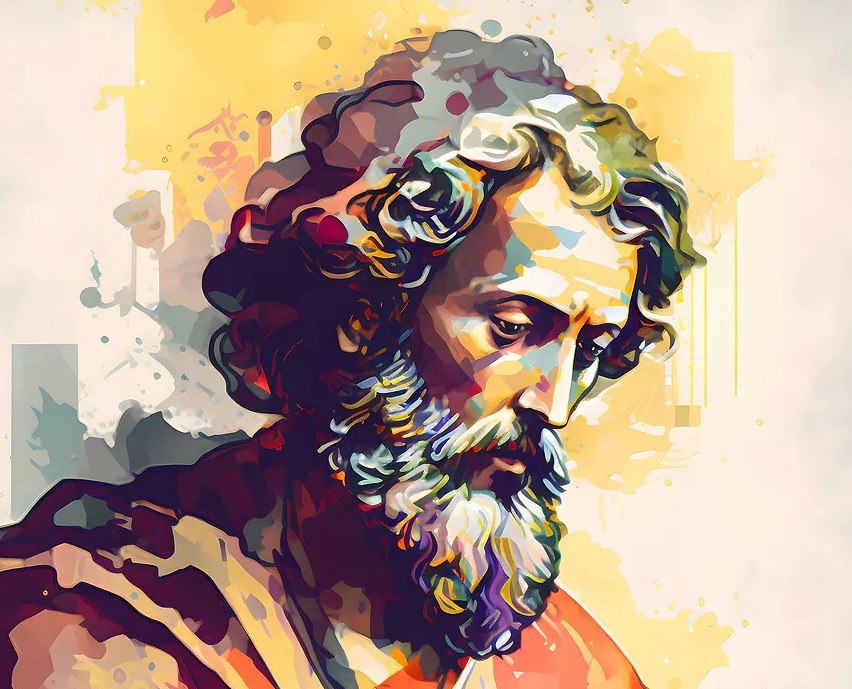
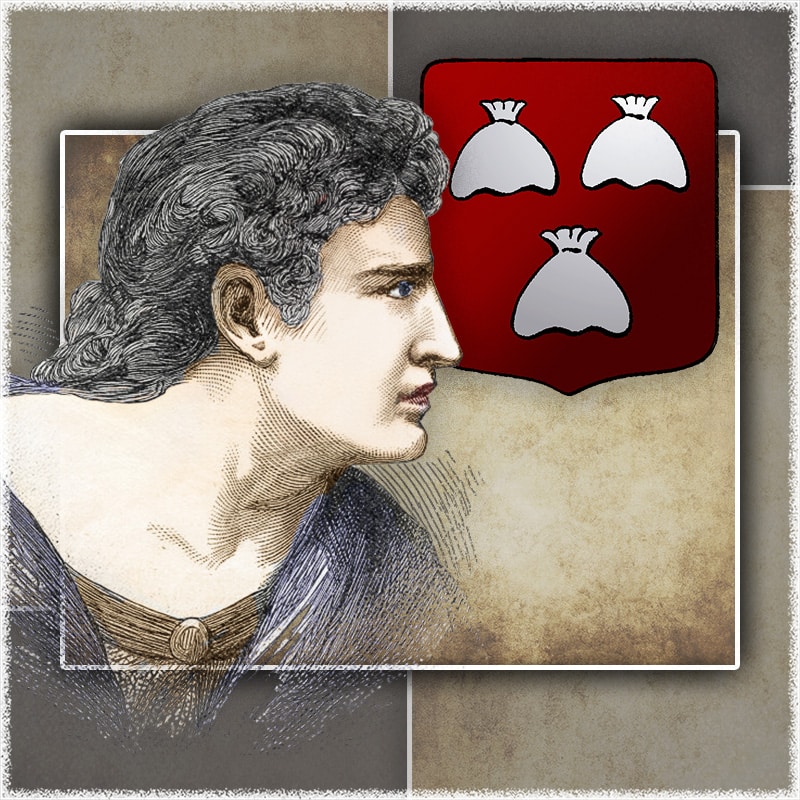
Matthew was Raised in the Seaside Village of Capernaum
Matthew and his brothers were raised in the small coastal fishing village located on the north shore of the Sea of Galilee, called Capernaum. Many Bible scholars agree that his parents, Alphaeus & Mary, the Mother of James the Lesser were a devout and observant Jewish couple. They had three sons, Matthew-Levi, James the Lesser (meaning the younger) and Joseph (Jose) Matthew 10:3, Mark 3:18 and Luke 6:15.
Matthew and Little James Might or Might Not Have Actually Been Brothers.
Some biblical academics reasonably assert the existence of two different men named Alphaeus, for several reasons. First of all, Alphaeus was apparently a common name back then. The academic nay-sayers also notice that the other two pairs of Apostolic brothers (Andrew and Simon, and John and James the Greater) are routinely described as brothers in various statements in the Gospels, whereas Matthew and James, the Younger are never specifically described that way in the Scriptures. That leaves you free to form your own opinion on the matter.
Like Many Galileans, Matthew Spoke Numerous Languages
As a Galilean, Matthew spoke and was literate in Aramaic, the common language of Galilee at that point in time. He would also have been fluent in Koine Greek, the common commercial language of the region which had been Hellenized by the conquest of Alexander the Great and ruled by his successors. Greek was the language Matthew read the ancient Jewish scriptures in.
The Septuagint Greek translation of the ancient vowelless Hebrew originals was translated by 70 Rabbinical scholars in Alexandria around 250 BC. It was the Septuagint translation of the ancient Jewish Scripture which most of Jesus’ disciples had access to and knew. That is why Matthew wrote his Gospel in Greek. Only trained scribes or educated Pharisees and Jewish Priests could read the ancient Hebrew scrolls.
To work as a Roman tax collector Matthew must also have been competent in Latin, the administrative language of the region’s Roman overlord, Herod Antipas. Clearly Matthew was an excellent record keeper. Finally, to work as a tax collector, Matthew must also have been good with figures and arithmetic.
Matthew was also the author who wrote The Gospel According to Matthew, hence his epithet “the Evangelist,” which is the ancient term used to describe a Gospel writer. His through and comprehensive writing style is clearly evident in his account of the Gospel’s many plainly stated narratives and truths.
Matthew’s Neighbors in Capernaum
Another well known biblical family who lived in the seaside village of Capernaum was that of Zebedee, the Fisherman and his wife Mary-Salome and their two sons James the Greater (meaning older or taller) Link to James the Greater, and his younger brother, the Apostle John, the Evangelist (the Gospel writer). Link to John. James was apparently both taller and older than John. Together James and John were nicknamed by Christ as the Sons of Thunder, because of their overzealous recommendation to Jesus that He call down fire from heaven on some Samaritans who were critical of Him.

Finally, Capernaum was also the town in which the observant Jewish couple Jonah and Joanna lived with their two sons Andrew, the First Called Link to Andrew, and his married brother, Simon-Peter who was operating Peter’s fishing business. Link to Simon-Peter.
Jesus Used Capernaum As A Home Base
Though Jesus spent a lot of time walking around the Levant (Greater Palestine). When He was not roaming about the countryside, He used the village of Capernaum as a sort of home base. The village itself had a population of around 3,000 people or more. The road from Damascus towards Jerusalem passed through Capernaum.
The population of the Region of Galilee is estimated to have been around 200,000 people, some of whom no doubt attended and heard Jesus’ Sermon on the Mount.
In the Near By Village of Bethsaida
The coastal village of Bethsaida was located about six miles east of Capernaum. It was the home town of Philip the Pragmatic Apostle Link to Philip, and his friend the Apostle Nathanael Bartholomew, who was initially skeptical about the idea that Jesus of Nazareth could be God’s Holy Messiah. Nathan became convinced that Jesus was the promised Messiah the moment he met Jesus in person and heard Him speak. Link to Nathan.
At Least 8 of the Apostles were Chosen on the North Shore of the Sea of Galilee
Therefor the north shore of the Sea of Galilee was also the region where eight of the people who would be chosen by Jesus to be His spiritual students and disciples lived.
After the risen Christ issued His Great Commission to them Matthew 28:18-20, these same people would go on to become eight of His apostles (ambassadors or missionaries) first to Israel, and then later to the whole world.
Gift from Yahweh
The name Matthew is a Hebrew name which means gift from Yahweh. The name Matthew is not found in the Hebrew Scriptures. Matthew was also called Levi. That name is also Hebrew and it means joined or attached. In the Book of Genesis, Levi was the third son of Jacob and Leah, and he was the progenitor of the Tribe of Levi. Some 500 years later, that tribe became the tribe God designated to Moses as his Holy Priesthood which He tasked with leading the Israelites in the worship of God.
Matthew the Publican, an Outcast of Galilee
When Matthew first appears in The Gospels he is working as a somewhat cynical agent of the Roman Empire collecting taxes from his countrymen in Capernaum. Having been raised in a devout and observant Jewish family, he would have been aware of the ancient Hebrew scriptural promises of a coming Messiah.
Those ancient prophesies, recorded in the Jewish Scriptures, described a Messiah who would be the salvation of those in Israel who believed in God and His chosen Messiah as well as all the Gentiles who would also choose to believe. He would also have been aware of the activities of Jesus in Capernaum, and the village rumors that Jesus was that promised Messiah.
The Roman Tax-Farming Franchise
Matthew was, most likely employed by a Roman Tax-Farmer. In that era, wealthy Roman citizens would offer “bids” to the Roman Senate to collect the regional taxes due to Rome. The bid was an estimate of how much the bidder thought he could collect. The winner of the “bid” would then pay the amount of the bid to the Roman treasury in advance, out of his own pocket.
It was then up to him to recover his costs by collecting the taxes “due to Rome” from the province along with and any amount more that he could collect, and would keep as his profit. The process could be quite lucrative for the tax farmer, especially if he was not too honest. Employee tax collectors commonly “skimmed” as much of their collections for themselves as they could. Hence an “honest tax collector” in Judea or elsewhere in the Roman Empire would have been a “rare bird.”
These tax farming revenue officers became servants of the hated provincial governments of the regions occupied by Rome which were under the control of men such as Herod the Great, who had controlled Judea. The Empire and its local governors were known for high taxes, graft, extortion, and the stern methods they used to enforce their authority. These publicans were considered by most Jews to be persons of the lowest estate, no better than other thieves or even harlots.
It is likely that Matthew was a sub-contractor for the regional tax farmer in the service of Herod Antipas, the Tetrarch of Galilee. A tax collector, like Matthew was, no doubt, well paid for his service. A Jewish person working for such a tax collector would also have been seen as being a turncoat traitor to his own people.
Jesus Christ Called Matthew to Be One of His Disciples
Matthew wrote the description of his own calling:
“As Jesus passed on from there, He saw a man named Matthew sitting at the tax office. And He said to him, ‘Follow Me.’ So he arose and followed Him Matthew 9:9, also see Mark 2:14 and Luke 5:27.”
That Matthew didn’t hesitate to obey the invitation reveals a deep level of discernment on his part, and a readiness to make a radical change in his own life in favor of something new and authentically real.

After Being Called, The Publican Matthew Threw a Dinner Party with Jesus and His Disciples
Matthew extended social hospitality to Jesus and His disciples. The early band of followers of Christ were an interesting crew of the region’s blue collar working people. Jesus associating with a despicable tax collector soon became fodder for the legalistic and judgmental members of the Pharisees and Sadducees who controlled the Sanhedrin and the temple in Jerusalem.
Jesus later responded to their malicious attacks on His authentically Divine piety by telling them:
“When Jesus heard that, He said to them, “Those who are well have no need of a physician, but those who are sick. But go and learn what this means: ‘I desire mercy and not sacrifice.’ For I did not come to call the righteous, but sinners, to repentance Matthew 9:12-13.”
After this grand beginning, Matthew fades from the story. He is not a prominent figure in any of the Gospel narratives. Unlike other apostles such as Peter or Paul, Matthew’s initial role was that of a quiet but extensive chronicler of the acts and teachings of Jesus the Christ.
The Manifesto of God – Christ’s Sermon on the Mount
The Gospel According to Matthew reports Jesus’ Sermon on the Mount in considerable detail. It starts at the beginning of Chapter Five and it extends through all of the next three chapters ending at the conclusion of Chapter Seven. A careful reading of this section of Matthew’s Gospel will establish a clear of understanding of the revolutionary content of the teachings of Jesus the Christ.

Jesus Answered the Question: Is it Lawful to Pay Taxes ?
Matthew, the former tax collector, tells us about Christ’s teachings regarding the lawfulness of paying two very different types of taxes.
The first type of tax was a ransom payment to God which was to be used for the service of the tabernacle of meeting, also described as atonement money. In the 30th Chapter of Exodus God told Moses to take a census of Israel and to have every man over the age of 20 pay a Ransom Tax of ½ of a shekel, which was roughly equivalent the pay earned by a common laborer for two days of work. This tax was in recognition of God’s providence to them in the wilderness. God forbade that tax being progressive. It was the same for rich and poor alike Exodus 30:11-16. This practice later became the Tabernacle Tax, and the amount was raised to a full shekel.
After Solomon built the Temple, it became known as the Temple Tax. After the period of the Jewish exile in Babylon, and the subsequent building of the Second Temple it was re-established. It was generally collected during one of the three mandatory festivals which observant Jews pilgrimaged to Jerusalem for each year: the festivals of Passover, Pentecost and Tabernacles.
In the 17th Chapter of The Gospel According to Matthew the keepers of the synagogue in Capernaum asked Simon-Peter if Jesus would pay that tax to them. When Simon came to Jesus, Jesus asked Simon if it was a just request? Simon said it was not just, and Jesus agreed with Simon despite the fact that God had originally instructed Moses to collect it. Clearly God’s original purpose had been changed somewhat by the Pharisaical legalism which had become common throughout Palestine by the time of Christ.
Nonetheless Jesus sent Simon to catch a fish which had a four shekel coin in its mouth, and He instructed him to use the coin to pay the Temple Tax for them. A miraculous example of God’s divine provision for them.
The Ruling Sanhedrin’s Trick Question to Jesus About Taxation
Matthew’s second reported event regarding taxation occurred during Holy Week, the week Jesus was executed in Jerusalem. The triumphal entry of Jesus into Jerusalem had occurred on Sunday. On Monday Jesus’ cleansed the Temple of the sacrificial animal vendors and money changers by throwing them out of the Temple courtyard Matthew 21:12-16. This action outraged the ruling Sanhedrin, and then catalyzed their active plotting to accomplish the quiet, but rapid demise of their radical opponent. These events occurred during the Jewish Festival of Passover when Jerusalem was overcrowded with every people from every Jewish faction who were all preparing to remember the Passover. Most like in the year of AD 33.
On Tuesday Jesus was back at the Temple teaching provocative parables to the crowd about the kingdom of God. A selected group of Pharisees from the Temple accompanied by “the Herodians” (the Romanized Jewish King Herod’s Jerusalem police squad) approached Jesus with a carefully chosen question they hoped would outsmart Jesus, and shame him in front of the large crowd. A wrong answer might even get Jesus arrested by Herod’s agents.
“Teacher, we know that You are true, and teach the way of God in truth; nor do You care about anyone, for You do not regard the person of men. Tell us, therefore, what do You think? Is it lawful to pay taxes to Caesar, or not Matthew 22:16-17?”
Simple question.
Is it lawful for God’s people to pay taxes to a brutally oppressive and unjust regime? The wise and wily Christ then asked them to give him a Roman coin. He asked them whose image was embossed on the coin? They answered that it was Caesar’s image, and Christ replied that they should:
“Render therefore to Caesar the things that are Caesar’s, and to God the things that are God’s Matthew 22:21, and Mark 12:17.”
Jesus did not directly answer their question. He recognized it as a false dilemma meant to trap him. He turned their trap into the sound advice that the faithful should give to God that which belongs to God. This was an indirect accusation against the Pharisee’s hypocrisy.
The Crescendo of Matthew’s Participation in the Life of Christ – Holy Week
The crescendo of the Life of Christ, which Matthew witnessed, was the events in Jerusalem during Holy Week. The importance and meaning of these events are described in detail in the post on the Son of Thunder – Apostle James the Greater. Link to James the Greater.
Suffice it to say here that the Crucifixion and death of the 37 or 38 year old Jesus Christ on Friday, April 3rd, and His bodily Resurrection back to life three days later, on Sunday, April 5th, of AD 33 changed the world forever.
Note that Jesus was born in the last year of the reign of the Romanized, ethnically Jewish King Herod the Great, who subsequently ordered The Murder of the Innocents in Bethlehem. Link to the Murder of the Innocents. Herod died in 4 BC. In AD 33 Jesus would have been either 37 or 38 years old.

Matthew was a Direct Eyewitness to The Passion of Christ
Matthew was an eyewitness to the events described in his Gospel and to both the crucifixion and death of Jesus and to His bodily resurrection from death back to life. Jesus was dead and in the grave from late Good Friday afternoon until sometime early on Easter Sunday morning when God Divinely resurrected Him from death to life. He was restored back to being a physical person, walking, talking, eating and even having his wounds examined. The risen Jesus was not the ghost or spiritual apparition that some imagine.
The Ascension of Jesus to Heaven Where He is Seated at God’s Right Hand
After living with Jesus for the ensuing 40 days, Matthew then became a direct witness to the Ascension of Christ when He rose up to heaven and rejoined God and took His seat on God’s right hand side.
The Arrival of God’s Holy Spirit – God’s Spirit Indwells All Baptized Christians
The Ascension of Christ occurred 10 days before the Jewish Festival of the Pentecost, when Matthew and his fellow Apostles and disciples experienced the dramatic indwelling of God’s Holy Spirit.
The Apostles Initially Ministered In and Around the Levant Region
The Acts of the Apostles details the initial evangelism performed by the 12 Apostles with the assistance of God’s Holy Spirit, in and around Jerusalem and throughout the region of the Levant (the area of Greater Palestine). They witnessed in the region and worked to help with the rapidly growing mostly Jewish “Sect of the Nazarene,” which soon became the nascent One, Holy, Apostolic and Universal Church.
The Local and Regional Focus of the Apostles Radically Changed in AD 44
After 11 years of evangelism, teaching and service in and around Jerusalem, the Church was well established throughout the Levant region.
In the spring of AD 44, just prior to the Jewish Festival of the Passover, the Romanized, ethnically Jewish King Herod Agrippa I, the grandson of Herod the Great, performed a show trial and executed James the Greater by having him beheaded Acts 12:1-2.
He apparently did this because he wanted to please the powerful and influential Jewish Pharisees and Sadducees who controlled the Second Temple in Jerusalem.
He also arrested the Apostle Paul, and planned for his execution after the festival was completed. Paul was released from jail by an angel of God. Paul then warned the Christian leadership in Jerusalem and fled the city Acts 12:5-19.
Satan Meant It for Evil, But God Used It For Good
As is always the case, Satan meant it for evil, but God used it for good.
Satan meant the execution of Jesus to be a victory for him and his selfish human “beasts” (the nefarious government authorities Revelation 13:1-4), and “the harlot who rides on the beast” (the atheistic and/or apostate religious leaders Revelation 17) who all worked together in tandem against God. Instead Satan’s actions wound up serving a far more important divine purpose.
Likewise the beheading of the Apostle James also served a greater purpose for God.
The Great Apostolic Dispersal
After the martyrdom of James and the flight of Simon-Peter from Jerusalem, many of the Apostles and disciples of Christ are believed to have begun leaving Jerusalem as well. Many of them apparently embarked to other places in the Roman Empire and well beyond it on personal missionary journeys, spreading the Gospel far and wide.
Again, Satan may have meant Herod’s actions for evil, but God used them for good of His kingdom.
Demographics of the Roman Empire
Secular historians estimate the population of the Roman Empire at the time of Christ to have been around 45,000,000 people. They estimate the total population of Jews in the Roman empire as having been 4,500,000, and they estimate that some 500,000 of them lived in the Levant (the Greater Palestine Region, near enough to Jerusalem to have been able to pilgrimage there for the mandatory festivals). That means the population of diasporic Jews inside the Roman empire was around eight times greater than those living in the vicinity of Jerusalem.
The same group of academics estimate that by AD 100, there were at least 1,000,000 Christians living within the Roman Empire. The Apostolic dispersion must have been must have been very evangelically effective.
Neither of these demographic estimates address the number of Jews or Christians living outside of the Roman Empire.
The Tyrant King Herod also Received His Gruesome Comeuppance
By the way, shortly after, Herod had James beheaded, Herod experienced the reward for his actions. The blasphemer was eaten alive by worms and he died died from that parasitic infection Acts 12:23 !!
Secular historians record the death of Herod Agrippa I as occurring in AD 44, so James’ martyrdom must have also occurred in that year as well.
Academic Tunnel Vision on the Dates of the Writing of the Four Gospels
An enormous amount of human conjecture and educated guessing has been expended regarding when each of the four Gospels was written, and when each of the epistles of the New Testament was written. These often dubious guesses have not been without a basis. In general the specific textual content of each of the books of the New Testament forms most of the evidence used to support the various points of view regarding when each book was written. The various letters are easier to speculate on.
Because these conjectures are weak and supported by very thin foundations they are generally backed up with the credentials of the particular person asserting the guess. The credentials and claims to the augustness of the guessers are generally impeccable. The best of the guessers are very well educated, respected and important professors, one and all. How can regular people question their conclusions?
Despite their good intentions it is, in fact, all an academic house of cards. While these paper tigers seem academically unimpeachable, their conclusions are, in fact, quite flimsy. The range of the academic conjecture is not too wide, but on the whole, their guesses always seem to obviously be significantly later than common sense would indicate. For example, take the commonly posited statement:
The Gospels were likely written between AD 50 and 100, with the Gospel of Mark dating around AD 70, Matthew and Luke around AD 80–90, and John between AD 90–100.
Though the walls of this academic fortress many be slowly crumbling, for most professional Bible academics it is tantamount to blasphemy to question the above assertions. You will almost certainly immediately be expelled from the club, and lose your job. Unfortunately, I think it is all just so much malarkey.
Without any academic credentials, other than my common sense and my grey-haired knowledge of human nature, I doubt it all. I am not unstudied, or unread, but I certainly do not have the academic depth of the most august of the academic guessers.
However, common sense says that a reporter wants to write and publish his story while it’s a hot news item, and fresh in his memory. Why wait decades later when he is so old he isn’t sure that he remembers it exactly the way it happen or remembers exactly what was said, verbatim?
Simple common sense and logic asserts, and I assume that the four Gospels were all written sometime during the interval between the Festival of Pentecost in AD 33, when the apostles and disciples were empowered by the indwelling of the Spirit of God, and the beheading of James the Greater by the nefarious Herod in AD 44, when they finally actually did “go out into all the world.”
The Apostle Paul didn’t begin his missionary journeys until around AD 48, so the writing of his epistles would, of course, have been written after that date.

Matthew the Evangelist, The Gospel Writer
Matthew’s obvious primary purpose in writing The Gospel of Matthew was to bring the news that Jesus of Nazareth was in fact the promised Messiah found in the Hebrew Scriptures, and that those Scriptures bear witness to Him.
His presumed audience was first and foremost his fellow Jewish countrymen, but his Gospel account would also have spoken loudly to any Gentile seekers of God as well. His gospel account was, no doubt, very helpful to the mostly Jewish “Sect of the Nazarenes,” which soon expanded well outside of Palestine and became the One, Holy, Apostolic, and Katholic Church.
Note that the Greek word katholic simply means complete or universal. It should not be restricted to the later western Roman Catholic Church. Hence, Matthew’s words spoke to the Jews first, but also to the Gentiles.
His account is detailed and structured, showing his commitment to accurately presenting the life, teachings, and actions of Jesus, which he personally witnessed.
Matthew’s Gospel uniquely emphasizes Jesus as the fulfillment of the prophecies of the Hebrew scriptures, portraying Him as the long-awaited Messiah.
The Gospel of Matthew may have been the first of the so-called synoptic Gospels. The other two synoptic Gospels are the Gospel of Mark and that of Luke. Many scholars attribute Mark’s Gospel as having been written first, but again, no one really knows for sure.

Matthew’s Personal Missionary Journeys
The Early Church Fathers, who were the successors of the Apostles, such as Irenæus of Lugdunum (modern day Lyon, France) in his Against Heresies, published in AD 180, and Clement of Alexandria (circa AD 189), both report that Matthew preached the Gospel to the Jewish community in Judea, before traveling further away.
The undisputed Orthodox oral tradition states that starting around AD 44 the Apostle brought the Gospel of Christ north to Syria, and then east to Media (the mountainous country of the northeastern region of modern-day Iraq). From Media he travel to Parthia (the farmlands of the central Tigris-Euphrates region modern-day Iraq), and then on to Persia (modern-day Iran). He finishing his preaching in Ethiopia (in northeastern Africa, south of Egypt) where he experienced a martyr’s death.
He founded the Church in the region of modern-day Ethiopia and he established it in the city of Mirmena. There he seated his companion Platon as bishop of that region. Legend has it that Matthew was slain with a halberd (a 5 or 6 foot long pole with a large axe blade topped with a spike) in the city of Nadabah (Madaba, in modern Ethiopia) around AD 60.
Matthew’s relics were reputedly discovered in Salerno (Italy) in 1080.
Symbols of Matthew in Later Artworks
Early Christian illustrations of the four evangelists depict them as “the four living creatures” which support and protect the throne of God in Heaven Ezekiel 1:2-10 and Revelations 4:7-9. Saint Matthew is symbolize as a winged man or angel. Saint Mark is illustrated as a winged lion. Saint Luke is shown as a winged ox or bull, and Saint John who is shown as an eagle.

The Collect for St Matthew’s Day
Saint Matthew is remembered on his feast day. In the western church that observance occurs on September 21st. The collect (specific prayer) for St Matthew’s Day from the 1928 edition of the Anglican Book of Common Prayer is:
“Almighty God, who by thy blessed Son didst call Matthew from the receipt of custom to be an Apostle and Evangelist; grant us grace to forsake all covetous desires, and inordinate love of riches, and to follow the same thy Son Jesus Christ, who liveth and reigneth with thee and the Holy Ghost, one God, world without end. Amen.”