The Apostle Andrew, the Brother of Simon-Peter
Andrew was born in the fishing village of Capernaum on the northwestern shore of the Sea of Galilee. His parents were an observant Jewish couple, Jonah and Joanna.
He was the brother of Simon who Jesus soon nicknamed Cephas which is Aramaic for rock. In Latin the word for rock is petros, hence Peter, so Andrew’s brother was the Apostle Simon-Peter Link to Simon-Peter.
Andrew worked in his brother, Simon’s fishing business.
Capernaum was also the town in which the observant Jewish couple Zebedee, the Fisherman and his wife Mary-Salome lived with their two sons, the Apostle John, the Evangelist (the gospel writer) Link to John, and the Apostle James, the Greater. Link to James the Greater.
Jesus Used Capernaum As A Home Base
Though Jesus spent a lot of time walking around the Levant (Greater Palestine), He used the village of Capernaum as a sort of home base. The village itself had a population of around 3,000 people or more. The road from Damascus towards Jerusalem passed through Capernaum. The population of the Region of Galilee is estimated to have been around 200,000 people, some of whom no doubt attended and heard Jesus’ Sermon on the Mount.
Capernaum Also Had a Roman Tax Collector
Finally, the village of Capernaum is also the town in which Matthew the Apostle and Evangelist worked as a Roman tax collector. That made him a “publican,” meaning that he was one of the Roman overlord, the Tetrarch of Galilee, Herod Antipas’ governmental administrators. Matthew is also the apostle who wrote The Gospel According to Matthew, hence his epithet “the Evangelist.” Link to Matthew.
Zebedee and His Wife Salome were Mildly Prosperous Entrepreneurs
Zebedee and his wife, were the parents of James and John. They were working class people of means in Capernaum. They owned their own house, and a fishing business complete with at least one fishing boat (probably several), and all the associated nets, tackle and other gear they needed to catch the fish they sold. Zebedee also employed a crew of hired fishermen to help him with his fishing business Mark 1:20. Zebedee and Simon were business partners in that endeavor Luke 5:7-10.
At the time of Christ, fish caught on the Sea of Galilean was either salted or pickled and sold all over Israel. It was a thriving commercial enterprise.
The Nearby Seaside Village of Bethsaida
Bethsaida is another seaside village located on the north shore of the Sea of Galilee. It was about six miles east of Capernaum. It was the home town of Philip the Pragmatic Apostle, Link to Philip, and his friend the Apostle Nathanael Bartholomew, who was initially skeptical about the idea that Jesus of Nazareth could be God’s Holy Messiah. However Nathan became convinced that Jesus was in fact the promised Messiah the minute he met Jesus in person and spoke with him. Link to Nathanael Bartholomew.
The Distinction Between Disciple and Apostle
The English word disciple is derived from the Latin root word discipulus which means pupil or leaner. The Greek word mathētēs means the same thing. This term emphasizes the relationship of learning and following a teacher, particularly in a religious context.
The English word apostle is derived from the Greek word apostolos which means messenger, envoy, or one commissioned by another to represent him in some way. The Latin translation of apostolos is missio, the Latin root of the English word missionary. In a general sense the 12 disciples of the risen Christ became His apostles when he gave them the Great Commission Matthew 28:19-20, just prior to His ascension back to Heaven.
The Greek Origin of the Name Andrew
It is interesting that Andrew’s name is of Greek origin. It is derived from the name Andreas. Andrew means manly or brave. It is remarkable because no similar name in Hebrew or Aramaic is recorded for him. This reflects the extent of the Hellenization which was left over from the conquests of Alexander the Great in 322 BC and the subsequent rule of Galilee by Alexander’s successors, the diadochi until they were expelled during the Maccabean Revolt (in 160 BC). Andrew, having been given a Greek name, shows the persistence of the Hellenization of Galilee which was still influential in the region at the time of Christ.
Andrew Was Actively Watching for God’s Promised Messiah
Like many observant Jews Andrew was expectantly watching for God’s promised Messiah to appear and he was very interested in the recent activities of an odd individual name John who was calling Israel to repentance and baptizing many of them in the nearby Jordan River to wash away their sins. John who was being called the Baptist, was calling Israel to repent of their sins and make “straight the path of the Lord” in preparation for the imminent appearance of God’s promised Messiah.
The Many Observant Jews Were Looking Forward to God’s Promised Messiah
At the time Jesus began his ministry, many Hebrews in Judea were alert and watching expectantly for the imminent arrival of God’s promised Messiah, who was understood to be coming to rescue God’s people, the Jews. While many such Jews were hoping that meant a political rescue from the Roman overlordship and oppression of Israel, few understood the promised Messiah as coming to atone for the disobedient apostasy of mankind towards God. The arrival of this “promised one“ was prophesied repeatedly in various books of the Hebrew Scriptures.
The anticipation of this Messiah was a significant part of the glue that bound the Jewish sect of the Essenes together. The Essenes were the pious Jewish faction who had separated from the corrupt power elites of the legalistic Pharisees and the Sadducees who controlled the 2nd temple in Jerusalem. The Essenes copied and preserved the sacred Jewish texts which were mostly written in vowelless ancient Hebrew. The Essenes kept these sacred texts sealed clay jars in caves around the Dead Sea. These now 2200 year old documents are known as the Dead Sea Scrolls.
Prior to being called by Christ, Andrew and his associate the Apostle John, were following John the Baptist in anticipation of the arrival of God’s Messiah John 1:35-42.
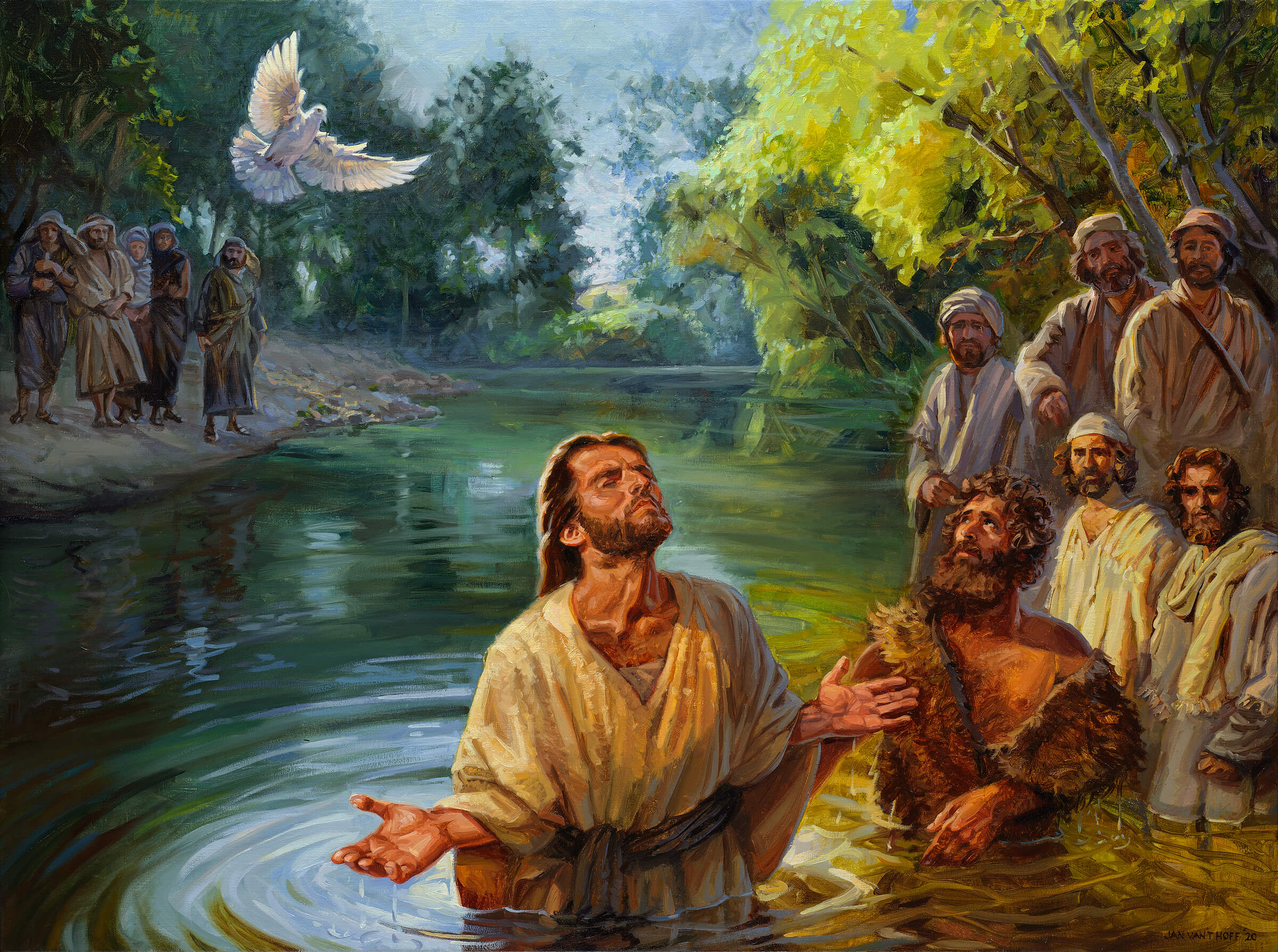
Andrew and his friend John, both witnessed, John the Baptist’s, baptism of Jesus of Nazareth. They were both also soon the become disciples of Jesus, the Christ.
Andrew Ran to Tell His Brother Simon that He Had Seen and Met the Messiah
Andrew and his brother Simon (Peter) were clearly not just Galilean fishermen; they were actively anticipating and watching for the coming of God’s promised Messiah.
When Christ called Andrew to follow Him, Andrew quickly went to tell his brother Simon that the Messiah had come and He was Jesus of Nazareth. Soon Simon too had also been converted to being a “fisher of men.”
The Loaves and the Fishes
Andrew was the disciple who told Jesus about the boy with the loaves and fishes, during the feeding of the 5,000John 6:8. Andrew was also one of the four disciples who came to Jesus on the Mount of Olives to ask Him about the signs which would herald the return of Jesus at the “end of the age.“

The Crescendo of Andrew’s Participation in the Life of Christ – Holy Week
The crescendo of the Life of Christ, which Andrew witnessed, was the events which occurred in Jerusalem during Holy Week. The importance and meaning of these events are described in detail in the post on the Son of Thunder – Apostle James the Greater. Link to James the Greater.
Suffice it to say here that the Crucifixion and death of the 37 or 38 year old Jesus Christ on Friday, April 3rd, and His bodily resurrection back to life three days later, on Sunday, April 5th, of AD 33 changed the world forever.
Note that Jesus was born in the last year of the reign of the Romanized, ethnically Jewish King Herod the Great, who subsequently ordered The Murder of the Innocents in Bethlehem. Link to the Murder of the Innocents. Herod died in 4 BC. In AD 33 Jesus would have been either 37 or 38 years old.

Andrew was a Direct Eyewitness to The Passion of Christ
Andrew was an eyewitness to the events described in the Gospels and to both the crucifixion and death of Jesus and to His bodily resurrection from death back to life. Jesus was dead and in the grave from late Good Friday afternoon until sometime early on Easter Sunday morning when God Divinely resurrected Him from death to life. He was restored back to being a physical person, walking, talking, eating and even having his wounds examined. The risen Jesus was not the ghost or spiritual apparition that some imagine.
After living with Jesus for the ensuing 40 days, Andrew then became a direct witness to the Ascension of Christ when He rose up to heaven and rejoined God and took His seat on God’s right hand side.
The Ascension of Christ occurred 10 days before the Jewish Festival of the Pentecost, when Andrew and his fellow Apostles and disciples experienced the dramatic indwelling and empowerment of God’s Holy Spirit.
The Apostles Initially Ministered In and Around the Levant Region
The Acts of the Apostles details the initial evangelism performed by the 12 Apostles with the assistance of God’s Holy Spirit, in and around Jerusalem and throughout the region of the Levant (the area of Greater Palestine). They witnessed in the region and worked to help with the rapidly growing mostly Jewish “Sect of the Nazarene,” which soon became the nascent One, Holy, Apostolic and Universal Church.
Around AD 38 Andrew Began His Far Reaching Missionary Journeys
Ancient Christian oral tradition tells us that around AD 38 Andrew founded the See of Byzantion and he seated Stachys as its first Bishop. Byzantion is the city whose name Constantine the Great later changed to Constantinople. That diocese would later develop into the influential Patriarchate of Constantinople. Andrew is recognized as the patron saint of Constantinople.
More of Saint Andrew’s Known Missionary Journeys
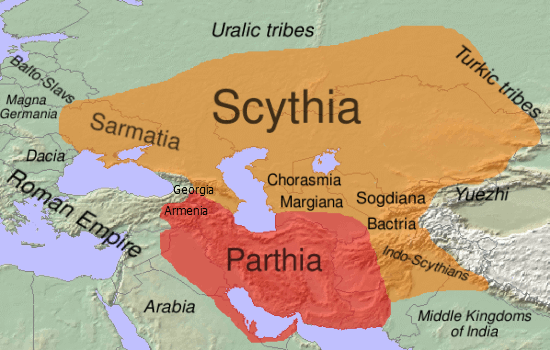
In Eusebius of Caesarea‘s book, The Ecclesiastical History of the Church which was written around AD 320, he quotes Origen of Alexandria‘s writing from AD 209 as saying that after establishing the church in Byzantion, Andrew traveled around Scythia, preaching Christ as he went. Later texts state that Andrew went as far north as the Baltic Sea.
The Chronicle of Nestor (complied in Kiev around AD 1113) adds that Andrew preached along the Black Sea and the Dnieper River as far as the region of Kiev, and from there he traveled further north up to Novgorod. Hence, Andrew also became a patron saint of Ukraine, Romania and Russia.
According to Hippolytus of Rome, from AD 170 to 235, Andrew also traveled and preached in Thrace (Northern Greece). Andrew’s presence in Byzantium is also mentioned in the anonymous and non-canonical text The Acts of Andrew (which was written in the 2nd century). Basil of Seleucia (AD 448) also tells of the Apostle Andrew’s mission in Thrace, as well as to Scythia and Achaia.
Andrew is Reported to Have Been Martyred by Crucifixion on an X-shaped Cross
Andrew is said to have been martyred by crucifixion at the city of Patras (Patræ) in Achaea, on the northern coast of the Peloponnesian Peninsula (of modern day Greece). Early texts, such as the Acts of Andrew, which was known to Bishop Gregory of Tours. Gregory mentions Andrew’s martyrdom in his History of the Franks written in AD 575, where Gregory describes Andrew’s crucifixion as his being bound, not nailed, to an X-shaped cross unlike the Latin cross on which Jesus was crucified.
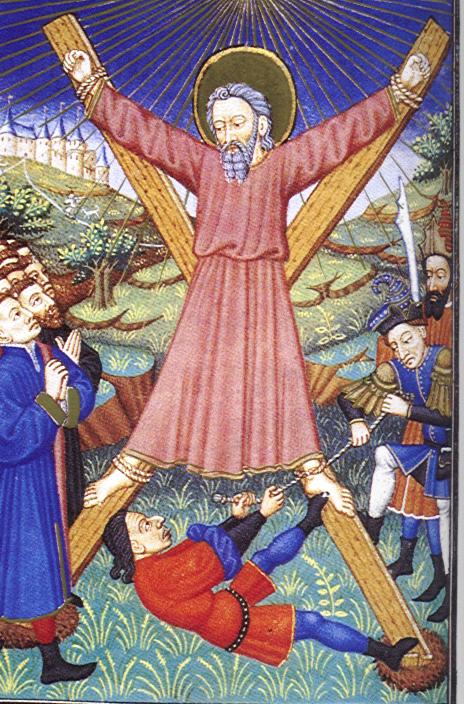
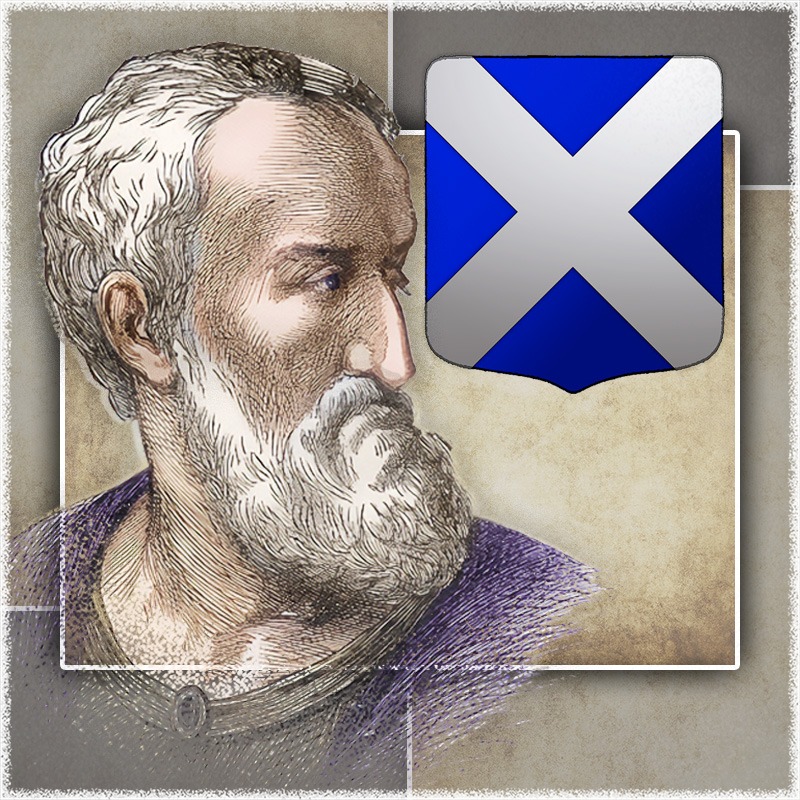
Other ancient oral tradition also states that Andrew was crucified on a cross of the form called a crux decussata (an X-shaped cross, or “saltire“), now commonly known as a “Saint Andrew’s Cross.” This is said to have been done at Andrew’s own request, as he deemed himself unworthy to be crucified on the same type of cross that Jesus had been crucified on. The familiar ancient iconography of his martyrdom also shows the apostle bound to an X-shaped cross.
Andrew’s Remains Were Later Transported to Scotland
In AD 345 Saint Regulus (Saint Rule) is said to have been told by an angel in a visionary dream that the Byzantine Emperor Constantius II had decided to remove Saint Andrew’s relics from the Greek town of Patras to Constantinople.
Regulus decided to move the saint’s relics out of Constantius’s reach. He is said to have taken them to “the far western end of the world” (that is, to Scotland) to keep them safe from the emperor. In Scotland Regulus founded a church dedicated to St Andrew. Thus Andrew also became the patron saint of Scotland, and the national flag of Scotland is the Saltire (i.e., Saint Andrew’s Cross).

The Collect for St Andrew’s Day
Saint Andrew is remembered on his feast day. In the western church that observance occurs on November 30th. The collect (specific prayer) for St Andrew’s Day from the 1928 edition of the Anglican Book of Common Prayer is: