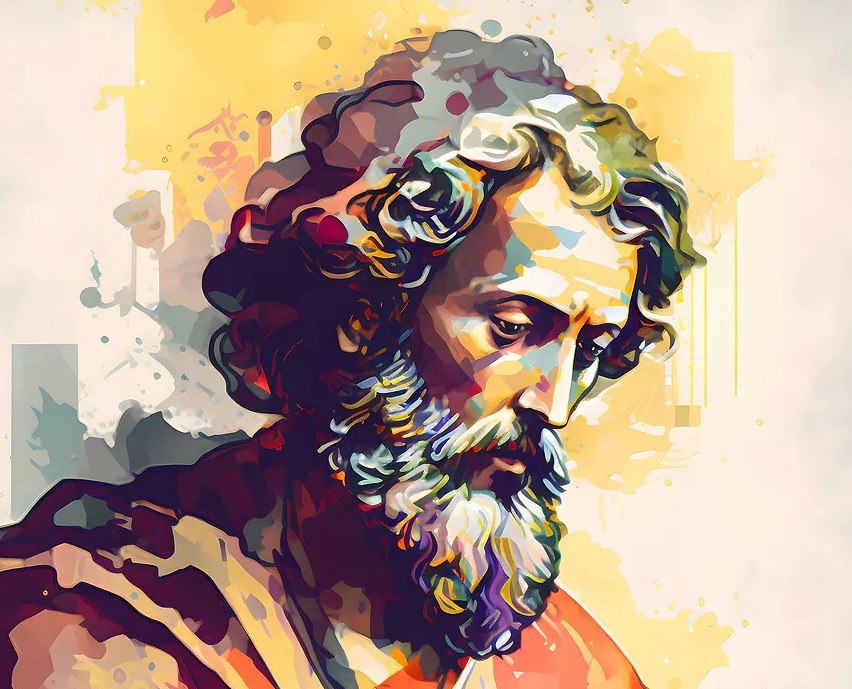

Nathanael was born in Cana, a small town on a plain west of the Sea of Galilee. His father was named Tolmai.
The Confusion about Nathanael Bartholomew’s Name Explained
His given or first name, Nathanael, is of Hebrew origin. It is derived from the Hebrew root words natan, which literally means to give, and El, which refers to God. Hence, Nathanael (sometimes spelled Nathaniel) means gift of God or given by God.
His surname or family name is Bartholomew, is derived from Aramaic root words. The word bar, which means son of and Tolmai which refers to a furrow, implying that Nathan’s family were once farmers. Bar-Tolmai has been modernized to Bartholomew.
Because of these reasons, there is a general consensus that the Nathanael spoken of in The Gospel According to John, and the Bartholomew spoken of in the other three Gospels are the same person, Nathanael Bartholomew.
The Context of Nathanael’s Calling
Nathanael’s hometown was Cana. It was located about 4 miles north of Jesus’ hometown of Nazareth.

Nathan Was In the Seaside Fishing Village of Bethsaida
Bethsaida is a coastal village located on the northeastern shore of the Sea of Galilee. The name of the town, Bethsaida is Aramaic for house of fishing. It was the home town of Philip the Pragmatic Apostle, Link to Philip, which Philip’s friend, and fellow Messiah anticipator, the Apostle Nathanael Bartholomew, was visiting.
Both Philip and Nathan were aware that Jesus’ cousin, John the Baptist was calling Israel to repent of their sins and make straight the path of the imminent appearance of God’s promised Messiah. Philip and Nathan were both young Galilean Jews who were closely following John the Baptist’s activity in the nearby Jordan River.
After John the Baptist, baptized Jesus, Andrew the first called became His first disciple. Andrew’s calling was closely associated with that of the disciple John. Jesus then called Andrew’s brother Simon, and John’s brother James the Greater, all from Capernaum. Then Jesus and His entourage walked to Bethsaida.
When Jesus called Philip, he ran to tell Nathan that the Messiah had come. Nathan was initially skeptical about the idea that Jesus of Nazareth could be God’s Holy Messiah. However Philip bad him to “come and see.”
Capernaum was Another Fishing Village Located on the North Shore of the Sea of Galilee
Capernaum was the home of the observant Jewish couple of Johan and Joanna. They were the parents of two sons, Simon, later called Peter, Link to Simon-Peter, and Andrew, the first Chosen. Link to Andrew. Simon-Peter was a married fisherman, and his brother Andrew worked in his fishing business.
Capernaum was also the home of Zebedee, the Fisherman, and his wife Salome who was also called Mary. They also had two sons, James the elder and taller, Link to James the Greater, and John the author of The Gospel According to John. Link to John the Apostle and Evangelist.
Zebedee was partners with Simon-Peter in a local fishing business Luke 5:7-10. They owner their houses and several fishing boats and all the associated nets and tackle required by such and undertaking Luke 5:1-11. Zebedee also employed a crew of several hired men to help him expand his fishing business Mark 1:20.
At the time of Christ, fish caught on the Sea of Galilean was either salted or pickled for preservation and then transported and sold all over Israel. It was a thriving commercial enterprise.
Jesus Used Capernaum As A Home Base
Though Jesus spent a lot of time walking around the Levant (Greater Palestine) teaching and performing miracles. When He was not roaming about the countryside, He used the village of Capernaum as a sort of home base. The village itself had a population of around 3,000 people (or possibly more). The road from Damascus towards Jerusalem passed through Capernaum.
The population of the Region of Galilee is estimated to have been around 200,000 people, some of whom no doubt attended and heard Jesus’ Sermon on the Mount.
Capernaum Also Had a Roman Tax Collector
Finally, the village of Capernaum is also the town in which Matthew the Apostle and Evangelist worked as a Roman tax collector. That made him a “publican,” meaning that he was a government administrator. He was employed by the Roman overlord, the Tetrarch of Galilee, Herod Antipas. As a Jew who was enabling the Romans, Matthew would have been despised by his fellow Countrymen.
Matthew was also the apostle who wrote The Gospel According to Matthew, hence his epithet “the Evangelist.” Link to Matthew.
Understanding Nathanael’s Calling to Follow God’s Messiah in Its Context
Shortly after Philip was called by Jesus, he went to tell his friend Nathanael that Jesus of Nazareth, the son of Joseph, was the Messiah of God, who had been written about, and promised to Israel by Moses and the prophets of old:
Philip found Nathanael and said to him:
“We have found Him of whom Moses in the law, and also the prophets, wrote—Jesus of Nazareth, the son of Joseph John 1:45 NKJV.”
Nathanael skeptically asked Philip if “any good thing could come out of Nazareth?” Nathanael was apparently well read in the Jewish Scriptures and he apparently shared the common Jewish belief of that day that the Messiah would come from Bethlehem in Judea. Philip replied to Nathanael that he should come and see for himself.
When Jesus saw Nathanael coming towards Him, he proclaimed:
“Behold, an Israelite indeed, in whom is no deceit John 1:47 NKJV!”
Still the skeptic, Nathanael challenged Jesus and asked Him how He could know that about himself?
Jesus’ reply is much more interesting than it first appears. Jesus said:
“Before Philip called you, when you were under the fig tree, I saw you John 1:48 NKJV.”
Nathanael answered and said to Him:
“Rabbi, You are the Son of God! You are the King of Israel John 1:49 NKJV !”
Clearly, on some level, Nathanael knew that the prophesied Messiah of God would have a Dual nature being both human and divine. Link to the Marvelous and Mysterious Dual Nature of Jesus the Christ.
At first pass Nathanael’s deeply theological proclamation seems to have no clear contextual basis:
“Jesus answered and said to him, ‘Because I said to you, ‘I saw you under the fig tree,’ do you believe? You will see greater things than these.’ And He said to him, “Most assuredly, I say to you, hereafter you shall see heaven open, and the angels of God ascending and descending upon the Son of Man John 1:50-51 NKJV.”
Jesus’ reply clearly made a deep impression on Nathanael. Nathanael decided then and there to commit to follow Christ. There are multiple superficially unclear components to this encounter which need to be explained and put into context.

The Deeper Allusion of “Sitting Under a Fig Tree”
First century Jewish disciples would follow their rabbi as he walked and taught them. This practice was similar to the descriptions of Socrates’ and Plato’s habit of teaching while walking around. Learning from a rabbi (or any philosophical teacher) in that time was routinely described as “sitting at his feet.” Sitting at a rabbi’s feet was also done under the fig tree, not only because of the shade it provided but also because of the tree’s sweet fruit Micah 4:4. “Under the fig tree” became an idiom for one who sits under the shade of a Rabbi’s teaching, and/or for one who is sitting under a fig tree contemplating the deeper meanings of the Holy Scriptures.
While Nathanael was almost certainly actually sitting under a fig tree, the figurative metasignal in Christ’s words was also probably not lost on Nathanael. When Jesus told Nathanael that He saw him sitting “under a fig tree,” he was also saying that he saw Nathanael contemplating the Scriptures.
The Possible Context of Jesus’ “Jacobs Ladder-Like” Statement to Nathanael
In the book of Genesis, Jacob (the son of Isaac, the son of Abraham), has a dream in which he see angels traveling up and down a ladder between heaven and earth Genesis 28:12. This dream is a symbol of the fact that heaven and earth are connected and coexistent; the natural and the supernatural are not really separate, mutually exclusive concepts.
The Bible describes many such “thin spots” where heavenly things exist in the material world, such as the scene in Exodus where God speaks to Moses through a burning bush which is not consumed by the “fire.” The fire was presumably actually the Shekinah Glory of the presence of God.

Jesus’ apparently out of context statement to Nathanael that Nathanael will see “heaven open, and the angels of God ascending and descending upon the Son of Man” was most likely made because when Jesus saw Nathanael “sitting under the fig tree,” He also knew that Nathanael was either reading about and/or contemplating Jacob’s vision.
If this rather likely speculation that Jesus also saw Nathanael’s thoughts is correct then it is no wonder than Nathanael immediately proclaimed Jesus to be the Son of God and the King of Israel, and made the snap decision to follow Jesus.
Nathanael was a Loyal Follower of and Disciple of Jesus
Nathanael followed Jesus during His earthly ministry, witnessing His teachings, miracles, and resurrection.
The Crescendo of Nathanael’s Participation in the Life of Christ – Holy Week
The crescendo of the Life of Christ, which Nathanael was an eyewitness to, was the events in Jerusalem on Holy Week. Most likely, these events occurred in AD 33. The importance and meaning of these events are described in detail in the post on the Son of Thunder – Apostle James the Greater. Link to James the Greater. Suffice it to say here that the Crucifixion (on Friday April 3rd) and Resurrection (on Sunday April 5th) of the 37 or 38 year old Jesus Christ in AD 33 changed the world forever.
Note that Jesus was born in the last year of the reign of the Romanized, ethnically Jewish King Herod the Great, who subsequently ordered the Murder of the Innocents in Bethlehem. Link to the Murder of the Innocents. Herod died in 4 BC. In AD 33 Jesus would have been either 37 or 38 years old.

The Risen Jesus Christ Continued to Disciple His Followers
Nathanael was also an active participant in the subsequent events of the risen Jesus’ teaching his disciples the meaning of his atoning death, and of his subsequent Divine Resurrection.
On that first Easter Sunday, the risen Jesus joined with Cleopas and his friend on the road to Emmaus. He spent most of his time during their walk together explaining how the entirety of the ancient Jewish Scriptures points directly to the events of His passion, which was, in fact, God’s divine plan from the beginning of his creation Luke 24:13-35.
Like Luke’s report regarding Cleopas, the risen Jesus Christ, no doubt spent most of his remaining days on earth explaining how the ancient Scriptures point to God’s plan to save and restore mankind and to restore God’s corrupted creation. Jesus no doubt taught them how all of that had been achieved in Jesus’s death and resurrection.
Nathan’s Breakfast By The Sea with the Risen Jesus
In the 21st chapter of the Gospel of John, Nathanael is mentioned as being with six other apostles who are fishing in the Sea of Galilee. The risen from the dead Jesus joins them on shore. He lights a fire, and then cooks them a breakfast of fish and bread.
Like He did at the feeding of the 5000 and at the Last Supper on Maundy Thursday, Christ makes breakfast for his disciples as an example of how divine leadership is in fact an act of service to those being led – in this case to His disciples. In the subsequent section of that same Gospel, Jesus repeatedly tells Simon-Peter and the rest of the disciples that their new job in His soon to be established Church is to:
“Feed My lambs v15,”
and to “Tend My sheep v16,”
and again to “Feed My sheep v17.”

The Ascension of Jesus to Heaven Where He is Seated at God’s Right Hand
Then, His direct discipling work done, Nathanael Bartholomew, along with the rest of the apostles, watched as Christ ascend back into Heaven to join His Father Acts 1:9-11.
The Arrival of God’s Holy Spirit – God’s Spirit Indwells All Baptized Christians
Ten days later Nathanael was also present at Pentecost and when he was filled with the Holy Spirit, and empowered by God to teach and preach the truth of Christ’s life and of the salvation mankind, and of mankind’s restoration to personal fellowship and closeness with God.
The Apostles Initially Ministered in and Around the Levant Region
The Acts of the Apostles details the initial evangelism performed by the 12 apostles and by God’s Holy Spirit, in and around Jerusalem and throughout the region of the Levant (the area of Greater Palestine). They witnessed in the region and worked to help with the growing mostly Jewish “Sect of the Nazarene,” which was the nascent Christian One, Holy, Apostolic and Universal Church.
The Ancient Oral Tradition Regarding Nathanael’s Missionary Journeys
The ancient and undisputed Christian tradition holds that the Apostle Nathanael’s first long distance missionary journey was with the Apostle Philip, and his sister Mariamne. They traveled through Greece, Anatolia (modern day Turkey), including the eastern region of modern day Armenia, and into Phrygia to the city of Hierapolis.
There they are reported as having fallen afoul of the Roman proconsul, by converting his wife to the faith. The three were tortured, and then Philip and Nathanael were crucified upside-down. However Philip preached to the crowd while hanging upside down on his cross and converted many in the crowd. The crowd then took Nathanael down off his cross, but Philip would not let them rescue him.
After that experience Nathanael is reported to have continued to preach the Gospel in various regions outside the Roman Empire, including India, Armenia, Ethiopia, and Persia.
Eusebius of Caesarea‘s Ecclesiastical History of the Church confirms that after the Ascension, Nathanael Bartholomew went on a missionary journey to India, where he left behind a copy of the Gospel of Matthew.
Nathanael and his fellow apostle, Jude (also know as Thaddeus, the author of the canonical Epistle of Jude), brought Christianity to Armenia. Together these saints are considered the patron saints of the Armenian Apostolic Church.
Other traditions record him as serving as a missionary in Ethiopia, Mesopotamia, Parthia, and Lycaonia (in central Turkey) before going on to Armenia.
While the Bible does not describe how Nathanael died, according to Christian oral tradition, he was martyred by being flayed and skinned alive and then beheaded in Albanopolis, Armenia. Legend has it that he converted Polymius, the king of Armenia, to Christianity. Astyages, Polymius’ brother, consequently ordered Bartholomew’s execution.
Nathanael’s Renditions in Later Artworks
The Apostle Nathanael Bartholomew is often depicted holding a knife because he is traditionally believed to have been martyred by being skinned alive. This gruesome fate has been represented in various artworks, including Michelangelo’s Last Judgment mural on the wall of the Sistine Chapel in Rome.
The Collect for St Bartholomew’s Day
Saint Bartholomew is remembered on his feast day. In the western church that observance occurs on August 24th. The collect (specific prayer) for St Bartholomew’s Day from 1928 edition of the Anglican Book of Common Prayer is:
O ALMIGHTY and everlasting God, who didst give to thine Apostle Bartholomew grace truly to believe and to preach thy Word; Grant, we beseech thee, unto thy Church, to love that Word which he believed, and both to preach and receive the same; through Jesus Christ our Lord. Amen.
Conclusion
Nathanael’s life and death exemplify his dedication to the Gospel of Christ and his commitment to spreading the message of Jesus, even in the face of frequent and great suffering.
Nathanael also teaches us that sincere doubt can lead to genuine faith. Though skeptical at first, he was open to finding the truth. Upon having a personal encounter with Jesus, his perspective completely changed, and he promptly recognized Jesus as the Son of God.
Another important lesson is Nathanael’s simplicity. He was not concerned with appearances or status but was focused on truth, authenticity and inner integrity.