The Revealed Attributes of God
The God of the Judeo-Christian tradition is profoundly distinct from the so called gods described…

The Chosen Demos hopes to present a balanced Christian view of the world. As audacious as that may sound, nonetheless, it is our goal.
The Koine Greek word demos means the people; the Latin synonym for demos is the more pejorative and derogatory word mob or sometimes rabble. That distinction gives us some insight into how the ancient Greeks viewed the common man, as opposed to how the Roman elites viewed (or how the modern “Progressives” view) the same group of people.
O.K.? Then why chosen?
The ancient Israelites understood themselves as being God’s chosen people, which they were by virtue of their birth and their obedience to God’s covenant with them through the sacrament of the circumcision of their male children. The nation of Israel was repeatedly symbolized metaphorically in their scriptures as a productive olive tree or as a fruitful vineyard.
Subsequent to the arrival of God’s promised Messiah, in the person of Jesus of Nazareth, the Christ (the Son of God) that distinction as God’s chosen people changed.
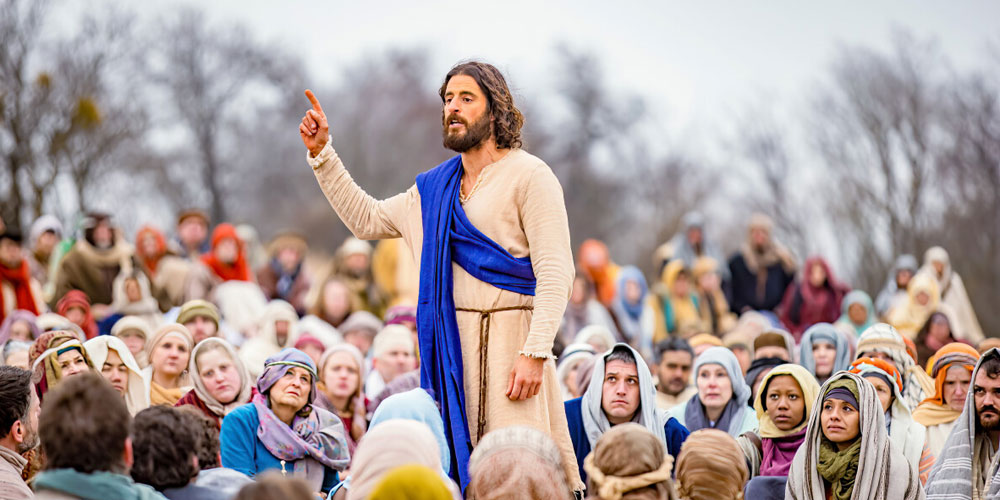
Many ethnic Jews sadly rejected the authenticity of God’s promised Messiah and those unbelieving branches of the olive tree image of Israel were divinely pruned and cut off from the tree. That is to say they chose have themselves cut-off from God’s blessing.
Christ repeatedly told us that non-Jewish strangers (Gentiles) who began accepting God’s Messiah as the Son of God, were being divinely grafted into that same olive tree image of God’s chosen people, as the ancient Hebrew scriptures had predicted it would.
The common scriptural metaphor of “Israel” as God’s chosen people began to describe all the Messiah believing peoples of the world. Jews first, but also Gentile believers; the olive tree continued to describe believing ethnic Jews and Gentiles converts alike. The divine hand kept the olive tree productive and growing. The vineyard continued to be fruitful.
As a result of Jesus’ well documented sinless life, and His unjust, but willingly submitted to, execution and death, and His subsequent divine resurrection the Son of God conquered death and corruption. He soon ascended back to heaven where He figuratively sits on the right hand side of God. Jesus Christ now reigns as the Lord of all of creation.
Those who chose or choose to follow and obey the Son of God have become God’s authentic chosen people, Israel living parts of His olive tree and his vineyard (be they ethnically Jewish or gentile believers).
The Chosen Demos website hopes to help all of us (Christians and non-Chritians alike) to understand the world that came before us, and how that prior world became the world we see and live in today.
The world we live in is one of the most beautiful and inspiring of places I can imagine, and its many enigmas are worth pondering and deciphering. Those who penetrate the many post and pages of the Chosen Demos will unfold some of those mysteries and perhaps see some of that beauty for themselves.

In the first chapter of the Book of Genesis, the Bible tells us we are all made in the image of God.
Fine!
But what in the world does that mean?
The Apostles and the early church fathers understood many aspects in which this ancient Hebrew statement was to be understood. The classically Greek trained and wise Cappadocian Fathers (of the mid 300s), Basil the Great, Gregory of Nyssa, and Gregory of Nazianzus, distilled the apostolic concept of being made in the image of God down to three essential elements in which men were made similar to their creator God.
1. Men have immortal souls, and God has always existed and is eternal.
2. Men have free agency, and of course, God’s nature is that He does as He wills to do.
3. Lastly, men have the power of their reason (they don’t always use it well, but they have that power, nonetheless), and God is, again of course, the essence of reason.
Other faithful Christian theologians have noted that human nature includes an innate desired to create, build and organize and that God is clearly the source of all of creation. Mankind’s creativity and his vocation as a steward of God’s creation are two other senses in which mankind having been made in the image of God can be understood.
Many of the pages of this site will be filled with the threads of human history and the ideas which have influenced and caused those events or caused counter-reactions to those ideas and events.
In 1905, the Spanish-American philosopher George Santayana famously, but negatively, said:
I would say, rather, that those who truly wish to learn from history and are willing to invest the time required to do so will be blessed both by being able to understand the people in our lives, and by seeing our world as a much more understandable place.
The fundamental truth of human nature does not really change over time. Good ideas lead to good choices, which in turn generally leads to good outcomes. I think we all want those.
Human history is complicated, and I am, to say the least, a flawed person, so I will no doubt be mistaken at times. For those errors, I apologize to you, the reader, in advance.
However, I do not apologize for the biases I will present. To the best of my ability they will never be hidden or camouflaged; I am not that subtle of a person. At times I will even point to those biases confidently. To quote Thomas Sowell:
I love discussions of ideas, however I have no desire to dispute ideas with those whose minds are closed. As Russel Brand once said:

As a Christian, I am also aware of the admonition of Christ during His Sermon on the Mount:
That quotation is often misunderstood (or even intentionally misused to try to silence the Christian voices out of the larger discussion in the virtual town square). The statement is not an injunction against sound judgment.
It is a warning to us that we will be divinely judged by the same standards we chose to hold others to. We are commanded to have good judgement and to thereby be “the salt of the earth”; however we are forbidden from being judgmental. Ultimately, that is God’s role.
Importantly viewers of the posts on this site will notice that this website will have far more apparently secular pages than overtly Christian ones. That is because many of the ideas and the events of our times, and those which have led up to the current conditions are considered to be secular facts and events.
As a Christian I fail to see that distinction, so this web site will not worry about “staying in its own lane.”
In the fifth century before Christ the Greek philosopher Plato described a distinction between physical things in this world, such as a chair, and the philosophical nature of the thing; the philosophical (or mental) concept of “chairness.” That distinction was Plato’s ontology, or his concept of being or of “that which is.”
Plato also postulated a related concept of personhood. Plato’s concept of a person centers on the idea that the soul, which he asserted, is the true self, while the physical body is merely a temporary vessel in which the soul resides. He believed that the soul is the immortal essence of what makes us who we are, and he distinguished that from the physical body.
The ancient Gnostic religious heresy of the first and second centuries postulated a reality which was in many aspects similar to that described by Plato. The Gnostic concept split human existence between the base and corrupted physical world and a noble and virtuous “spiritual” world of the soul.
For those Gnostics the highest form of existence in this world was to be so spiritually minded that one virtually transcended into the metaphysical world while one was still living in this physical one.
Both of these trains of thought are diametrically opposed to a Christian view of creation and of reality, in which heaven and earth are confluent and overlapping realities. They are not really separated or particularly distinct things.
God walked in the garden with Adam and Eve. In the modern vernacular, they hung out there together. God give Adam and Eve stewardship over his creation. Eden is part of the earth but its is not separate or distinct from God’s realm which is Heaven. Creation is not corrupt, it was and is good. The Platonic and Gnostic dichotomies and the wide separation and rigid distinction they postulate between the physical and the metaphysical worlds have no place in a Christian understanding of reality.

In numerous weird ways that falsely dichotomous Platonic and Gnostic thinking reappears in many more modern circles during and since the western enlightenment period.
During that time people began to replace superstitious religious ideas which purported to explain the causality of numerous curious observations of the physical world with actual scientific ones based in observable and reproducible facts.
As scientific understanding of the physical world grew, the intelligent and virtuously secular people in those modern western societies began expressing an increasing intolerance of religious thinking which became such that they would only tolerate those silly religious ideas of others if those who held them kept those thoughts to themselves. It became nominally acceptable to have your own transcendent or metaphysical ideas about things that are beyond the physically known reality as long as you kept that stuff in your “private” life. Hence the rebirth of a form of the ancient Platonic or Gnostic dualism has been imposed on many in the modern age.
Christianity, on the other hand, actually has no room for such knavish thought. The God who created the cosmos did not just create the physical world, but the metaphysical one also. Importantly there is no clear or defining distinction between the two. To quote The Nicene Creed of the 4th century:
One should note that the word “visible” used here means physical, and the word “invisible” is somewhat analogous to the modern expression metaphysical.
In his Confessions, Augustine agreed with Origen of Alexandria and Tertullian of Carthage that there is a convergence between Christianity and classical culture that provides ground for a synthesis, though not without tension and struggle. Tertullian summarized this with his famously pithy rhetorical question:
So the Christian presuppositions of the Chosen Demos will not allow us to ignore the modern world in which we now live.
Finally, in actual practice, I will focus on “the real world” all the more. To quote the wise and sometimes whimsical Fyodor Dostoevsky:
Tolerance is a virtue in its broadest since, but it is not the overriding goal of this life, or of the Chosen Demos website.
The truth is out there. You just have to let it in.


The God of the Judeo-Christian tradition is profoundly distinct from the so called gods described…
“In the beginning God created the heavens and the earth(14 billion years ago and 4.5…