
The Relative Justice of Economic Redistribution
Despite all the philosophical stone-throwing between nominally “right” thinking people and nominally “left” thinking people, socialism is an innate part of the modern civilized world. Like it or not, it IS the world we all live in.
The truth is that Classical Liberalism with its love of limited government, and its justly and correctly founded defense of the rights of the individual, and in particular the right of the individual to control his/her private property, is not wrong. If a settler legally homesteads a plot of farm land, builds a cabin and a barn on it, clears the fields and plants crops. His/her right to that farm as their own private property is the natural result of extensive personal time, labor, and financial investments they put into their farm. Again, that is NOT wrong, it is simply not the reality of the 21st Century life in the modern world.
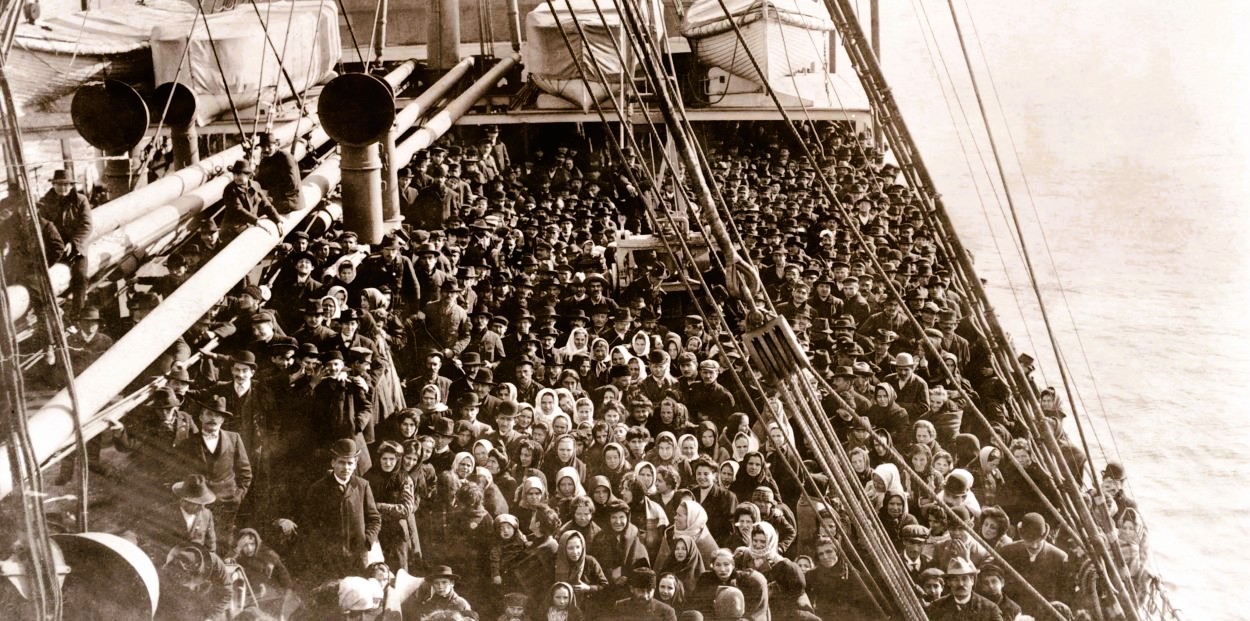
The other truth is that the rise of the modern administrative state has vastly overshadowed traditional Christian obligation to charitable practices. That older and wiser more morally discriminating and ethically based form of giving to the poor was not sufficient in its scope and scale to handle the full needs of a growing industrial society with the open borders of the late 1800s and early 1900s in America. In that era America was being built, strengthened and at the same time overwhelmed by the flood of able bodied and willing to work for their living migrants who came into our land of promise.
Understand it as you may, the modern reality in every civilization in the world is that, at least at some level, all governments administer at least some level of redistribution of private wealth to the less fortunate of their societies.
Nonetheless, as a pragmatic realist, and as a Christian, I think it is a generally good thing for us to provide pragmatic and useful help to those less fortunate among us who are in need.
Everyone who is well off and reasonably comfortable should help those who are not so fortunate amongst us. That assistance should rightly be at least mildly painful to those of us who are able to be the givers.
This is not a statement of support for the phony virtue signaling calls for unlimited “Social Justice.” Nor is it the radical demands of Marxist extremists in any their many philosophical camps. It is the selfless love Christ demanded of us all, as Christians and non-Christians alike, and the need is very real.

All of that having been said, I have many reservations about how these systems are administered. The fiery rhetoric which has divided the socialist left from the conservative right has overshadowed all hope of pragmatic compromise which could potentially result in a reasonably just and secularly administered system which should work if we actually focus on the result we aim at: helping the downtrodden of our society.
Pragmatic Economics – The Tax System; The Main Source for Redistribution
The “tax the rich” schemes always sound great, but they never actually work. Those who propose this as a solution need to “get over it.” It is just the envy, avarice and angry jealous rhetoric relabelled as a form Social Justice, which it never really is. More importantly, it never actually works.
A Simple Model of a Just Tax System
For a just tax system to work, it must be a flat and universal tax on everyone (paraphrasing Karl Marx) “according to his ability.” Higher income earners pay more because they earn more. With this system we all pay the same portion of our earnings, no special exemptions, except that the bottom 10% of earners pay nothing.
A graduated tax system is specifically designed to punish the higher earner for his/her success. In fact those who are legally more productive than most of us should be encouraged to be all the more productive as their success increases the tax base which is used to fund the socialist redistribution we are talking about.
Optimum Tax Policy is a Pre-Condition to Funding Pragmatic Socialism
There is a huge body of proof that when tax rates are oppressively high, then tax rate decreases result in increased government revenues. This happens because of the general increase in the private economic investment and productivity of society which the lower tax rates foster. That general increase in the productivity of society soon expands the tax base. Again, a large tax base (more general prosperity in society) is the goal. It is the mandatory pre-condition needed for all systems of redistributive socialism.
Tax Rate Decreases Often Increase the Total Amount of Government Revenue Collected
The surprising and initially counterintuitive fact is that the significant tax decreases of the Harding and Coolidge (Republican) administrations, the Kennedy (Democratic) administration, the Reagan (Republican) administration, the Clinton (Democratic) administration, and the first Trump (sort of Republican) administration, all saw significantly increased government revenue streams. John Kennedy famously stated that:
“A rising tide raises all boats.”
While that claim is not strictly, immediately, or universally true, it is generally true for the most part.
Andrew Mellon was the U.S. Secretary of the Treasury from 1921 to 1932 during the Harding and Coolidge administrations. He used the vast amount of historical data in the tax payment records of his Department which he and his employee assistants had access to in that pre-digital age. Under Mellon’s leadership, they compile the earliest information available on the effect of various tax rates on the payment of taxes from the various economic tranches of the American society. His illuminating book, Taxation: the People’s Business, which was published in 1924 and is still in print, is the summary of his factual findings of that reality:
“It seams difficult for some to understand that high rates of taxation do not necessarily mean large revenue to the Government, and that more revenue may often be obtained by lower rates”.
More importantly, the share of that increased government revenue stream which is paid by the wealthier tranches of society also increases with decreasing tax rates. Counterintuitive as that may be, decreasing the tax rate has repeatedly increased the amount of taxes paid by the wealthy.
Increasing the tax rates nominally aimed at “taxing the rich” does not (!) decrease the ever-widening material wealth “gap” which is the focus of so much angry modern rhetoric against this nominal “social injustice.”
The concept that at some high tax rate, the tax liability incurred against the profits of business activities actually depresses the rates of national investment and productivity is not really surprising. In the over-burdened private sector this fact has been repeatedly demonstrated and confirmed. Overtaxing America decreases the actual total amount of money collected by the government. It also increases the tax burden on the ordinary people living on main street. The wealthy hire willy tax advisors to tell them how to avoid owing the tax, so they are able to avoid paying what would otherwise have been their share.
It is not the rich who are punished by the economically knavish politicians, it is the ordinary people living on Main Street.
This economic reality is actually a specific example of the well-known and more general subject of the mathematical calculus of max-min equations.
A simple example is to understand that if one tries to manufacture and sell exotic, high performance status cars, the exorbitant price you have to charge to cover your costs of production will limit the number of cars you can find buyers for. On the other hand, if one wants to make more money, one should manufacture and sell reasonably good quality economy cars to millions of people. The profit per car is much smaller than that of the Ferrari seller, but the large volume of cars sold produces a much larger net profit.
That is max-min mathematics 101.
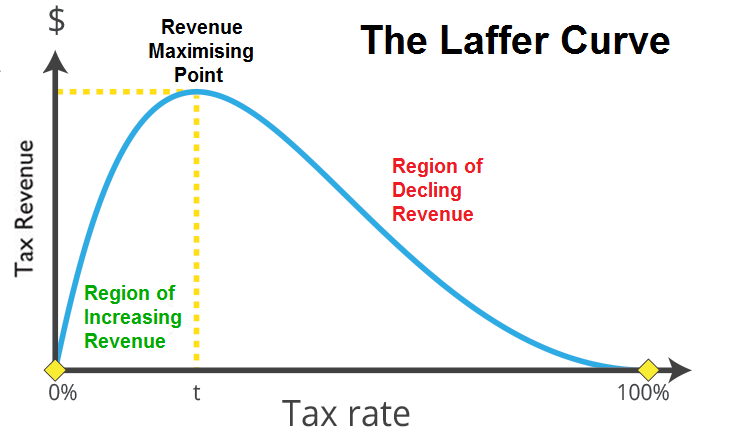
Arthur Laffer was far from the first to discover this relationship about taxation, but he promoted the fact during the Reagan administration and his name has stuck with graph ever since. The Laffer curve diagrams how high taxes produce low revenue streams and visa versa.
The Wise and Pragmatic Optimum Tax Rate
The tax rate which produces the largest amount of government revenue is the tax rate which allows the government redistributive system to send the largest amount of money to the poorest segment of society.
Hateful Jealous and Punitive Taxes should be Repealed
The Corporate Income tax should be repealed.
That tax was passed in 1909 under the nominally “Progressive” Theodore Roosevelt’s administration. It was Teddy’s alternative tax scheme because a personal income tax been deemed unconstitutional by the US Supreme Court. Teddy used the corporate tax as a back door road to his populist “tax the rich” program.
When the 16th Amendment to the Constitution was passed to circumvent SCOTUS’s ruling and to make a federal direct personal income tax legal, the Woodrow Wilson administration quickly established the personal income tax in 1913. Wilson’s rhetoric to get the income tax passed promised that it would “only effect the top 1% of America’s wealthy.” If Wilson’s rhetoric were true then all of the ordinary people would, of course, support the proposal, or not care about it.
When the personal income tax passed they should have repealed Teddy’s alternative tax on corporations. But then, no politician has every seen other people’s money he/she didn’t want to confiscate.
BTW: in 1914, the year after the income tax was passed, Congress and Woodrow changed the income tax code so it applied to 99% of Americans. The “Progressive” rhetoric never actually aligns with the actual practice of the elitist ruling oligarchy of the administrative state.

Shareholder income (dividends) is and should taxed as personal income. Capital gains on the profits realized from stock sales are and should be taxed.
Corporation boards and CEOs should be freed to focus on building value and income for their shareholders, not on end-of-the-year tax avoidance schemes.
Governmental Tax Schemes Designed to Alter Business Decisions Should be Abolished
The government should stop using tax avoidance exemptions as a method to manipulate commercial behavior. Such government oversight of corporations is and should remain the legitimate role of legislation and of government administration, not of a national tax code which is so complicated no ordinary person can understand it.
The Elephant in the Room – The Power Elites Are a Significant Part of The Poverty Problem
The middle classes in the western nations have been repeatedly decimated and nearly obliterated by the globalism of the of the last 80 plus years. The many ever-growing and monopolistic commercial enterprises which the Bretton Woods global financial system produced has systematically destroyed the lives of millions of the ordinary working class people, by off-shoring production and by abolishing national protective tariff barriers in the name of free trade.
At the same time the nefarious politics behind the administrative state and nominally progressive political parties has favored and fostered the rampant dependency that the state welfare system naturally produces. The politics of the state welfare system has built an army of dependent patrons to who vote for the party and the politicians that provide them with their meager crumbs.
Both of these factors have caused the problem of poverty in America to grow rather than shrink because it is in the interest of these ruling elites to disempower ordinary people from being in control of their own lives.
This group of facts and factors does not change the truth that the poor among us need a helping hand. However it also needs to be honestly stated that the nominally virtuous helpers often have a stake in the programs they propose and administer ultimately failing.
After all, there is no reason to be idiotically idealistic or knavishly naive about the real goals of the administrative state. It always acts in its own best interest.

The Inherent Fraud and Corruption Problem
My cynically pragmatic side reels at the vast and obvious amount of corruption, fraud, and inefficiency which is involved in the redistribution system. The administrators of the funds ear-marked for redistribution inevitably manage to siphon off vast amounts of that money for themselves (and their many tax exempt NGOs and foundations). A relatively small fraction of the money actually gets to those who so desperately needed the money to begin with.
Many of the recipients, also, work numerous frauds to claim they are worthy to receive such transfers. Many have unreported streams of cash income which are hidden from the view of the administrative state.
That is not to say that I think an efficient, well-run system would decrease the tendency towards the fraud and corruption which the system is a magnet for. It won’t.
The corruption and fraud problems flow out of the flaws of the human heart. We are almost all at our most basic level selfish and greedy schemers acting in our personal best interests. Some of use may resist that temptation better then others but it is the core reality of the human nature of us all.
Hence every redistributive system will always need vigorous criminal oversight, monitoring, investigation and prosecution. Some people grabbing other people’s money will always be a part of any system of redistribution of money to people. Investigating and prosecuting those criminals will diminish the volume of such crimes, but it will never stop it all together. The modern secular moral compass is severely broken.

Conclusions
It is often said that:
“The Love of money is the root of all evil.”
As is so often the case when discussing issues related to money, that statement taken by itself, is poor quality scholarship. The actual Biblical source is more complex:
“For the love of money is a root of all kinds of evil, for which some have strayed from the faith in their greediness, and pierced themselves through with many sorrows 1Timothy 6:10 NKJV.”
Taking the full passage in its context leads us to the actual point being made. The bad choices people make are the root of all evil. In particular our basic selfish nature is that root. The Judeo-Christian heritage refers to this as our “sin nature.” However, there is no distinction between these two statements. They are the same fact stated different ways.
Despite the impassioned and fiery rhetoric of Marx, Engels, Lenin and Stalin, or that of nominally well-meaning American Progressives, Social Justice is not served by making everyone materially equal. That is not a solution; it is a foolhardy fantasy. The Homesteaders who built their farm with their own blood, seat and tears, should rightly own that homestead. The goal is not to make everyone equally poor by overly-aggressive and punitive systems of forced redistribution.
The pragmatic goal is to use the self-serving nature of us all to generate a general prosperity which can then secondarily be judiciously redistributed to the less able or less productive among us.
The Bible demands our charity:
“Then the righteous will answer Him, saying, ‘Lord, when did we see You hungry and feed You, or thirsty and give You drink? When did we see You a stranger and take You in, or naked and clothe You? Or when did we see You sick, or in prison, and come to You?’ And the King will answer and say to them, ‘Assuredly, I say to you, inasmuch as you did it to one of the least of these My brethren, you did it to Me. Matthew 25:37-40 NKJV.”
However that is not the whole story. It also demands that we not reward the lazy and the slothful among us:
“If anyone will not work, neither shall he eat 2 Thessalonians 3:10 NKJV.”
Christian charity does not support the corruption or fraud of the system administrators (and their favored tax exempt NGOs and foundations). Such a system of charity is also forbidden to undeserving fakers posing as rightful recipients.
If we can all get past our personal anger and disappointments about the flawed nature of others (and of ourselves), then we can dump our fiery rhetoric and open a productive discussion about an efficient and effective system to help the people we all need to give a hand together.