

China’s now long-standing economic boom has significantly raised the living standards of nearly a quarter of the world’s population. It has brought hundreds of millions of people out of extreme poverty.
It doesn’t matter whether you are a panda-hugging globalist, or a Sinophobic American nationalist, China must have the accolades it deserves for this remarkable accomplishment. China’s economic development program has truly been the world’s Third Industrial Revolution.
In the “Strange Bedfellows of Modern Geopolitics” series of posts on this website (all linked below), nowhere is there a stranger group of associates than the group which came together to enable Communist China to pull itself out of its nearly universal poverty. These factors, forces and factions worked together in one way or another over a period of 45 years to lift China out of poverty, and it has been a true marvel to observe!
Just as the First & Second Industrial Revolutions lifted the common poor of the west out of their Dickensian poverty and also formed the Western middle classes, so the world’s Third Industrial Revolution has done the same for China.
The Many Factors Which Combined For China’s Success
By far the most important factor involved in China’s elevation has been the vast resources of the both wise and intelligent people inside of the Chinese Communist Party (CCP). China’s greatest resource is the willingness of its students, young and old, to study the world’s economic options in detail and to accept and use the facts those studies produce.
The Chinese people have at least a two millennia old tradition of being great students of all things.
When Mao Zedong died in 1976 his overbearing and restrictive influence on China’s idea of what Communism must look like was relaxed. While the political struggle for Mao’s successors played out over the next two years, a quiet philosophical identity struggle of what “Communism with Chinese characteristics” meant was also proceeding behind the closed doors of the party’s offices in Beijing.
In 1978 the Chinese Communist Party’s apparatchiks knew there were things they didn’t know about the underlying realities behind Western prosperity. More importantly they knew what had been accomplished in post-World War II Japan, and the Asian Tiger Nations of South Korea, Taiwan and Singapore. They knew what those countries had been able to accomplish in terms of national economic development. The Party also knew much about the national commercial policies which had led to the 1st and 2nd Industrial Revolutions in the west.
Importantly, the Leaders in the Chinese Communist Party Understood What the Soviets Had Missed
in the late 1970s, China strongly wanted to become a modern, prosperous and developed nation without making any more of the lethal and embarrassing mistakes they had made during the Maoist era. China understood (in part) what the Soviets, to their peril, had never learned. Karl Marx’s magnum opus of economics, Das Capital, was critically and tragically wrong in several very important ways. His Capital was not far off in its analysis of Victorian England’s version of events, but that analysis is now utterly out of date and out of place, and it is not applicable to the modern world. Even back then, Marx had chosen to ignore the far more relevant and globally universal treatise by Friedrich List, The National System of Political Economy.
The more sagacious Chinese understood what List and the Asian Tigers were teaching them. In some way the market-price-based commercial system was the critically required basis for establishing a thriving modern economy. However the CCP had no actual experience dealing with such a system. The Chinese clearly chose not to follow the Soviet model of strict centralized control of everything. To learn how market-price-based economic exchange worked, the CCP apparatchiks decided to try some limited experimentation in their national economy.
China Both is, and is Not, a Centrally Controlled Society
Communism “with Chinese characteristics” must be understood.
Much of China’s central control directives are in most instances more like suggestions to the provinces. At the provincial level the regional leaders are expected to experiment somewhat with the Party’s instructions and they are allowed the latitude to do so. The Party’s central leadership then gets to compare the various provincial level alternative versions of its policies. The Party then figures out which system works best and adopts that “best structure” and replicates it in the other provinces. This has been a routine relationship between the capital and the provinces throughout China’s long dynastic history. It is nothing new or remotely recent in China’s long history.
The Reform and Opening-Up Program was Not Really Pre-Planned in Detail
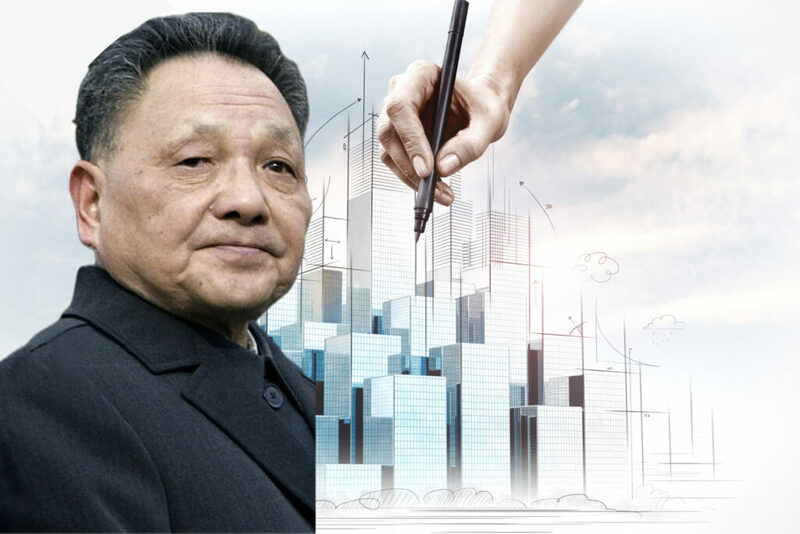
In keeping with China’s uniquely flexible control system, when the December 1978 Party Plenum launched the Reform and Opening Up Era, what it was actually announcing was a vague endorsement of experiments in land management and with produce prices by rural collectives. Deng Xiaoping’s official announcement, in early 1979, launched the beginning of China’s new way. Deng’s associate and rival, Chen Yun was the head of the all important Economic Planning Bureaucracy of Communist China. He was more cautious and conservative than Deng, and together they controlled the rate at which this new experiment was applied.
The following year, Deng and company decided to broaden their national economic experiment to include urban commerce in specially designated, geographically limited, but economically liberalized economic zones they referred to as Special Economic Zones or SEZs.
The Severity of Poverty in China in 1979
In 1979, China’s mean national income per person was $200 a year. That was less than one-tenth the world average. The living standards of the average Chinese were not that much different than those in Afghanistan, Bangladesh, or many African countries. In 1979 at least 800 million Chinese people lived in what the World Bank described as extreme poverty.
Clearly Mao’s adaptation of Soviet policies to China had not improved the well being of the Chinese people in any significant way.
The Shamefully Bad Results of Mao’s Old Soviet Style Collective Agriculture Program
When Mao’s Communist Chinese forces won the Chinese Civil War, in 1949 all land and property in China officially belonged to the state. During Mao’s disastrous Great Leap Forward of 1959 to 1961 he followed Lenin and Stalin’s mistake of collectivizing farming. Somewhere between 15 million and 55 million Chinese are reported to have starved to death during that period. The staggering number of around 30,000,000 Chinese is the sum most commonly assumed to be factual.

By 1978 many economic planners in the CCP understood that wage and price controls everywhere and always cause shortages. Alternatively, when the person tilling the land is allowed to sell his produce himself, and to choose the price he will sell it for, the farmland under his control becomes measurably more productive. That is the power of market-price-based commerce.
Deng Followed many of the Policies Lee Kuan Yew Used for the Development of Singapore
The specific techniques Lee Kuan Yew used to create an economic success in Singapore had a profound effect on the CCP leadership in China. Under Deng Xiaoping’s leadership China made a major effort to emulate Lee’s policies of drawing foreign capital to support national economic growth. Deng also chose to support domestic entrepreneurship. They also admired his careful suppression of civil dissent. See the link to Singapore’s Salvation – Lew Kuan Yew – The Authoritarian Dictator Who Improved the Lives of the Common People, in the post list linked below.
Getting Agriculture Right – Reform’s First Bottom-Up Program Success
Between 1978 and 1983, the agricultural economy of China was revolutionized by the Household Responsibility System which placed specific plots of farmland under the control of individual families. Chinese peasants were able to exercise formal control of the state-owned land they were allowed to farm, as long as they sold a contracted portion of their crops to the government at the lower plan-price levels. The Reform Era announcement had also raised official agricultural plan-prices some, but the farmers selling their produce were soon setting their own market-based-prices rather than using state approved prices.
This all started in the small village of Xiaogang in Anhui province, where a group of farmers got together in secret and signed an agreement to dissolve their collective and to divide up their farmland into individual family plots. This innovation rapidly spread, and the province’s party secretary, Wan Li, realized he was facing a powerful popular revolt against an immiserating collective system. Rather than crush it, he decided to promote this land-to-the-tiller reform. The party secretary of Sichuan Province, Zhao Ziyang, made a similar decision. This one move increased China’s overall agricultural production by 25 percent between 1975 and 1985, setting a precedent for privatizing other parts of the economy.

Generally, reforms in this period started with local experiments that, when successful were adopted in a given province. Such experiments were then expanded to the national level once their success had been demonstrated. Regional CCP officials generally faced few penalties for experimenting and failing and those who developed successful programs received nation-wide praise and recognition.
China’s Rural Control Laxity also Spawned Township and Village Enterprises
During the 1980s and into the 1990s, the gradual and spontaneous development rural industrial and commercial enterprises played a central role in the steadily rising prosperity of rural communities. Although the Township and Village Enterprises (TVEs) were often described as collectively owned, the term primarily refers to enterprises being located in townships and villages in China rather than to a specific ownership structure. Emerging from the earlier commune and brigade-level enterprises, TVEs expanded rapidly and became a major source of rural employment and industrial output. By the mid-1990s, the TVEs accounted for a substantial share of China’s non-state industrial production. The TVEs soon underwent a significant restructuring to formally become private entities. The TVEs were in fact a diverse group of various acceptable transitional forms which progressed from collective ownership using market-based initiatives, to actual private entities.

Special Economic Zones (SEZs) – The Second Big Transition
In 1979 Deng’s nominal Open Door Policy invited foreign corporations to come to do business in China (and to bring their foreign capital with them). Starting in 1980, as the result of Deng’s careful examination of Lee Kuan Yew’s Singapore, China initiated the Chinese Special Economic Zone (SEZ) experiments. These regions became powerful engines of growth for the national economy.
The concept of a Special Economic Zone first arose in the late 1950s in Ireland. The Irish government established the Shannon Free Zone to encourage Foreign Direct Investment (FDI) in Ireland by offering significant tax incentives to foreign companies and their new Irish-based subsidiaries.
Numerous American pharmaceutical manufacturers took advantage of Ireland’s tax scheme and moved their pharmaceutical manufacturing and production facilities to Ireland. They established Irish-based subsidiary companies which then overcharged their American parent company for the products they produced. That enabled the American parent company to report a high cost for the drugs they sold in America. This phony high cost/low profit situation allowed the American parent company to avoid paying a substantial amount of American Corporate Income Taxes on the drugs they sold in America. Meanwhile the American drug company’s Irish subsidiary, which was not being taxed by Ireland, enjoyed a huge amount of untaxed profits. This is also why John DeLorean chose to manufacture his DeLorean cars in Ireland. This somewhat sophisticated tax avoidance system is part of what China has been providing to the US and international companies which participate in China’s SEZs.
This tax dodge structure is also, an early example of the real truth about globalism’s virtueless appeal to the super wealthy financier-type western power elites, who own the companies involved. It was and is another significant carrot China was offers to wealthy Western investors in China. As it had been in Singapore it was another enticing initiative to western corporations, to get them to finance China’s initial industrial development, and it cost China nothing.
Various Chinese leaders visited the Shannon Free Zone, including Jiang Zemin (in 1980) and later Zhu Rongji, Wen Jiabao, and still later Xi Jinping.
Foreign Direct Investment Allowed China to Use Foreign Capital to Develop Chinese Industrial Infrastructure
The term Foreign Direct Investment was originally used to describe a foreign company using its capital (foreign money) to buy land in a recipient third world country and then building a new factory there from the ground up. That company would then start manufacturing goods using cheaper (often underpaid) local labor to do the work.
The recipient country benefits from the employment of its population, and from providing support services and often raw materials to the factory. The foreign direct investor often also builds infrastructure in the recipient country, such as roads, ports, electrical generation systems, etc. That development is a further benefit to the recipient country.
To the cynical western academic socialist, FDI is described derisively as Neo-Colonialism, but to the recipient county which controlled the process it was a cost free developmental godsend.
The FDI term also includes other associate commercial endeavors such as buying stock in other enterprises operating in the recipient country. This activity brings a significant amount of foreign capital into the recipient country.
China aggressively used Special Economic Zones to attract a huge volume of FDI into China which was initially quite capital-poor. By so doing China was able to rapidly grow its industrial sector with no real cost to the Chinese Communist Party.
China’s First SEZs Were Located in the Southeastern Coastal Ports Which Had Previously Been Used by Foreigners During China’s Qing Dynasty Period
Special Economic Zones in mainland China were granted more market-oriented economic policies and flexible governmental measures by the government of China in an effort to be more attractive to foreign and domestic businesses. In SEZs, foreign and domestic trade and investment is conducted with tax and business incentives tailored to attract foreign investment and technology.
The FDI investors were drawn to China by the promise of being able to potentially penetrate China’s huge domestic market. The CCP adroitly allowed some access to its domestic markets for a while, and then later severely restricted the foreign company’s access to it. This is a classic Red Chinese bait and switch routine continued in successive Chinese markets for decades, while the western investors were duped by false Chinese promises, time and again.
Officials in Guangdong Province led by Provincial Party Secretary Xi Zhongxun and Yang Shankun sought to make Guangdong a national demonstration zone for the Chinese SEZ experiment. Fujian Province was also avid to join the experiment.
The first four Chinese SEZs were located in the urban centers of Shenzhen, Shantou, and Zhuhai, in Guangdong Province and in Xiamen in Fujian Province. The SEZ model was so successful that three more were SEZ’s were added in Hainan in 1988, in Shanghai’s Pudong New Area in 1990, and in Binhai in 2009. By the 2020s, the combined number of SEZs, national-level new areas, and free trade zones in China had reached 45.

The CCP’s Initial Dual-Price System Tries to Have Pricing Both Ways
A dual-price system was introduced in the pricing system for urban State-Owned Enterprises or SEOs. These SEOs were allowed to sell any production above the centrally required plan quota production levels. The quota products were sold at the low plan-prices, but the surplus commodities were allowed to be sold at much higher market-based-prices. Moreover, the adoption of Industrial Responsibility System in the 1980s further promoted the development of state-owned enterprises by allowing individuals or groups to manage the enterprise by contract.
Private businesses were allowed to operate in the open for the first time since the CCP takeover in 1949, and they gradually began to make up a greater percentage of China’s overall industrial output.
The dual price system in China was two-edged sword. On the good side it allowed companies to sell to surplus production above their quota’s plan-price level for the much higher market-based-price which incentivized companies increase their profits by increasing their production efficiency. However the dual-price system also generated an arbitrage opportunity which allowed many corrupt government officials to buy products at the low centrally planned-price levels and then to resell that same merchandise elsewhere at the higher market-based price. Some Western Sinologist experts believe that this arbitrage invitation to bureaucratic corruption was an intentional mechanism to motivate the regional bureaucrats to support this blatantly non-communistic but centrally supported, economic reform program.
This nearly universal source of bureaucratic corruption was a significant factor in the nationwide urban political protests which arose in 1989. It was stopped after the Tiananmen Square Massacre, when China ended the arbitrage opportunity by ceasing to issue government plan-prices. Hence, China finally went to a strictly market-price-based pricing system for all non-strategic products made in China.
Combined Foreign and Domestic Chinese Joint Ventures Were Part of the CCP’s Plan from the Beginning
In July 1979, China adopted its first Law on Joint Venture Using Chinese and Foreign Investment. As the world learned from the Tiananmen Square massacre 20 years after Deng’s announcement of China’s Reform and Opening Up, the Chinese Communist Party had no intention of ever losing control of China.
Clearly Chinese State Owner Enterprises (SEOs) were under the direct control of the Party. These state monopolies are used in the commanding heights enterprises of the economy controlling banking, petroleum and national security concerns. The vast bulk of Chinese SEOs are engaged in mundane urban services, such as managing utilities.
The party’s mechanism for control of “private” enterprises, included using their joint venture system. The party would embed CCP member/entrepreneur “commissars” into the management of “private” companies. These CCP commissars would report back to the Party about what the company was doing. They would also chime in on the company side to let management know what the CCP expected from the company. These CCP commissars are embedded inside of every “foreign” and/or “private” firm operating in China.
In addition to that mechanism of control over foreign companies, medium to large-sized domestic Chinese firms are also required to have CCP party commissars who establish party branches for company employees inside Chinese enterprises. The corporate charters of these domestic enterprises also mandate that party governance goals be a “harmonious” part of their corporate goals. This integration aims to ensure that all private companies are always aligned with the party’s objectives and that the CCP can maintain close oversight of all of their commercial operations.
Urban Housing Privatization was an Enormous Windfall to Chinese City Dwellers
China’s Urban Housing Privatization Program began in 1998. It marked the end of the state-provided urban housing system that had lasted for decades. This shift transformed housing into a commodity, allowing individuals to buy and sell their properties in the open market. This not only generated a huge windfall state disbursement to urban working families, it also spawned a real estate construction and investment boom which surged in China for at least the next decade.
Because the state never privatized Chinese farm land, no similar windfall even occurred in China’s rural areas.
Conclusions
China’s long economic boom has raised the standard of living of nearly a quarter of the world’s population and it has brought hundreds of millions of people (almost a billion people !!) out of extreme poverty.
From 1979 through 2011 China’s economy grew at an average inflation adjusted rate of 10% per year. That is easily the longest period of double-digit growth ever recorded. Since then its economy has cooled off a bit, but it still grew at around 7% per year from 2012 through 2018.
Since 1979, China’s per capita Gross domestic Product or PC-GDP value has grown at an average rate of about 8.5% per year. At that rate the national income of China has doubled every 9 years.
The income of the average Chinese person is more than 30 times higher today than it was in 1979. Again, In 1979, China’s mean national income per person was $200. In 2018, just 40 years later, the mean national income per person was about $9,400 per year. That value is about 84% of the world average. Again, in 1979 at least 800 million Chinese people lived in what the World Bank called extreme poverty. Today the number of people resident in China living in dire poverty is less than 10 million. These “forgotten poor” are comprised mostly of the non-Han ethnic minorities such as the Tibetan people living in Tibet and the Uyghur and Turkic Muslim people in living in the huge Xinjiang Province in far Western China.
The introduction of market-price-based commerce into the Chinese economy, has dramatically and resoundingly changed life in China for the better!
The primary theme of this Strange Bedfellows of Modern Geopolitics series of posts has been that the American constitutional republican democracy and individual rights and freedoms so cherished and touted in the West are not the only road to a happy and functional society.
The many oppressions to which the inhabitants of Communist China must routinely submit has not gone unnoticed, but net good China has accomplished for its enormous cohort of common working people must also be recognized, and applauded.