After the Presentation of the Jesus, the firstborn of the virgin Mary, and the Purification of Mary, at the Temple in Jerusalem, Joseph and Mary fled to Egypt, with the infant Jesus. They stayed in Egypt until the Romanized Jewish King Herod the Great died. After Herod’s death it was then safe for them to go home to Nazareth.
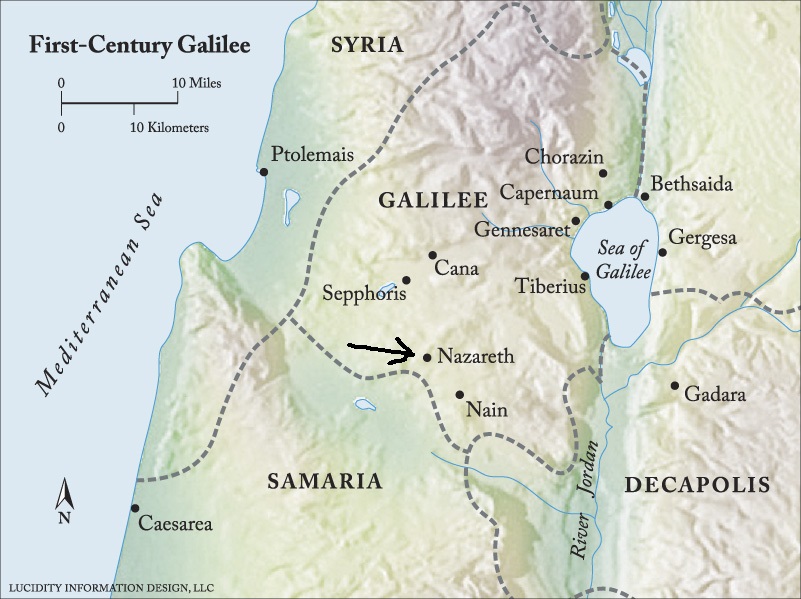
Nazareth is located in the mountainous southwestern region of the province of Southern Galilee. There, Jesus was raised by Joseph and Mary and he learned his trade as a carpenter. At some point the Virgin Mary was widowed and her Son Jesus became her sole provider, although presumably Jesus’ half brothers from Joseph’s first wife were also involved in some way.
Secular history tells us that King Herod the Great, died in 4 BC, so the stay of Joseph, Mary and Jesus in Egypt was not a long one. As soon as word of Herod’s death arrived in Egypt they made their way back home to Nazareth.
Jesus Christ is the Crescendo Demonstration and Proof of God’s Love for Mankind
As stated in my Flight Into Egypt post (linked below), in the eyewitness Gospel According to Matthew, Matthew points to a foretelling of the Virgin Birth of Christ which is mentioned in the prophetic Book of Isaiah:
“Therefore the Lord Himself will give you a sign: Behold, the virgin shall conceive and bear a Son, and shall call His name Immanuel 7:14 NKJV.”
The name Emmanuel is ancient vowelless Hebrew. As Matthew tells us, It means God is with us Matthew 1:22-23 NKJV. This epithet for Jesus speaks of the divine nature of Jesus (who, of course, had two natures, one human and one divine).
In the elaborate figurative tapestry of the Holy Scriptures God instructs Moses to tell Pharaoh that Israel is His son, His firstborn:
“Then you shall say to Pharaoh, ‘Thus says the Lord: Israel is My son, My firstborn. So I say to you, let My son go that he may serve Me Exodus 4:22-23 NKJV.”
So, in the often figurative language of the ancient Scriptures, God’s chosen people are also a foretype for Jesus and that God’s love for the Nation of Israel is a foretype of God’s love for all people. This is demonstrated to us by the incarnation of Christ who ultimately provides the necessary atonement for all of mankind who are willing to accept that atonement.
Out of Egypt . . .
When Jesus and the Holy Family returned from Egypt it was a fulfillment of the prophesy found in the Book of Hosea. Many of the prophesies in the Old Testament have more than one fulfillment, and this is an example of that truth. Clearly the first fulfillment was the Exodus of the Israelites from Egypt. The Holy Family’s Exodus from Egypt was a second fulfillment of the same prophesy.
“When Israel was a child, I loved him, And out of Egypt I called My son Hosea 11:1 NKJV.”
The eleventh chapter of the Book of Hosea is a description of God’s promise to his chosen people, Israel, who are corporately described as God’s son. Through Hosea God promises that he will continue to love His people even though they are disobedient to Him.
The crucifixion of the guiltless Jesus and His subsequent resurrection which atoned for all the sins of mankind, is the ultimate fulfillment of God’s promise through Hosea’s of His Divine love for us; for all of mankind.
Nazareth Was a Weeks Walk From Jerusalem
Nazareth was about one week’s walk from Jerusalem, where Joseph, Mary and their extended families would journey three times a year to attend the mandatory festival pilgrimages required for devout and observant Jews. In Jerusalem they would make their offering to God and worship God at the Second Temple.
Three Festival Pilgrimages Which Were/Are Mandatory for Observant Jews
The First Was/Is the Festival of Passover
The Festival of Passover, is when the devout Jews remember God’s mercy sparing them from His final plague on Egypt.
That night the divine angel of the death killed all the first born in Egypt, men and livestock alike. However that plague passed over the households of the Israelites in Egypt and did not kill their firstborns. The Plague passed over them because the Israelites had invoked the divine protection of the blood of a sacrificed unblemished lamb which they had painted on the lentils and door posts of their homes.
That event was, of course, also a foretype of the blood of the Lamb of God, Jesus Christ’s, personal sacrifice on the cross for the sins of the whole world on Good Friday.
The Second Was/Is the Festival of Shavuot
The Festival of Shavuot, is also known as the Festival of Weeks, or Pentecost. This festival occurs 49 days, or 7 sevens, or a Sabbath of Sabbaths after the Passover remembrance.
Shavuot is another annual celebration of the grace of God to Israel. It recalls when God gave the Israelites the grace of the Mosaic Law. Though some modern Christians emphasize God’s grace to us and contrast that divine grace against the “tough taskmaster of the law,” they forget that Jesus said:
“Do not think that I came to destroy the Law or the Prophets. I did not come to destroy but to fulfill Matthew 5:17 NKJV“.
God’s law is also a form of grace and a blessing to his people. As Robert Frost said, “Good fences make good neighbors.” The Mosaic Law provided Israel with guardrails, and Shavuot (or Pentecost) is the annual festival where they gave (and they continue to give) thanks to God for that grace.
This ancient festival is also a foretype of the Descent of the Holy Spirit upon the nascent Christian church in Jerusalem. The Holy Spirit who indwells Christian believers during the Sacrament of Baptism is the transcendental and personal sustainer and sanctifier of the Christian life of each believer. With the indwelling of the Holy Spirit in our lives, we outwardly become obedient Christians, members of the universal Christian Church. Inwardly and spiritually we each become living temples of God. His law is written on our hearts.
The Third Was/Is the Festival of Sukkot
The Festival of Sukkot, is also known as the Festival of Tents or the Festival of Booths. Sukkot is observed continuously for eight days. Sukkot is the annual remembrance of the time when the refugees from Egypt wandered in the desert, lived in tents and were utterly dependent on God’s providence for their daily survival in that inhospitable land.
Observant Jews move out of their comfortable homes and live in tents for an entire week to remind themselves of what their forebearers did for an entire generation in the wilderness.
The Exodus of the Jews from the tyranny of Egypt was, on one level, the salvation of the Israelites. God acting through Moses brought them out of Egypt so they could live livee of dependence and service, worshiping and obeying God.
God sending Moses to save the Israelites in Egypt is also a foretype God sending his own Son to die on the cross thereby atoning for the sins of mankind. The Jewish understanding of God’s presence among His people was dramatically typified by God being present in the Shekinah Glory of his pillar of fire amongst the Israelites. That ancient image symbolizes the idea of dwelling in the presence of God. Again, Christians believe this is fulfilled by the indwelling of God’s Holy Spirit in us which occurs during the Sacrament of Baptism.
God’s Holy Spirit indwelling us is also symbolized by divine tongues of fire descending on His believers, as described by Luke in the beginning of the book of The Acts of the Apostles. Sukkot also represents the Christian themes of gratitude, deliverance, and the hope of eternal life with God.
Each of These Mandatory Festival Pilgrimages are Foretypes of Christ
These ancient festivals are each foretypes of the later Christian understanding God and His relationship to mankind. The divinely ordained death of Jesus on the Cross atoned for the sins of mankind which started with the sins of Adam and Eve in the garden of Eden.
Christ’s passion changed our observance and understanding of these annually remembered landmarks of faith in God for evermore, however the one, holy, apostolic and universal Christian Church continue to observe these events in our festivals of Easter, Pentecost, and our eternal dependence of the providence of God is remembered in our weekly participated in the sacrament of Holy Communion.
These mandatory Jewish festivals were, of course, also changed forever by the Roman Empire’s utter destruction of the Second Temple in Jerusalem in 70 AD which was prophesied in detail by Jesus and is recorded in the 24th chapter of Gospel of According to Matthew, the 13th chapter of Gospel of According to Mark and the 21st chapter of the Gospel of According to Luke.