
The Big Bang Event is the general term applied to the group of naturalistic (non-supernatural) theories which attempt to explain the origin and subsequent development of the physical cosmos by academic cosmologists.
Technically there was no medium through which sound could travel so there was no “bang”; it was actually The Big Flash Event.
“In the beginning God created the heavens and the earth.”
The cosmos appeared 14 billion BC (14,000,000,000 years ago). The earth appeared some 4.5 billion BC (4,500,000,000 years ago).
The Precondition Problem – The Inexplicable Singularity:
Essentially all naturalistic, secular scientists agree that “in the beginning” all the matter of the future cosmos was concentrated in a single point in space and at an energy density level which was essentially infinitely dense. This enigmatic pre-condition is referred to as the Singularity. How that condition could possibly have happened as a result of natural phenomenon, is utterly inexplicable by any of the known characteristics of physical matter and energy. That is a rigid fact, an inescapable truth.
Without invoking either ridiculously pretend Alice in Wonderland conditions of physics that don’t exist in any known reality or invoking the divine providence as an explanation of those conditions they cannot be explained. No kind of physics which is confirmable, or testable in a scientific way can account for how such a singularity could exist. Because that state of matter would be grossly unstable, that condition immediate begins to degrade (as in it immediately explodes and begins to expand). However let us leave that enigma for now and “beg the question” by simply acknowledging that the condition of the Singularity happened.
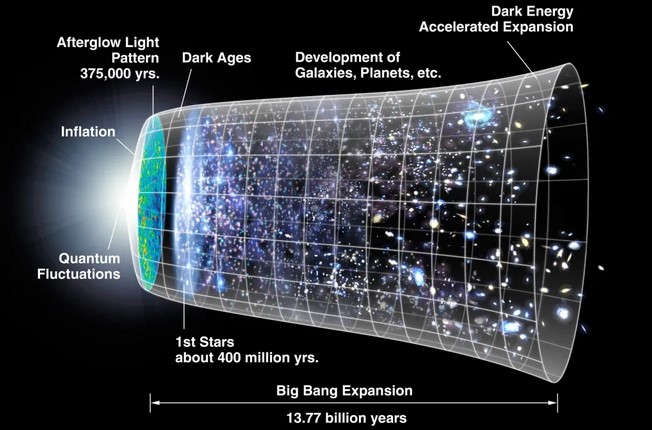
That inexplicable precondition of the Singularity did exist, whether we can explain that condition or not. What is far more plausible is that once the precondition of the Singularity did exist, the narrative of the Big Bang Theory of cosmology describes how the universe expanded from an initial state of incredibly high energy density and temperature. That is to say, a state of pure energy so concentrated that there was no physical matter present whatsoever, not even subatomic particles.
This hyper-concentrated state of pure energy then rapidly expanded and the extreme energy density lessened and as it did it cooled and subatomic particles formed (condensed) out of the expanding and cooling energy concentration. The first subatomic particle are thought to have appeared about 1 microsecond into the process. the first simple nuclei are thought to have appeared about 3 minutes into the process. This involved hydrogen has has only a single proton as a nucleus and Helium which has two protons and two neutrons in its nucleus.
As expansion continued with the associated cosmic cooling continued atoms began to form. That occurred 300,000 years into this process! Atoms are the initial components of physical matter. Once the subatomic particles coalesced into atoms, the atoms began to react and combine to form molecules, and thus the building blocks of the physical universe began to appear.
These primordial elements, mostly hydrogen, with some helium and lithium, began to coalesce as a result of gravitational forces. Note that these three most abundant element are also the three simplest elements on the periodic table. They have one, two, and three protons in their nuclei respectively.
Much later that coalesced matter began to form first cosmic dust clouds, and then eventually to form early stars and galaxies around 200 million (200,000,000) years into this process.
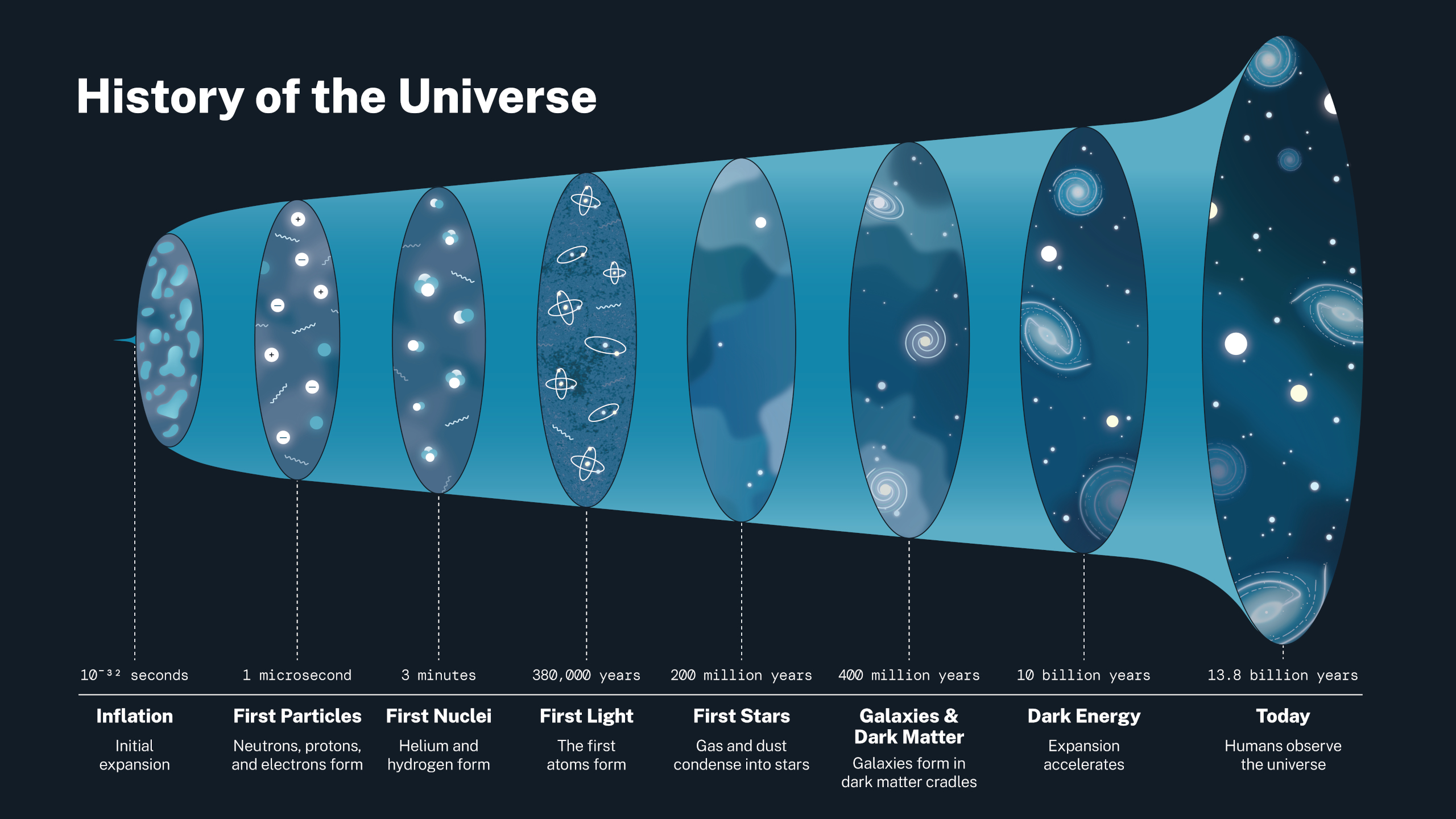
The gravitational effect of dark matter surrounding the galaxies of the cosmos is observed by astrophysicists. Most of the gravitational potential in the universe seems to be in the form of this dark matter.
The various cosmological models of the “big bang” propose to explain the evolution of the observable universe from the earliest known periods through to its subsequent phase of the large-scale formation of “clouds” of matter further coalescing. These models offer a comprehensive explanation for a broad range of observed phenomena, including the abundance of light elements, the cosmic microwave background radiation (CMB), and the large-scale structural properties of the current cosmos.
Crucially, these models are compatible with the Hubble–Lemaître law, the observation that the farther away a galaxy is, the faster it is moving away from the Earth. Extrapolating this cosmic expansion backwards in time using the known laws of physics, the models describe an increasingly concentrated cosmos preceded by a singularity in which space and time lose meaning, typically named “The Big Bang Singularity.” This “singularity” is the prevailing non-supernatural, secular, academic description of the fact that the initial incomprehensibly dense concentrate of energy which caused the big “bang” to occur CANNOT be explained by any imaginable physical theory of matter and energy.
A wide range of empirical evidence strongly favors occurrence of the Big Bang event, which is now essentially universally accepted by scientists and most others. Detailed measurements of the expansion rate of the universe place the date of the Big Bang Singularity (the creation or origin of the cosmos) at an estimated 13.787±0.020 billion years ago, which is the age of the universe.
The big bang is a reasonable and most likely factual description of the divine creation sequence of the Cosmos.
Remarkable Similarities Between Secular and Divine Cosmologies:
What is, in my opinion, truly remarkable is how similar the erudite deduced secular cosmology is to the Biblical description of God divinely creating the cosmos given in the Book of Genesis, which was written more than 3,000 years ago.
If one doesn’t get too hung up on “the petty narrative details” of the ancient text, the Genesis account sounds a lot like a narrative which the divine creator God might reasonably have used to explain His actual creation process to an, as yet, scientifically unsophisticated, agrarian tribal people. God “spoke” and creation came into existence, and he did so sequentially over a period of six “days.” The Hebrew word which is routinely translated as day also means six periods or six epochs.
No other extant ancient creation myth gets anywhere near this close to describing the events modern science has deduced about the creation/origin of the cosmos. If one is not an absolute biblical literalist (i.e., a fundamentalist), then there is no significant conflict between the Biblical narrative and the secular naturalistic descriptions of the origin of the cosmos. The ancient narrative account sounds remarkably similar to the modern-day secular account of the origin of the cosmos.