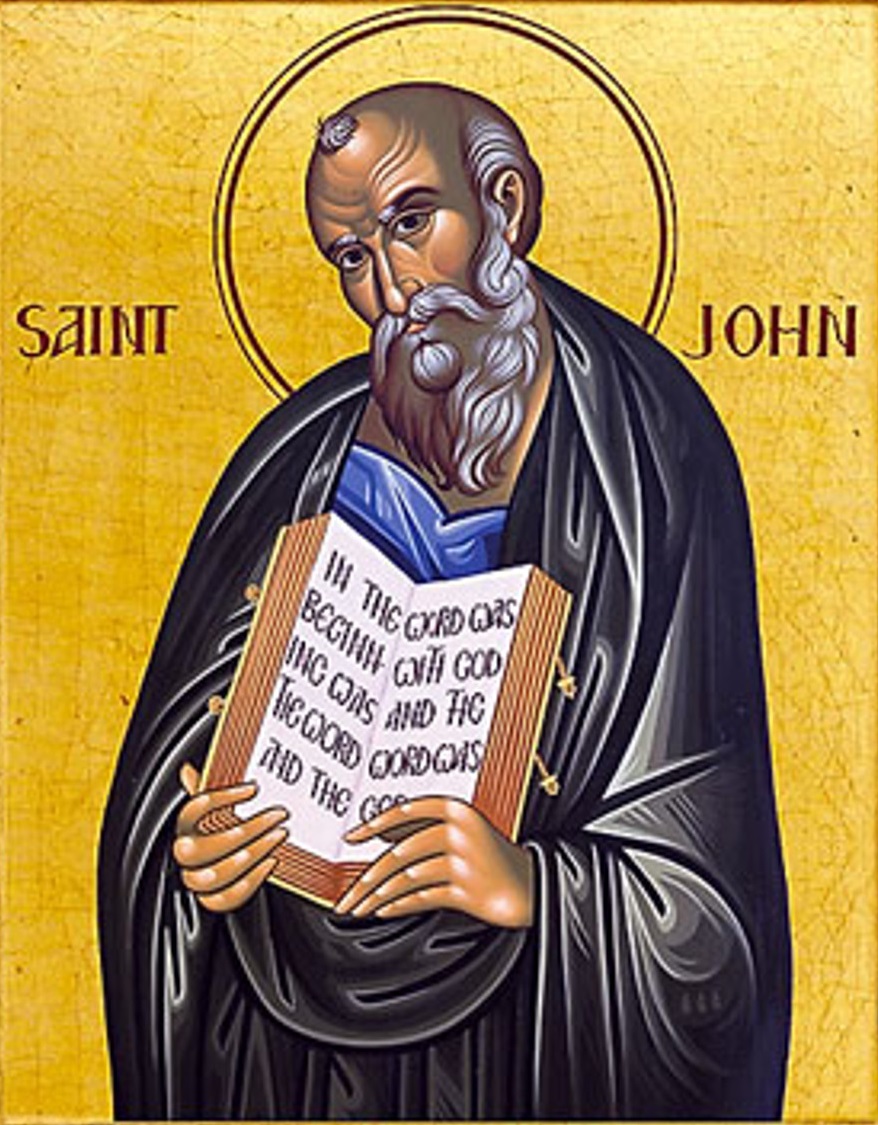
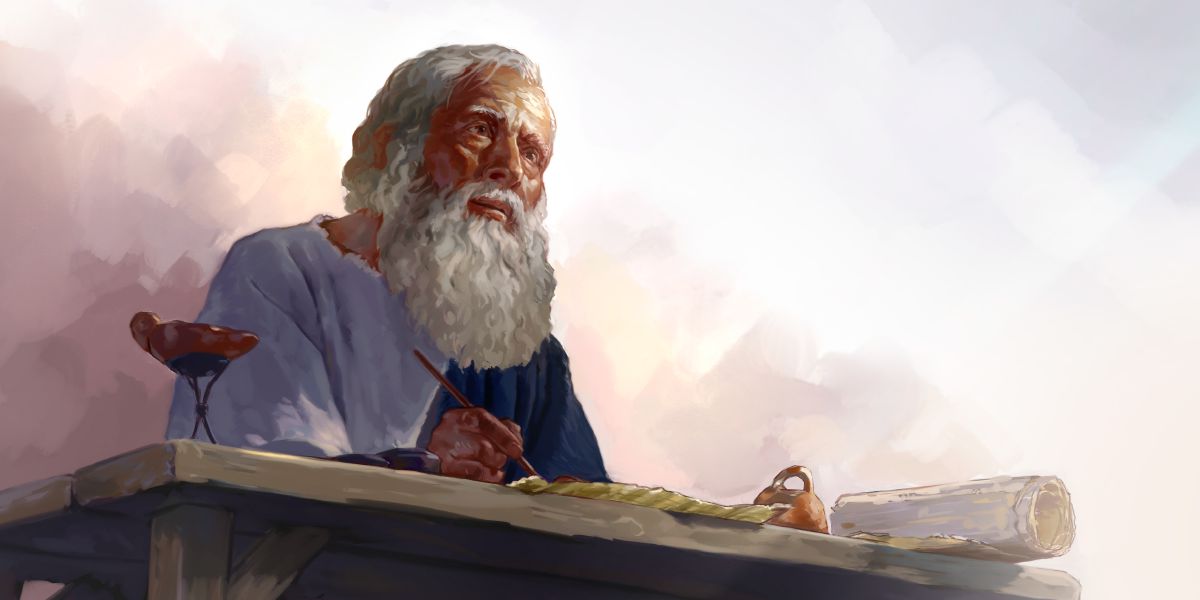
Saint John the Beloved Disciple was the son of Zebedee the Fisherman. He was also known as John the Evangelist, Saint John the Theologian, Saint John the Divine, and John of Patmos.
John and his brother James the Greater were also nicknamed by Christ as the Sons of Thunder because of their overzealous defense of Christ’s honor when some Samaritans disparaged HimMark 3:17.
John was born sometime around AD 6. He was the second-born son of Zebedee the Fisherman and his wife Salome.
John’s Mother Was Salome, Also Called Mary
John’s mother Salome was one of the women who traveled with Jesus and His disciples, and ministered to their practical needs (along with Mary the Mother of Christ, and Mary called Magdalene). Salome was also a direct eyewitness to the crucifixion and death of Jesus on Good Friday,Matthew 27:55 & Mark 15:40 and she watched the dead body of Jesus laid in the tomb of Joseph of Arimathea by Joseph and NicodemusMark 15:47.
Three days later Mary-Salome was one of the women who brought spices to the grave of Jesus early on the morning of Easter Sunday (after the end of the Jewish Passover Sabbath). Mary-Salome was with Mary-Magdalene and Mary the wife of Clopas, who was also the sister of Mary the mother of JesusJohn 19:25. The Marys intended to anoint the dead body of Jesus the Christ. Instead they found the tomb open and emptyMark 16:1, because Jesus, the Son of God, who had been dead and buried, was no longer dead but rather, was risen from death to lifeJohn 20:18. The mortal body of Jesus Christ had died and then later been divinely restored such that the Son of Man and the Son of God knew no corruption.
The Apostle John Witnessed the Baptism of Christ
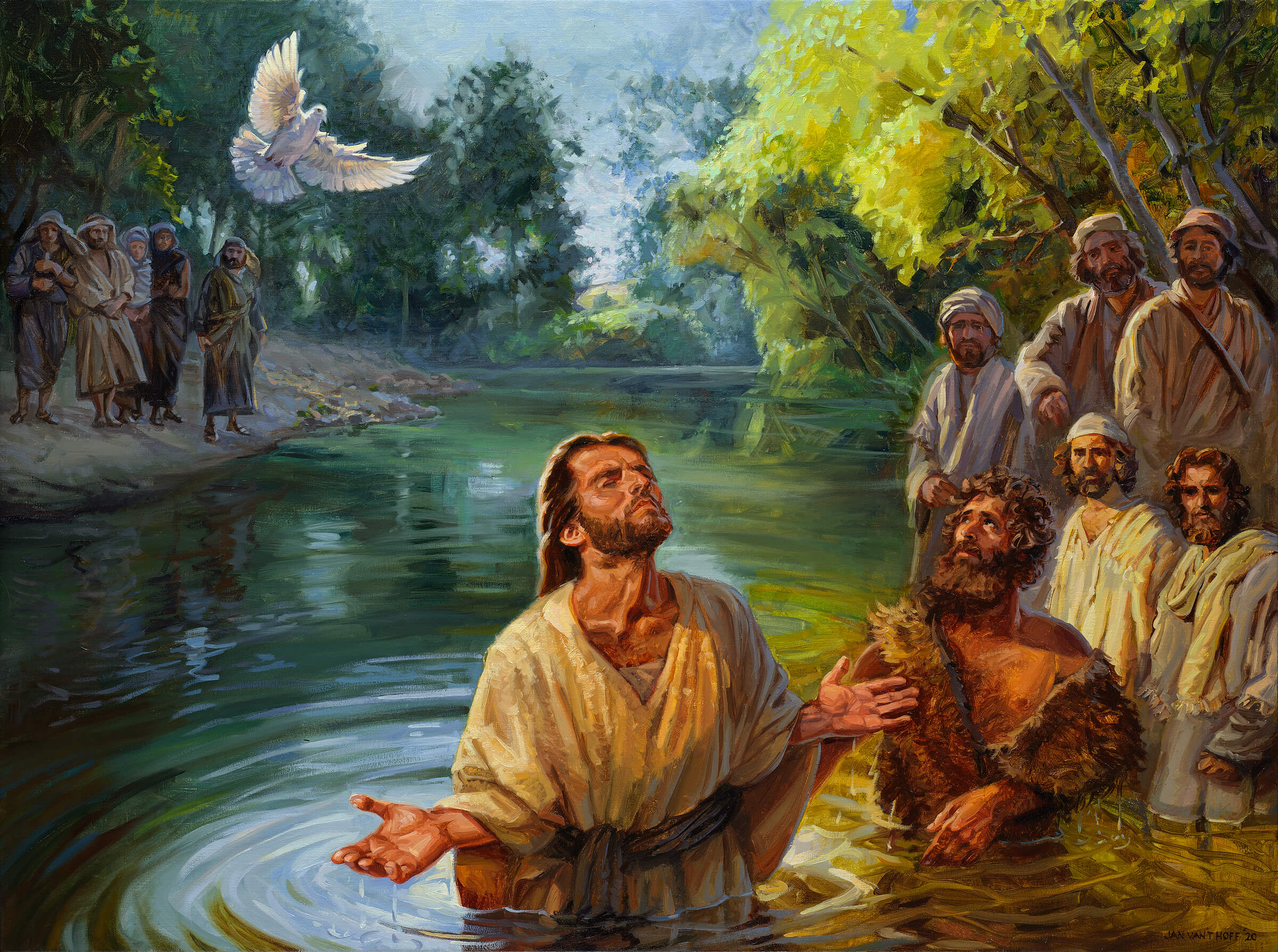
John the Evangelist is widely presumed to have been the unnamed disciple of John the Baptist who was with Andrew the First Called when they witnessed Christ’s baptism. John tells us that the day after Jesus was baptized, Jesus was walking along the Jordan River and John the Baptist proclaimed: “Behold! The Lamb of God who takes away the sins of the worldJohn 1:29!” and that Andrew (and his associate John) then began to follow Jesus, instead of John the BaptistJohn 1:37-40.
Andrew (and John) went and found Andrew’s brother Simon to tell him that he had found the promised Messiah, who was Jesus of Nazareth and to bid Simon to come and meet him. Jesus renamed Simon as Cephas (Aramaic for the stone or rock, the Latin of which is Petra, and hence Simon-Peter.
John and his brother James the Greater (meaning the taller or the older), were also the Sons of Johan (Bar-Johan). So the four Galilean fishermen, Andrew, Simon, John and James, who were likely also commercial partners, were each called by Christ, and hence became his first four disciplesMark 3:14.
John Also Witnessed the Transfiguration of Christ
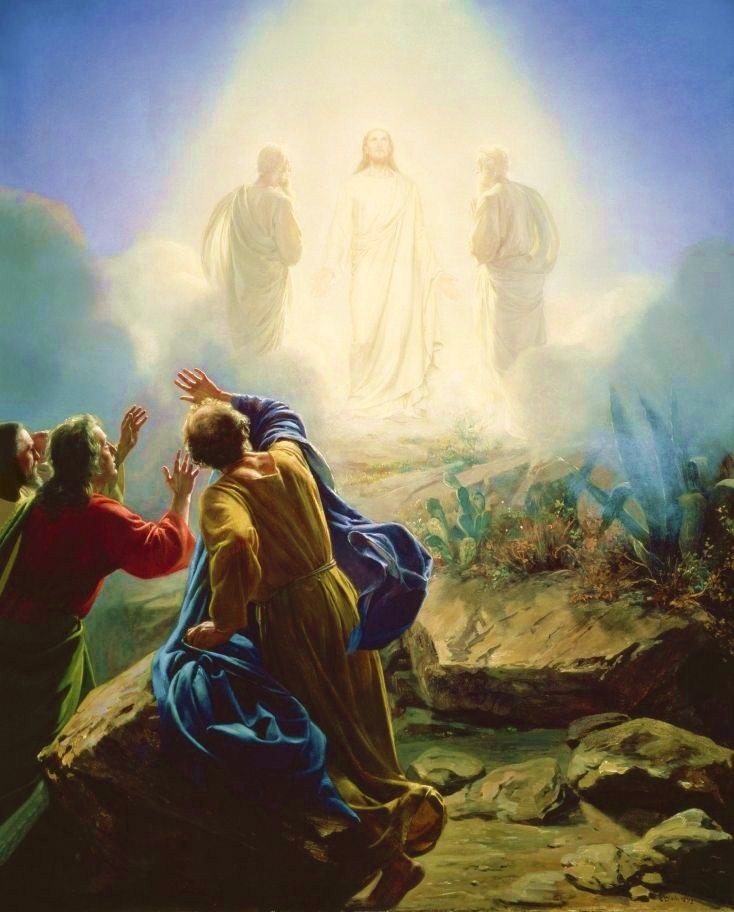
John, his brother James the Greater, and Simon-Peter comprised a sort of “inner circle” of Christ’s disciples. They were the three whom Jesus brought with him to witness the Transfiguration of Christ, one of numerous scriptural and Christian existential examples of “thin spots” between heaven and earth, where the visible and the invisible, the physical and the metaphysical coexist. These biblically mentioned thinspots are numerous in Scripture. John the Evangelist, James and Simon witnessed the divine illumination of Christ, Moses and Elijah in the “uncreated light” of The Shekinah Glory of the Son of GodMark 9:2-3.
It was also these three who Jesus invited to join him when he went to the house of Jairus, the ruler of the synagogue, and restored his dead daughter back to lifeLuke 8:49-54 & Mark 5:35-43.
It was these three, again, who Jesus took to pray with him in the Garden of Gethsemane, after he had instituted the sacrament of holy communion on the evening of Maundy Thursday, just prior to Christ’s arrest in the GardenMatthew 26:36-38.
The Writers of the Four Gospels were Referred to in the Ancient Church as Evangelists
John is also “the Evangelist” who wrote The Gospel According to John sometime between AD 40 and AD 60 or shortly thereafter. During that era John left Jerusalem and journeyed to the city of Ephesus, where he served as the first bishop of Ephesus. He was a direct eyewitness to each of the events he described in his Gospel. In the ancient church, the term evangelist (which was derived from the Latin word evangelium) was a reference to one of the writers of the four Gospels of Christ, which John certainly was. Much later, during the 16th century Reformation, the term was used to describe Martin Luther and his followers, the Lutherans, and today it connotes any Christian who wants to grow the church by recruiting converts to the faith.
John is Also the Author of Four Other Books Which are in the New Testament
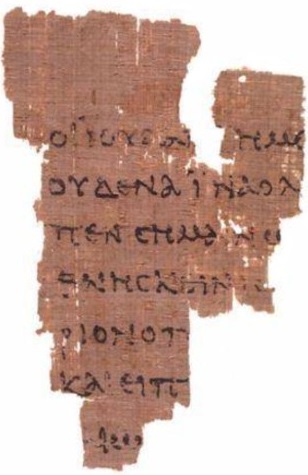
John was also the author of four additional books which were incorporated into the 27 books of the New Testament. Those four books include the Epistles of 1st John, 2nd John & 3rd John (written around AD 60), and the Book of Revelation (most likely written around AD 60 to 65 while John was exiled on the Island of Patmos). John’s final 4 books were each pastoral writings which he wrote to encourage the Christian believers in and around his diocese of western Anatolia (which is also known as Asia Minor, which is located in modern-day western Turkey). The Apostle John’s authorship of these writings was never disputed by the ancient, medieval, or post Reformation church. The modern disputation of John’s authorship of his Revelation has only in occurred the last 2 centuries. The dispute by these gnostic nay-sayers and “pseudo-scholars” has cast flimsy and unfounded aspersions on John’s authorship of these books.
Incidentally, the canon of the New Testament was not formally agreed upon by the one, holy, universal, and apostolic church until the middle of the 4th century, and it was not officially established by the Patristic Fathers of the church as the New Testament until very late in the 4th century. Prior to that the authority of the church was based on the testimony of the Apostles and their duly appointed apostolic successors, the Bishops of the church.
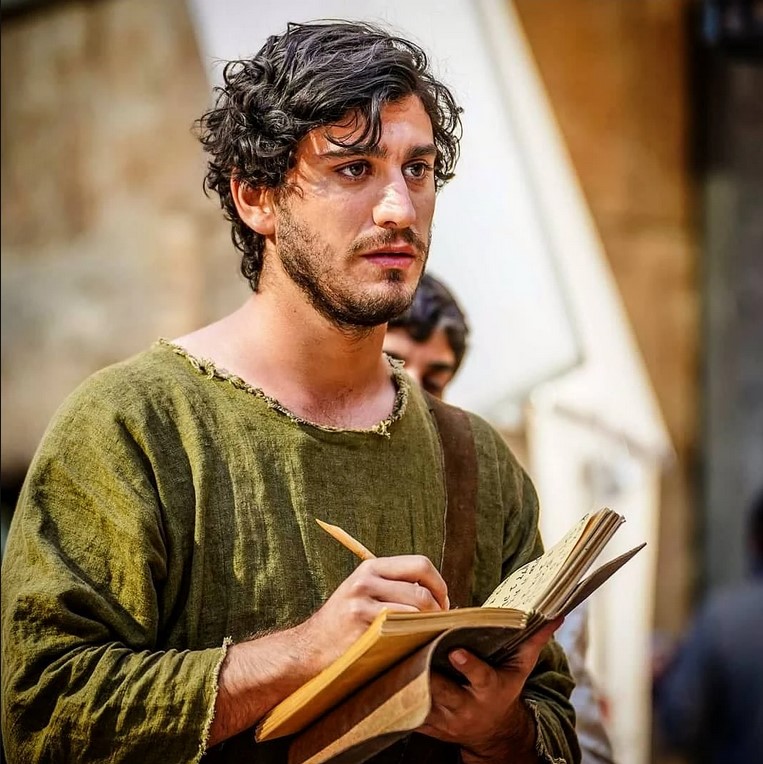
John is also Considered to be One of the Three Preeminent Theologians of Christianity
John the Son of Zebedee is also the first of the three men that the Eastern Orthodox church considers the “preeminent theologians” of the Christian faith. The other two are Saint Gregory of Nazianzus, AD 329 to 390 and Saint Symeon the New Theologian, AD 949 to 1022.
John, “the disciple that Jesus loved,” was at the foot of the cross with the Virgin Mary when Christ was crucified. John was ordered by Christ to become Mary’s guardianJohn 19:26-27, and he provided for her well-being for the rest of her earthly life. Sometime around AD 38, John went to the coastal port city of Ephesus (in Asia Minor) with the Virgin Mary, the mother of Christ, and, he became the bishop of the nascent church in that region and beyond. John served, taught, demonstrated, discipled and mentored in that region for some 60 years.
John’s Prolonged and Extensive Discipleship of his Successors is an example of the Full Meaning of Apostolic Succession
When John was older, he discipled the young Polycarp of Smyrna (AD 69 to 155), who became the Bishop of Smyrna. This was important because Polycarp was able to carry and transmit John’s teachings and understanding of the faith which John had taught him to the next generation of Christians in that region.
The mature Polycarp followed John’s example when he taught and discipled Irenæus of Lugdunum in Gaul (now Lyon, France), passing onto him stories about what John was really like, and John’s understanding of who Christ was and what He had done for mankind. Irenæus was born in Smyrna and after being discipled and then ordained he moved to the important crossroads city of Lugdunum in Gaul. In Irenæus’s Against the Heretics, he relates how Polycarp told him a story of John’s days in Ephesus:
“John, the disciple of the Lord, going to bathe at Ephesus, and perceiving Cerinthus [the heretic] within, rushed out of the bathhouse without bathing, exclaiming, ‘Let us fly, lest even the bathhouse fall down, because Cerinthus, the enemy of the truth, is within.’ ”
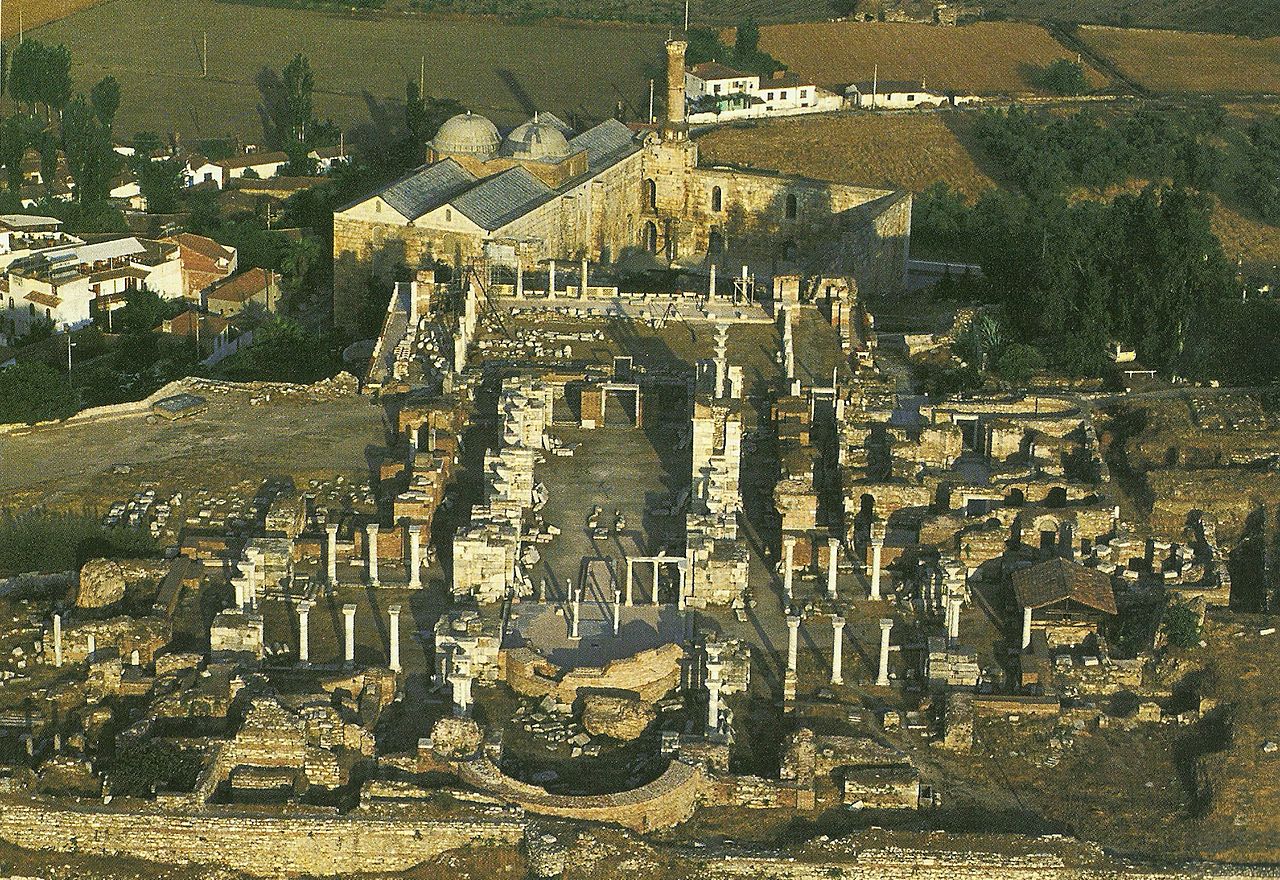
Irenæus, in his turn, discipled Hippolytus of Rome (AD 170 to 235), who was influential in establishing and maintaining Christian orthodoxy in the politically corrupt, divisive and sometimes doctrinally confused third century capital of the Roman Empire. The extensive training and discipleship these Patristic Fathers received from their mentors is an excellent example of the full depth of meaning of the concept of the apostolic succession of the church.
The Iconography and Symbolism of the Church’s Four Evangelists
As mentioned above, John is one of the four evangelists (with Matthew, Mark, and Luke). The epithet “evangelist” is the ancient Christian description used the describe a writer of one of the Gospels of Christ. Because the four Gospel writers were considered to the four supporters of the truth of the life of Christ they were considered to be like the four holy cherubim in heaven who support the throne of God. These many-eyed cherubim are described in Ezekiel 1:2-10 and in Revelations 4:7-9.
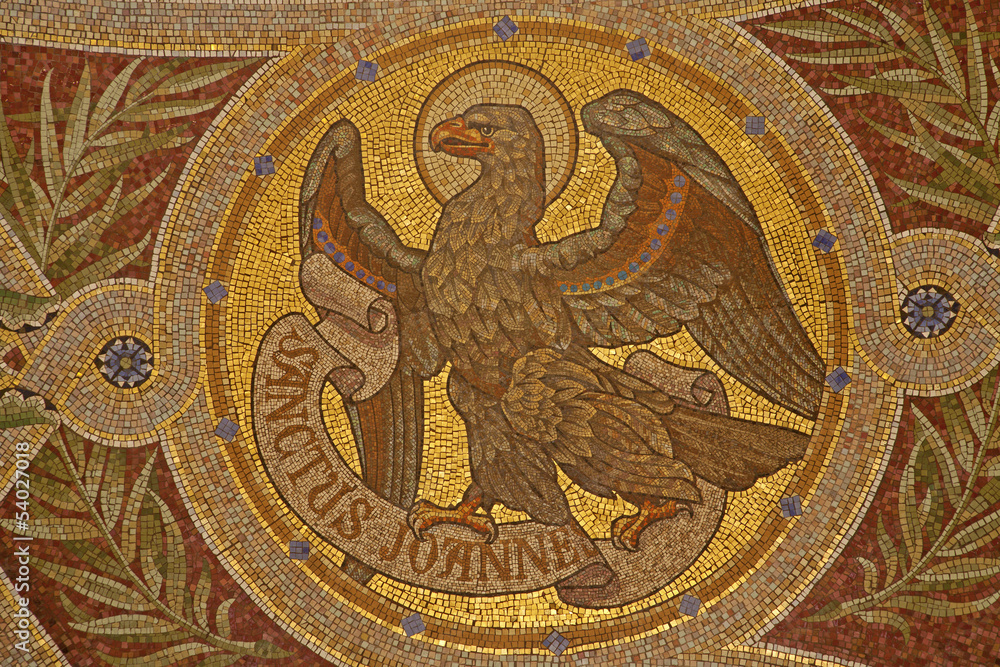
Many of the ancient and medieval Christian artists rendering the four evangelists depicted them as “the four living creatures” which support and protect the throne of Christ in heaven, the glory seat of God.
John is symbolized as the eagle along with Matthew; who is shown as a winged man or angel; Mark, who is shown as the winged lion; and Luke who is shown as a winged ox.
John’s Arrest and Unsuccessful Persecution
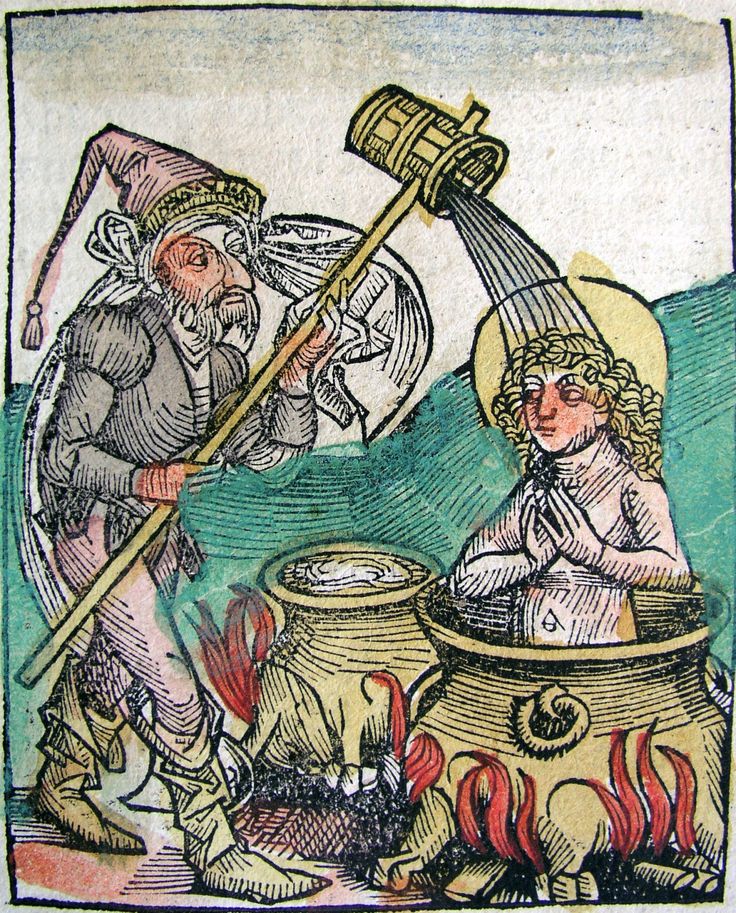
According to Tertullian of Carthage in his The Prescription of Heretics, written around AD 95, the aging John was arrested and taken to Rome, where the Emperor Titus Flavius Domitian (the Christian persecutor who ruled the empire from AD 81 until 96) had John plunged into a caldron boiling oil in front of thousands of Roman citizens present in the Colosseum that day. John emerged from the boiling oil unharmed, and according to Tertullian, everyone in the Colosseum that day converted to Christianity after witnessing the amazing event.
John’s Ironic Exile to the Roman Prison Island of Patmos
At some point, John was also banished to the Greek island of Patmos, which is located in the Aegean Sea, not far from the port City of Ephesus. John’s exile may have been under the order of the Roman Governor Asia during the persecutions of the Emperor Nero, which occurred after he had started the Great Fire of Rome in AD 64. Nero reigned from AD 54 to AD 68. Less likely, but still academically popular and plausible, is the possibility that John’s exile to Patmos occurred as a result of the Christian persecutions which occurred during the reign of the Christian-hating Emperor Domitian who ruled from AD 81 to AD 96.
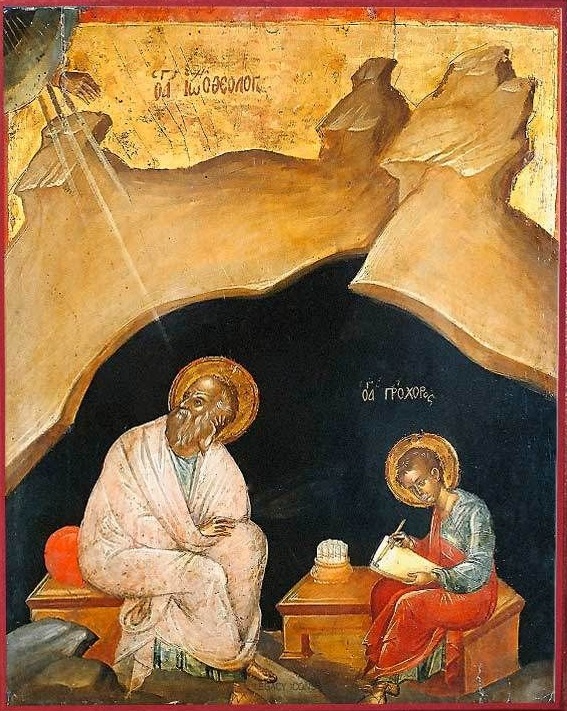
Ironically whichever emperor it was meant John’s exile for evil, but God used it for good. John’s exile on Patmos gave him a welcome break from his administrative and pastoral duties as the Bishop of Ephesus, which allowed him undistracted time to worship and enjoy God and to write the Book of Revelation. After the death of his persecutor (and John’s completion of his final book), John’s exile was reversed and John returned from Patmos to Ephesus and resumed his pastoral work there. In Orthodox icons John is often depicted dictating the Book of Revelation to his scribe Prochorus.
The Apostle John Died of Natural Causes Around AD 98
John lived to an old age, and he died sometime around AD 98 in Ephesus. Despite the Emperor Domitian’s rather dramatic attempt to martyr John (and a few later and probably spurious reports of John’s having actually been martyred) he almost certainly died of natural causes. Saint John outlived the all the other apostles and he was the only apostle who did not die a martyr’s death.
It is traditionally believed that John was the youngest of the apostles and that he survived all of them.