

During the Big Flash (more commonly known as the Big Bang) an essentially infinite amount of energy was concentrated in a single point location in the cosmos. This physically impossible and unstable pre-condition immediately began to expand; that is to say that it exploded with phenomenal amount of force.
The first physical matter (subatomic particles) to condense out of this super-concentrated energy condition are thought to have appeared 1 microsecond into the cooling expansion process. Atomic nuclei (initially, lone protons) are thought to have appeared after about 3 minutes of cooling and expansion.
These primordial nuclei, the first chemical elements of the universe were primarily hydrogen, helium, and lithium. Those elements are the three lightest and simplest elements on the periodic table. Element numbers 1, 2, & 3, which are characterized by the fact that they have 1, 2, and 3 protons in their nuclei respectively. To this day they are the most common elements in the universe.
At first the physical matter in the cosmos was somewhat evenly distributed as cosmic gas and dust particles formed from these primordial elements.
Over the ensuing time period, gravitational forces acting on the gaseous “dust” caused it form into clumps or areas of concentrated dust known as cosmic dust clouds.
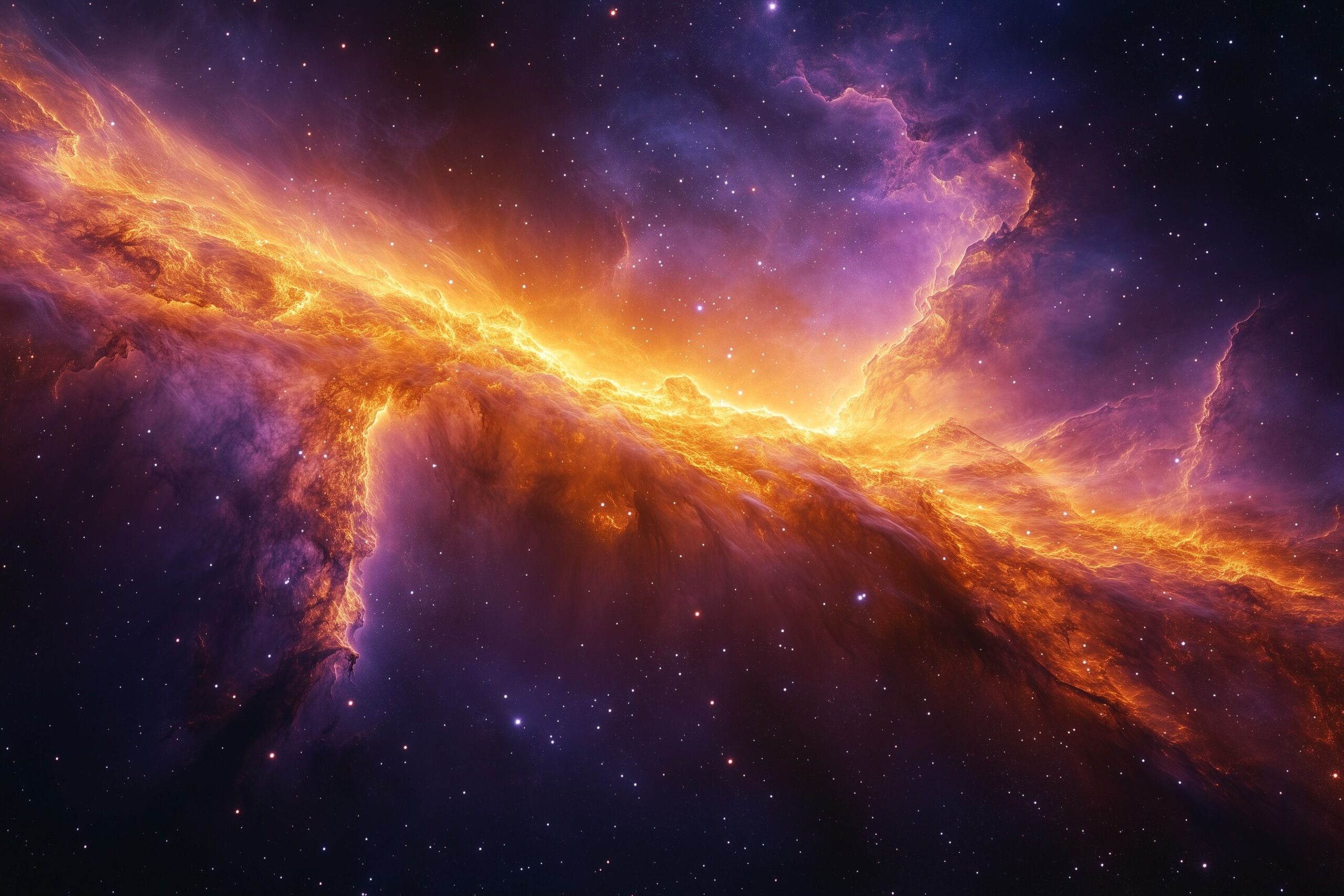
Nebulae – Dense Cosmic Dust Clouds are the Nurseries of Stellar Formation:
The continued gravitational accretion of these cosmic dust clouds allowed them to produce concentrations of physical matter that were large enough that by sometime around 300,000 years after the Big Bang singularity the process of stellar formation was able to begin.
Nebula is the Latin word for cloud, or fog. The plural of nebula is nebulae. Nebulae are a distinctly luminescent part of interstellar medium. They consist of ionized, neutral, or molecular hydrogen and other forms of cosmic dust. Nebulae are often star-forming regions, such as the Pillars of Creation in the Eagle Nebula. In these regions, the formations of gas, dust, and other materials “clump” together to form denser regions, which attract further matter and eventually become dense enough to form stars. The specific nebula in which the Sun and its Solar System formed is called the Solar Nebula.
Protostar – The Second Phase of Stellar Formation:
Protostars are formed from giant molecular clouds (nebulae), which are vast regions of interstellar gas and dust. These clouds are primarily composed of hydrogen and helium, the two most abundant elements in the universe. When a region of a molecular cloud becomes dense enough, gravity begins to pull the gas and dust together, forming a protostar.
The stellar formation phase begins when a molecular cloud fragment first collapses under the force of self-gravity and an opaque, pressure-supported dense core forms inside the collapsing fragment. It ends when the infalling gas is depleted, beginning a pre-main-sequence star.
As the pre-main-sequence protostar continues to acquire mass, its core temperature increases, eventually reaching temperatures high enough to initiate nuclear fusion in a few locations within the dense core. The initiation of nuclear fusion is the Real Big Bang which is the beginning of stellar formation. Star-forming nebulae have a gaseous medium for sound to travel through so it this a true “Big Bang,” unlike the mediumless space around the energy concentration of the Big Flash (that is the so-called Big Bang Singularity) which would not actually have made any sound.
Initially the nuclear fusion process is somewhat patchy during this nascent phase of stellar development. Once the ignition of nuclear fusion has begun the infant star formed is said to have been born. Our Sun’s birthday is thought to have occurred around 4.567 Ga (billion years ago).
At this point in its development the newly forming and erratically burning star is called a T Tauri Star, as the first such newborn star was observed in the constellation Taurus. This fusion process releases energy in the form of light and heat, causing the protostar to shine brightly. At this point, the protostar has officially become a young star.
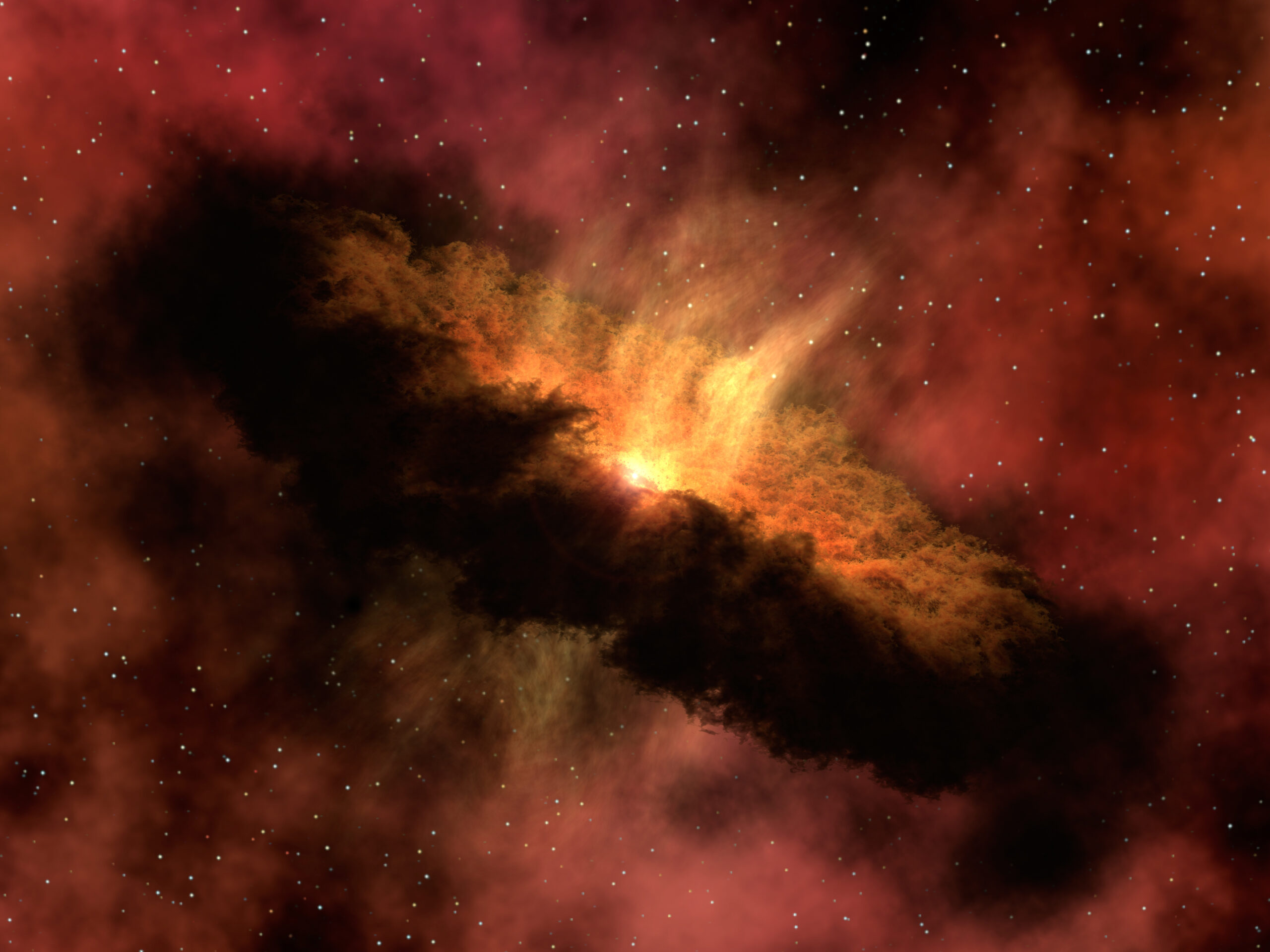
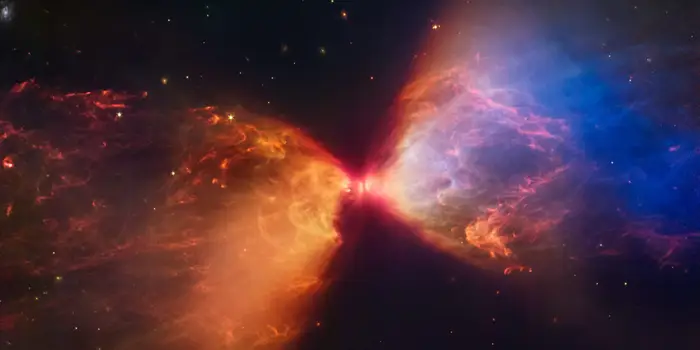
Protostars are considered to be in their infancy, as they are still in the process of accumulating mass and developing into a fully-fledged star. The nuclear fusion process gradually becomes generalized throughout the core mass of the T Tauri star, so the fusion process becomes a fully stable process.
As a protostar continues to accrete mass and undergo nuclear fusion, it gradually evolves into a main-sequence star, like our sun. The duration of the protostar stage varies depending on the mass of the star, with more massive stars forming and evolving more quickly than their lower-mass counterparts.
Protostars are rotating masses. They have been observed to have accretion disks and jets or outflows from their poles (which cause their hourglass appearance). The accretion disk is blown away when the protostar becomes a more stable main sequence star. The outflows created by the three components are not well understood.
During the protostar stage, the star’s luminosity and temperature increase as it gains mass and energy from the matter in the surrounding equatorial disk. Eventually, the protostar reaches a point where the pressure and temperature in its core are high enough to sustain a steady nuclear fusion reaction process.
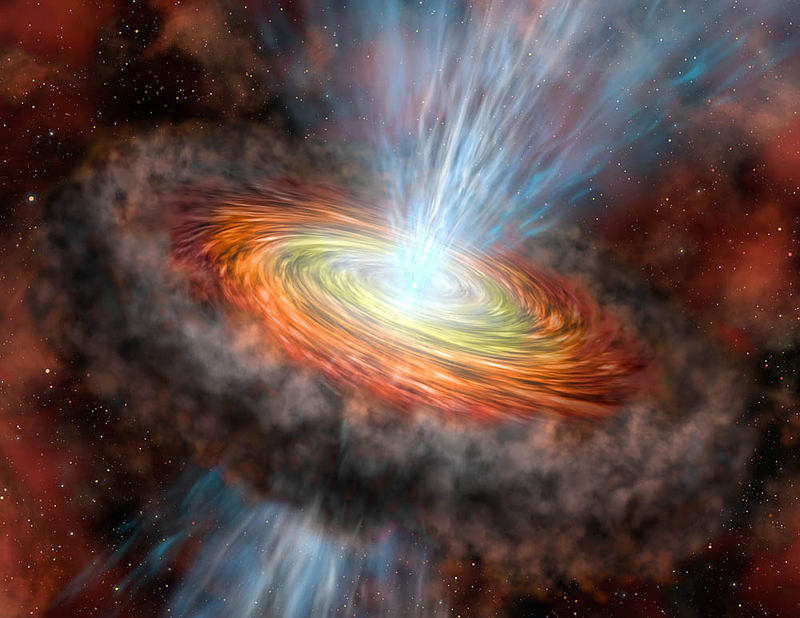
At this point, the protostar becomes a main-sequence star and enters a stable phase of hydrogen burning.
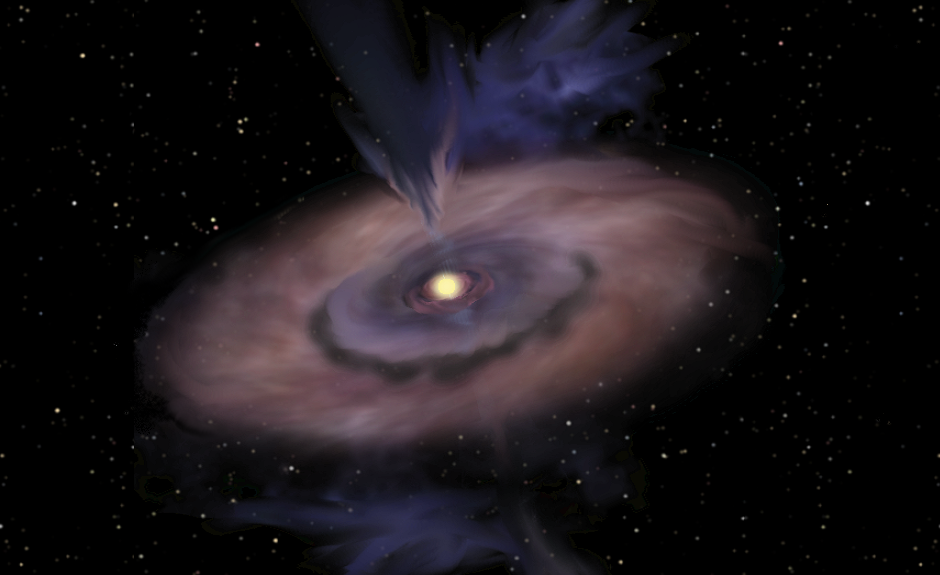
A protostar is a very young star that is still gathering mass from its parent molecular cloud. It is a phase in the process of stellar evolution. For a relatively low mass star, like our sun, this phase lasts around 500,000 years.
Protostars are only modestly larger than main-sequence stars of the same mass.
This process was first suggested by Chushiro Hayashi, a Japanese astrophysicist, in 1966. He was born in Kyoto and enrolled at the Tokyo Imperial University (now the UTokyo) in 1940. He earning his Bachelor of Science degree in Physics after just 2½ years. He was then conscripted into the Imperial Japanese Navy. After the war ended, he joined the group of Hideki Yukawa at Kyoto University. He was appointed a professor at Kyoto University in 1957.
Main-Sequence Star – Our Sun Is in This Phase of Stellar Evolution:
When the protostar phase becomes a stably burning star then a true star has been born. Our sun is an example of such a star.
Main-sequence stars continue to go through additional phases as they progress. When nuclear fusion of hydrogen becomes the dominant energy production process and the excess energy gained from gravitational contraction has been lost, the star progresses along a curve on the Hertzsprung–Russell diagram (or HR diagram) called the standard main sequence.
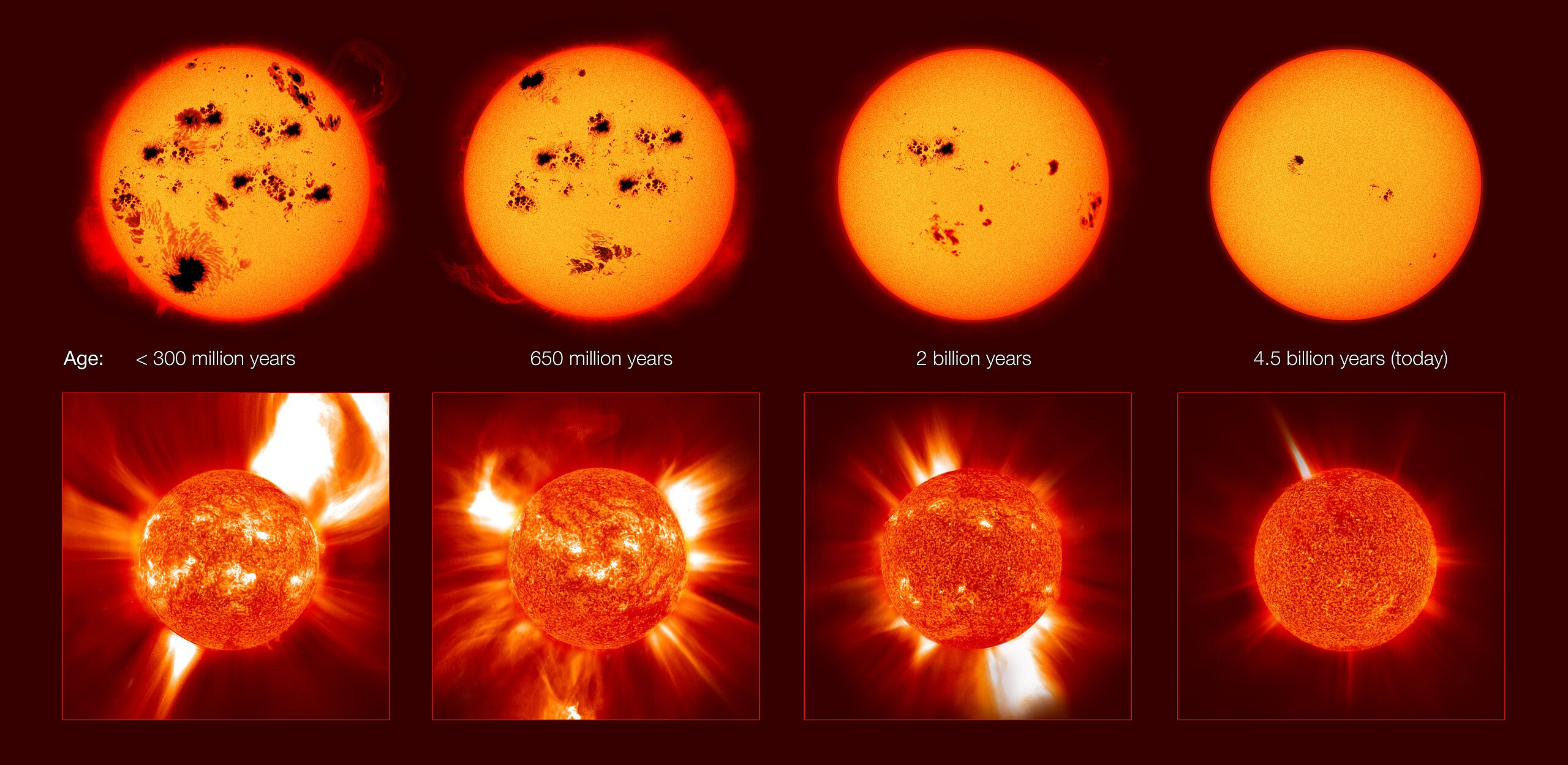
Our sun’s youth was quite violent, as the diagram below illustrates.
The Structure of our Sun:
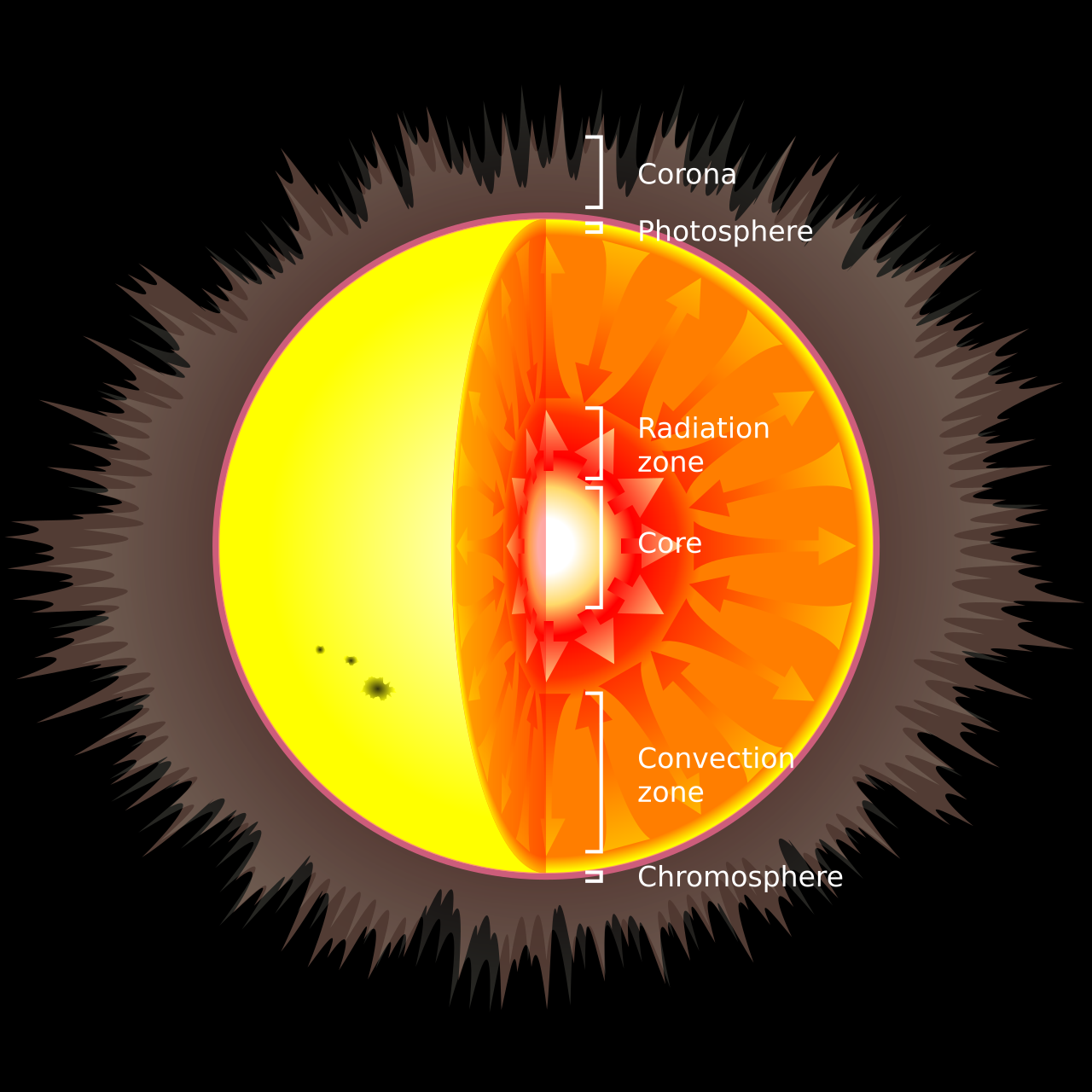
Because there is a temperature difference between the core and the surface, or photosphere, energy is transported outward. The two modes for transporting this energy are radiation and convection. A radiation zone, where energy is transported by radiation, is stable against convection and there is very little mixing of the plasma. By contrast, in a convection zone the energy is transported by bulk movement of plasma, with hotter material rising and cooler material descending toward the solar center. Convection is a more efficient mode for carrying energy than radiation, but it will only occur under conditions that create a steep temperature gradient.
Conclusions:
I would like to make clear that all the processes described in this post occurred as a result of routine and generally well understood and testable physics. While there has been a considerable amount of deduction required to put this scientific narrative together, no real Kierkegaardian leaps of faith are required to believe the truth of it all. This is utterly unlike the attempts to explain the pre-condition state which proceeds the Big Flash (the big bang singularity) which cannot be understood without invoking such a Kierkegaardian type leap of faith. [See the: The Big Flash – The Divine Creation of the Cosmos linked below.]
Amazing and marvelous as this story is, all the existing evidence supports the truth of these conclusions. The divine creation of the cosmos was not a quick event.