As described by the early church fathers at the ecumenical councils of Nicaea and Constantinople (AD 325 & 381 respectively) in the Nicene Creed:
“I Believe in one God the Father Almighty, Maker of heaven and earth, And of all things visible and invisible:
And in one Lord Jesus Christ, the only-begotten Son of God; Begotten of his Father before all worlds, God of God, Light of Light, Very God of very God; Begotten, not made; Being of one substance with the Father . . .”
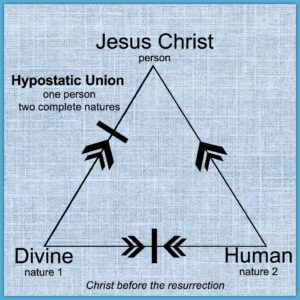
By the conclusion of the 4th Ecumenical Council, held at Chalcedon, just across the Bosporus Strait from Constantinople in AD 451, the concept of the twin natures of Jesus Christ’s divine incarnation (that is of His hypostatic union) was understood to be:
“Christ is the eternal Son of God made known in two natures without confusion (i.e. without the two natures somehow combining), without change, without division, without separation, the difference of the natures being by no means removed because of the union, but the property of each nature being preserved and coalescing in one person and one hypostasis [substance] – not parted or divided into two persons, [i.e. two hypostases], but one and the same Son, the only-begotten, divine Word, the Lord Jesus Christ.”
In other words, Jesus Christ is a hypostatic union of the man Jesus and the Son of God, the Christ. The hypostatic union is a Christian theological term that describes the union of Jesus Christ’s divine and human natures in one person. It means that Jesus is fully God and fully man at the same time, maintaining two distinct natures without confusion or separation in one person.
Why The Dual Natures of Christ Matters:
As the early church father Athanasius of Alexander clarified for the Christian church in his adroit and eloquent On the Incarnation, the atoning death of the sinless human person, Jesus required that He be a man like us, able to sin, but one who did not sin, and hence a person worthy of atoning for all the sins of all people past, present, and future. This was a necessary prerequisite for His atonement to have been valid before God.
However it also required that the Son of God, the Christ, the creator of the cosmos, condescend to the shame of being made a mere man, who would be tainted by all the world’s sins. That explains why a son of man, Jesus had to be combined with the Son of God, the Christ (without a co-mingling of their individual natures) to be Jesus Christ.
Of course the Son of God was also the second person of the Holy Trinity, the Father, the Son, and the Holy Ghost. On one level Christians can describe this relationship but on another level, I don’t think any of us actually fully understand it.