
The Strong Land Army vs. the Strong Naval Force – The Prelude to the First Punic War
In the middle of the 3rd century before Christ, the two great powers in the western Mediterranean were the growing Roman Republic and the growing Carthaginian Empire. In the area of maritime skills and experience the Roman Republic was utterly outmatched by those of Rome’s southern neighbor, the Carthaginians. The modern-day city of Tunisia is founded near the location of the ancient city of Carthage. Initially, there was no chance that the Romans would prevail in a naval battle against the mighty Carthaginian Navy.
Simply put, the growing Roman Republic was a respected and accomplished land power and Carthage was a commercially accomplished sea power which was standing on the shoulders of its ancestors, the ancient founders of Carthage, the Phoenicians. The Latin word for Phoenicia is Punicus, hence the Romans would refer to this conflict as The Punic War. The Carthaginian Empire was based on their skills as commercial maritime traders, while the strength of the Roman empire was based on the territorial acquisitions of their land-based army.
The Heritage of the Carthaginian Empire
Various Phoenician city-states had been sailing on the Mediterranean, Aegean, and Black Seas since the end of the Late Bronze Age Collapse around 1170 BC. Along with their Greek city-state counterparts they had established numerous outposts along the shores of those bodies of water.
The Phoenician (Lebanese) king of the city-state of Tyre had worked with the Ancient Israeli King David to construct a port on the Red Sea for him, called Ezion-Geber (the modern-day port of Aqaba). He had also supplied David with Lebanese Cedar Trees for the wood he needed for his ship-building program. The king of Tyre had also subsequently worked with King Solomon in similar endeavors including providing Solomon with a particularly skilled Lebanese Bronze casting workcrew to make the massive 52 foot tall twin pillars named Jachin and Boaz(2 Chronicles 3:15-17) which supported of the front of the Temple of Solomon(see 1 Kings 9:26).
The Phoenicians had been sending trading fleets to circumnavigate the continent of Africa since at least 600 BC. Carthage had originally been founded as a Phoenician outpost in the western Mediterranean to receive their African circumnavigation fleets when they returned into the western Mediterranean.
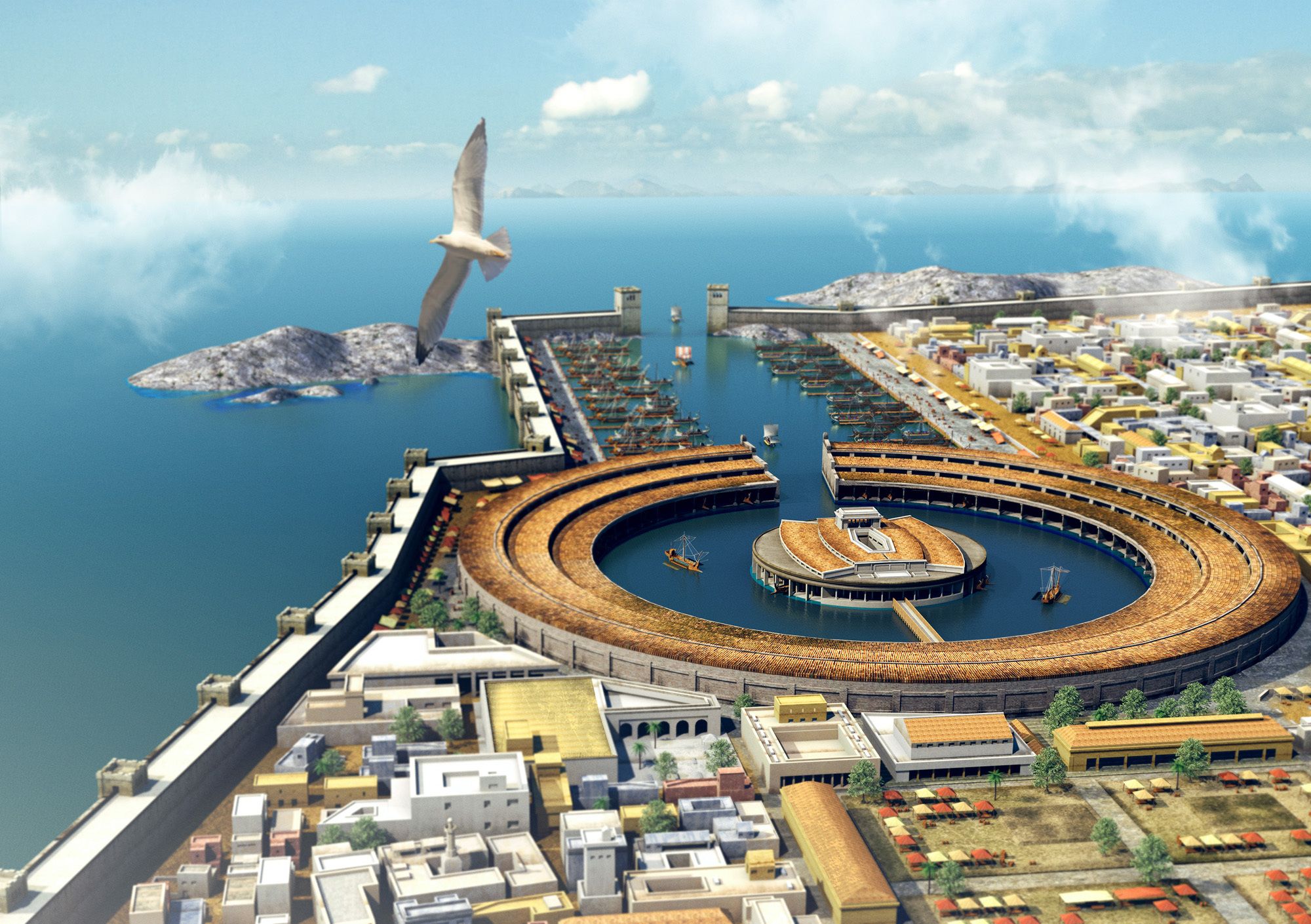
The Ancient seaport at Carthage had been constructed in two huge sections. The outer commercial port known as the Salammbo and it opened directly onto the Mediterranean. The entrance to the far less accessible inner port was from the Salammbo and it was barred by a heavy chain across the its entrance. The inner port housed and protected the warships of the Carthaginian city-state’s Navy.
Suffice it to say Carthage’s maritime heritage was rich and deeply experienced.
The Rise of the Roman Republic
According to the much later Roman historian Marcus Terentius Varro (who lived from 116 to 27 BC) the Roman Republic was born in 509 BC, when four Roman aristocrats plotted a coup d’etat and overthrew the 7th and last king of Rome. They founded a republic which was to be governed by a Curia. The Curiate Assembly was comprised of representatives from the 30 founding “clans” of the city of Rome. The Curia was the forerunner of the later Roman Senate.
The Curia fashioned itself as “the voice of the people,” and it appointed two individuals to the executive office it oversaw, the offices of the consuls of Rome. The consuls handled the day-to-day business of governing the republic. Each consul would serve for a limited term of one year. Either consul could overrule a decree of the other by declaring a veto of the first consul’s proclamation.
In case of an emergency situation the curia could appoint a time limited dictator to handle the emergency. The dictator’s authority was absolute; however his rule would end when the specific emergency he was appointed to handle had been dealt with.
This structure was considered to be an improvement on the Greek concept of a democracy in which all the citizens have to vote on every issue at hand. It was lauded as being more stable and yet more decisive than a democracy.
In 450 BC, the Curia established the rule of law in the republic by approving the Twelve Tables which became the 12 fundamental principles of Roman law. The Roman Republic was a stable and generally prosperous city-state situated on the seven hills of the modest city of Rome, until it encountered an unexpected disaster.
Suddenly Everything Changes for the Peaceful City-State of the Roman Republic
In 390 BC the vulnerability of the republican city-state of Rome was demonstrated to Rome’s citizens when Rome was invaded, razed, plundered and burned by a large band of roving raiders, the Senone tribe of Gallic Celts. The Senone tribe was from somewhere to the north, most likely somewhere in the southern regions of modern-day France.
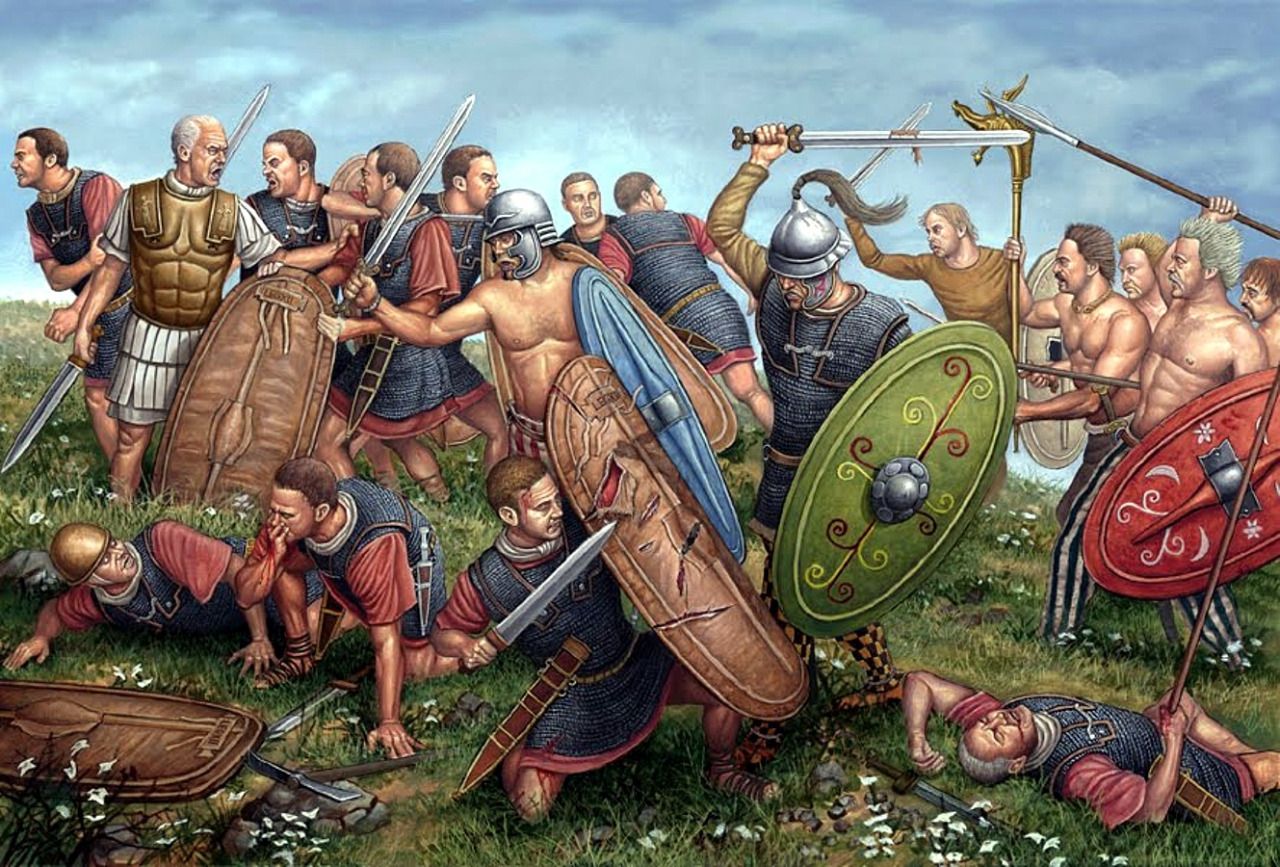
The otherwise well-organized Romans were profoundly disturbed by their defeat, and the sudden poverty which had descended upon them. They vowed that never again would they be the victims of such an attack. They built a huge thick wall around the city and they decided that every yeoman farmer and citizen in the republic had to acquire body armor and personal weapons for their defense, and they drilled and practiced fighting tactics regularly.
Soon the Romans were the most militarily competent force in their neighborhood. They established a colony downstream at the mouth of the Tiber River, which became the Roman sea port of Ostia, and they established salt-drying flats there to produce sea salt. However the Romans did not become sea faring mariners.
When the neighbors of the city of Rome engaged in tribal warfare, those neighbors would request Roman military assistance and it was provided to them. The Romans would thereby acquire the territory of the friendly neighbor they had “helped.” Their neighbors were given a diminished version of Roman citizenship.
These Roman half-citizens were granted the automatic future protection of Rome, and in turn, they enjoyed the privilege of paying Roman taxes and serving in Roman military legions anytime the Romans made the request or demand. The Roman half-citizens did not have the right to vote in Roman elections; that privilege was only allowed to the full citizens of Rome.
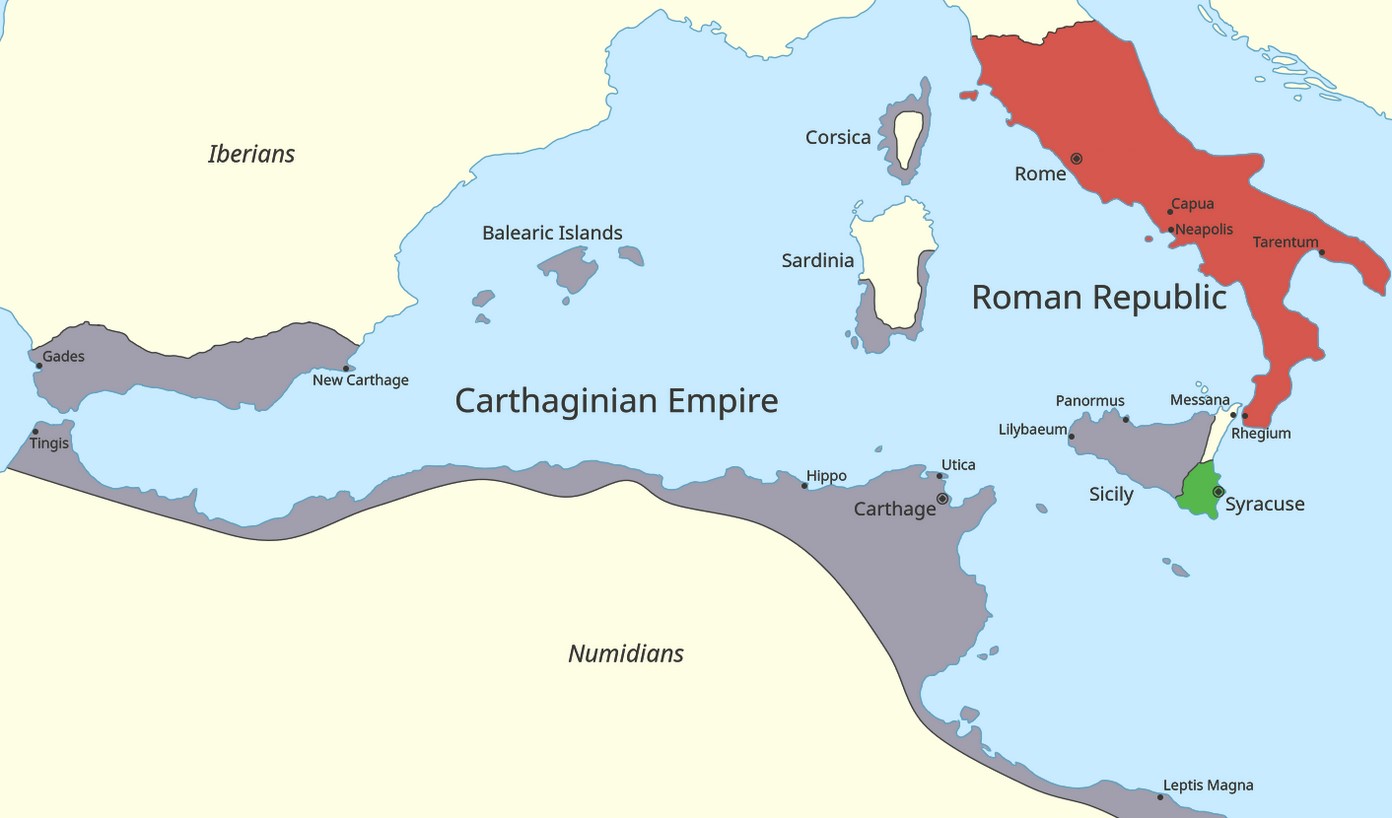
By the time of The First Punic War the Roman Republic was the military ruler of most of the modern-day Italian Peninsula as shown on the map below.
The Initial Rub Between Rome and Carthage was not a Direct One
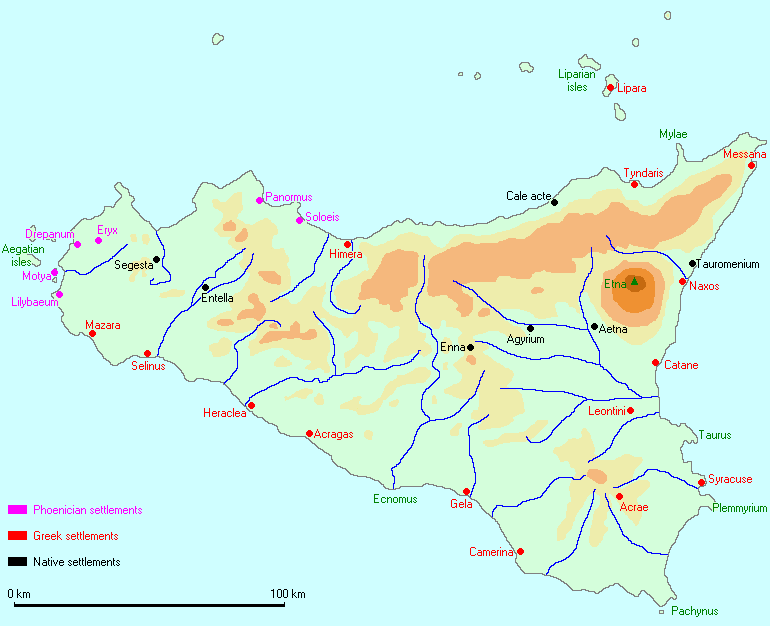
The problems began on the Island of Sicily which is, of course, located between Rome’s Italian peninsula and the city of Carthage.
Prior to the beginning of the 1st Punic War most of the cities on the island of Sicily were loyal allies and client states of the Carthaginian Empire. The great exception to this was the southeastern portion of the island which was controlled by the Greek city-state of Syracuse which was ruled by the Greek tyrant (king), Hiero-II. Syracuse was a centuries old adversary of Carthage.
History buffs will remember that the city of Syracuse (which was founded by the Corinthian Greeks in 733 BC) was the odd and foolish focus of The Peloponnesian War fought between Athens and the Greek city-states of the Athenian League and the Spartan led Peloponnesian League. As the Greek historian Thucydides tells us that war was fought between 431 and 404 BC.
The Peloponnesian War was greatly extended by the effect of the pesky Persian “archers.” The Persian coins featured a Persian archer on the obverse side of the coin. After the Peloponnesian War broke out the Persian emperor provided financial support to help whichever side was losing. As the war progressed the nefarious Persian financial support would oscillated back and forth, always going to the losing side.
After its failed invasion of mainland Greece in 480 BC, the Persian emperor considered it to be in Persia’s national interest to prolonged the war as long as possible. This behavior on Persia’s part also explains Alexander the Great‘s desire to attack and overthrow the Persian Empire in 334 and 333 BC.
In the end the prosperity of Greece was the actual looser of the war, thought technically the Spartans were the victors. The war ended the golden age of Greece, and Syracuse was essentially unharmed by it all.
The Rub of the Mamertine Pirates Became the Friction Which Lit the Fire of the First Punic War
The Mamertines enter this story as mercenaries who had been hired from their home in Campania (the region around the port of Naples on the Italian Peninsula) by the tyrant (king) of Syracuse, and self-proclaimed king of all of Sicily, Agathocles. He ruled Syracuse from 317 to 289 BC, and he hired the Mamertines sometime around 307 BC. When Agathocles died in 289 BC it left his Mamertine mercenaries idle and unemployed in Sicily. Many of them returned home; however the remainder were an independent military force (outlaw band) in Sicily.
In 288 the Mamertines invaded the city of Messina and seized control of it. After they took over the city, the mercenaries named themselves the Mamertines after the Oscan (Campanian) war-god Mamers.
Messina is just across the Strait of Messina from the toe of the boot of modern-day Italy. Hence Messina is gateway of all traffic passing from Sicily to Italy or vise-versa, and it can control the passage of maritime traffic through the narrow, less than 2 mile wide strait. The outlaw band of Mamertine mercenaries soon also became pirates and they who raided the vessels trying to pass through the straits.
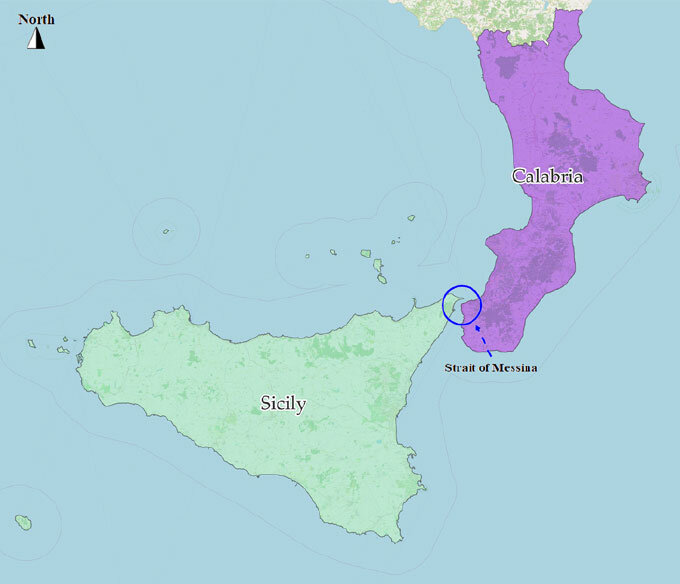
By 265 BC the Mamertine pirate-outlaws were being hard-pressed by the king of Syracuse. They appealed both to Rome and to Carthage for military assistance and protection from “Syracusian tyranny.” The Roman Senate could not decide. The Carthaginians chose to place a small garrison in Messina. After prolonged procrastination the Romans also decided to help the Mamertines.
In 264 the Roman general Appius Claudius Caudex led an army of 2 Roman Legions (a force of between 3 and 8 thousand men) to garrison Messina, and Mamertines excused the Carthaginian garrison and sent them home.
The following year both Roman Consuls led a force of 40,000 men in Sicily and besieged Syracuse which rapidly made peace with Rome and became a Roman ally. On land the Roman were a force to be reckoned with. The reverse was true at sea.
The Roman’s Design and Build a Fleet Equipped with Their New Secret Weapon – The Raven’s Beak
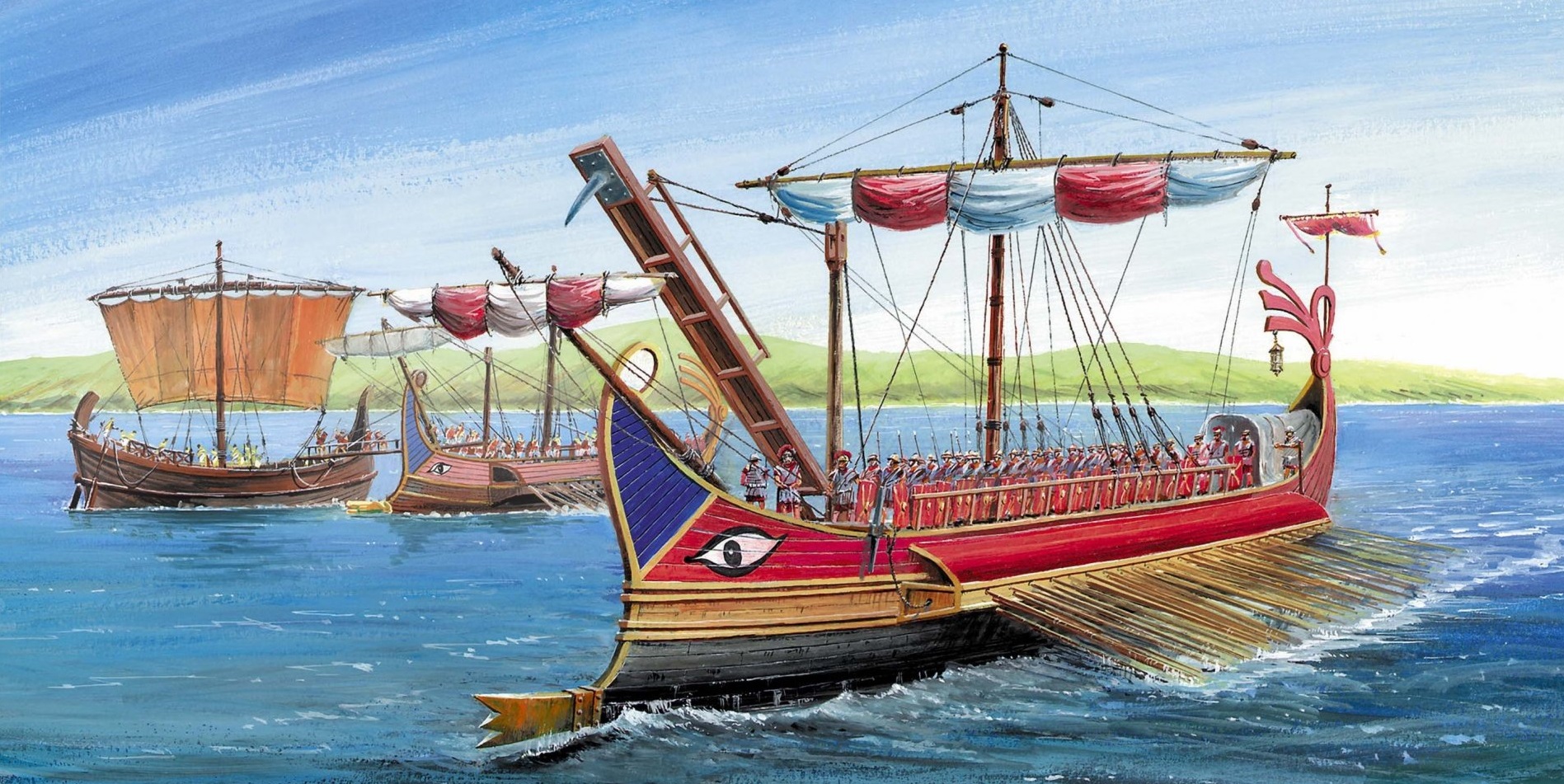
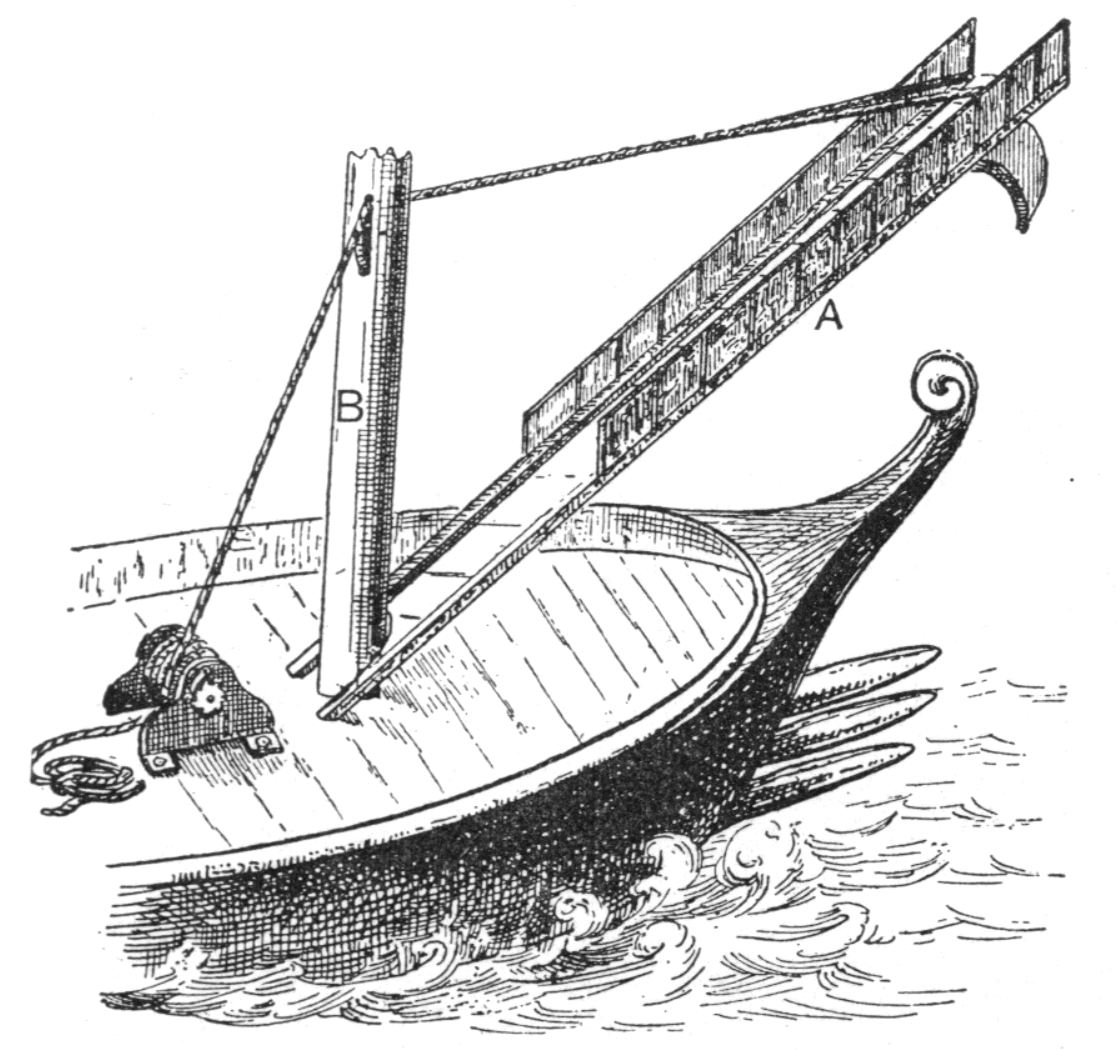
The Roman navy was not up to the standards of the Carthaginian mariners. The moment of brilliance for Rome occurred in 260 BC when someone associated with Consul Gnaeus Cornelius Scipio figured out how to convert a sea battle into a land battle. The Consul built a fleet of 120 Roman Quinqueremes (meaning 5 oarsmen), equipped with the Roman secret weapon, the Raven’s Beak or Corvus.
According to the Greek historian Polybius, the Roman corvus was a boarding ramp 4 feet wide and 36 feet long with a heavy iron spike on the bottom of it. When the ramp was dropped on the deck of the enemy ship it locked the two ships together, allowing the Roman marinus (the legionaries of the naval infantry) to board the enemy ship and fight hand-to-hand with the enemy crew.
Roman Mariners Triumph Decisively at The Battle of Mylae
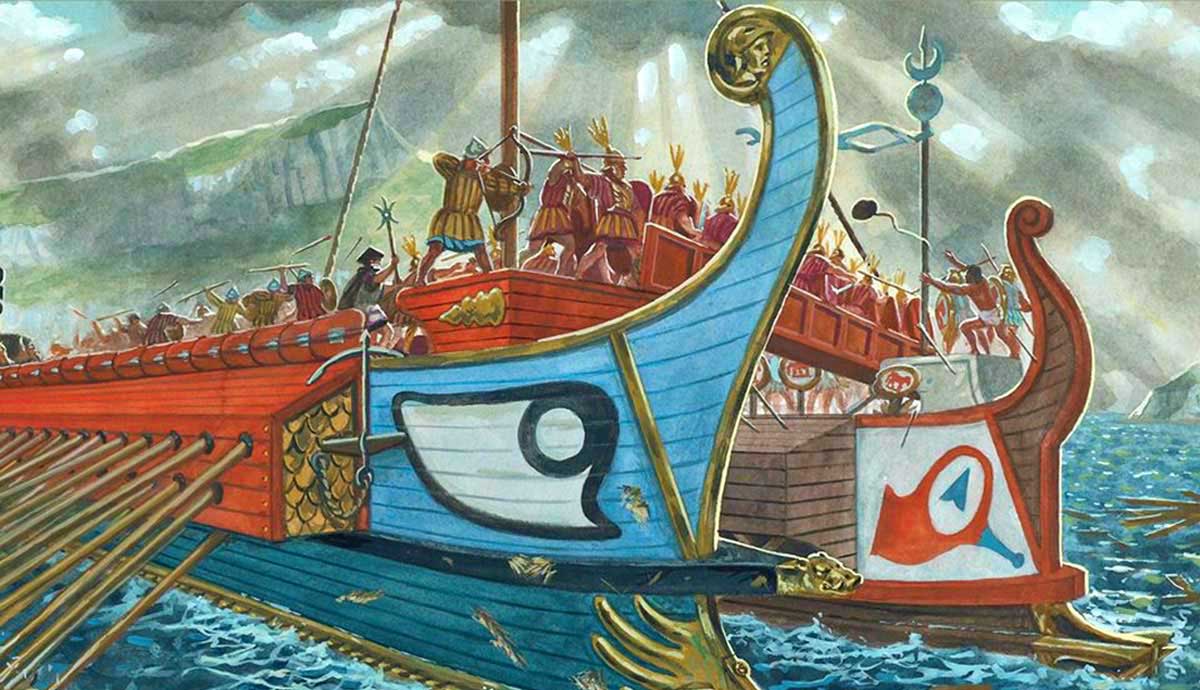
During the early summer of 260 BC the newly built Raven’s beak equipped Roman fleet of 120 ships, commanded by the Roman consul, Gaius Duilius, encountered the Carthaginian fleet of the same size commanded by Hannibal Gisco off the city of Mylae (modern-day Milazzo).
The first 30 Carthaginian ships led by Hannibal broke formation to close rapidly on what they thought would become their Roman victims. When they got into close quarters with the Roman ships the Roman dropped their boarding ramps and locked the Carthaginian ships in place. The Carthaginian ships were all captured. The Roman fleet was able to capture and board an additional 20 more ships, before the remainder of the Carthaginian’s fleet was able to escape. The Carthaginian Admiral Hannibal had to escape in a Carthaginian skiff.
The Raven’s Beak Became Standard Equipment on Roman Warships
For the next 250 years every Roman warship was corvus equipped.
For the next 19 years the Carthaginian army fought on in Sicily, but the Carthaginian Empire was not able to reliably resupply their troops on Sicily and eventually, in 241 BC the beleaguered Carthaginian army on Sicily negotiated a peace agreement with Rome and thereby ended the 26 year long First Punic War.
Eventually the Hand-Thrown Grappling Hook Replaced The Corvus
Around the same time Romans first deployed their Raven’s Beak innovation a second device was pioneered by the Roman for the same purpose, the Grappling Hook. Multiple grappling hooks could be thrown against then rigging of an enemy ship. The ensnared ship could be brought alongside the hull of the attacker ship, and the ship’s crews could jump across to the enemy ship and engage in hand-to-hand combat until one crews was in control of both ships.
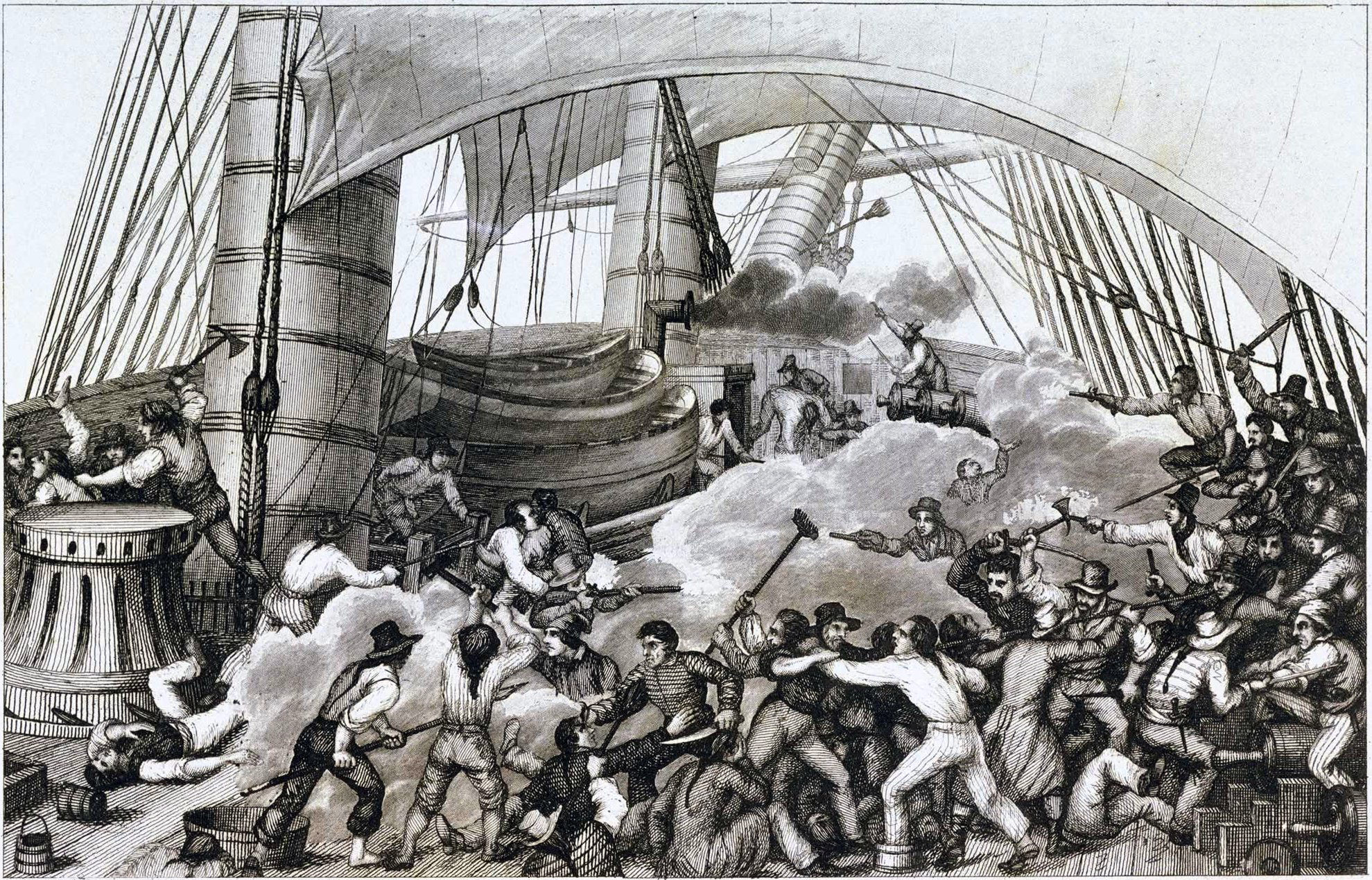
The last huge naval battle fought using this tactic was The Battle of Lepanto fought in 1571 in the Adriatic Sea, at the mouth of the Gulf of Corinthian. That battle was fought between the Holy League (comprised of ships and crews from the Roman Catholic states of Western Europe) against a similar force of ships and crews from the Ottoman Empire. Some 450 warship grappled together in what was essentially a gargantuan mat of floating mass of ships on which a land-style battle was fought using hand-to-hand combat to decide the outcome.
The grapple and board tactic of fighting sea battles continued until 1588 when the arrival of gunpowder, invented by the Chinese, allowed the development of naval artillery. It was only 17 years after the Battle of Lepanto that the English Privateers used the entirely new tactic of shipboard cannons firing broadsides at the enemy ships. The privateers would stay out of grappling range of the ships of the Spanish Armada and they instead used their cannons to try to damage the armada’s ships.