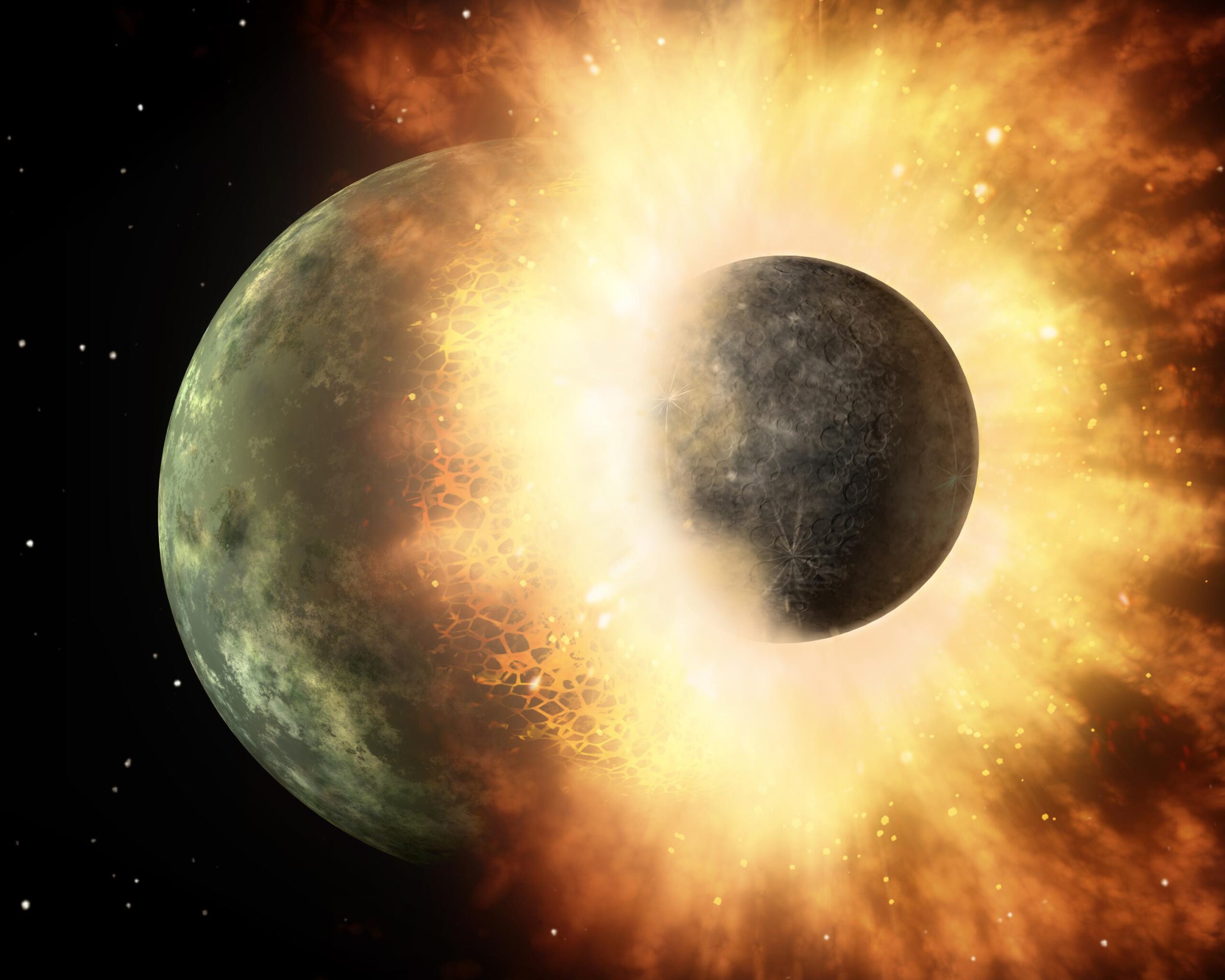
In the long fascinatingly complex and amazing story of the creation of the cosmos no event draws my imagination or makes me marvel quite as much as the story of the Big Splash: the creation of our moon.
The dense core of the solar nebula began igniting the nuclear fusion reaction which became the Sun some 4.567 Ga (billion years ago). The proto-Earth’s growing planetesimal appeared some 4.54 Ga. Shortly thereafter, around 4.53 Ga, an amazingly colossal planetesimal-to-planetesimal collision occurred.
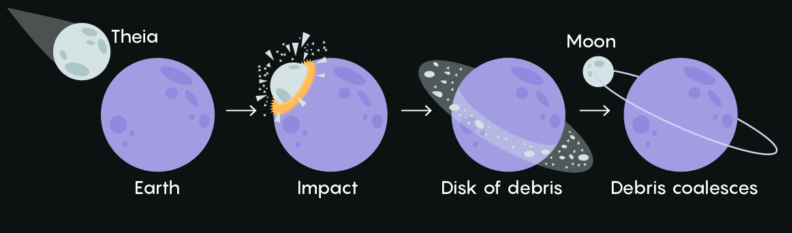
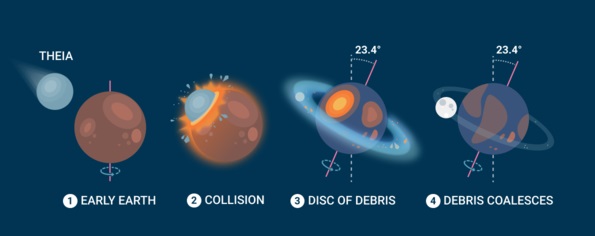
The larger Earth planetesimal (the forming early Earth) was struck by a somewhat smaller, Mars-sized, planetesimal which has been named Theia. This not quite a head on collision which resulted in a sort of fusion of the two celestial bodies.
So the three most remarkable events in the creation of our solar system were the Big Flash (the origin of the cosmos), an actual Big Bang (when the explosion of the sun igniting in its nuclear fusion reaction) and the Big Splash event when the moon was formed; there is a lot of drama involved in this creation thing.
All kidding aside, the remnant and now enlarged Earth was surrounded by an orbiting debris field of material from the Earth (splash debris) and also contained debris fragments from Theia. The planet Earth got most of its matter back after a period of time, but some of that matter collected into a second planetesimal circling Earth. A similar phenomenon explains the formation of the rings of the planet Saturn which never coalesced into a moon,but rather became “dust belts.”
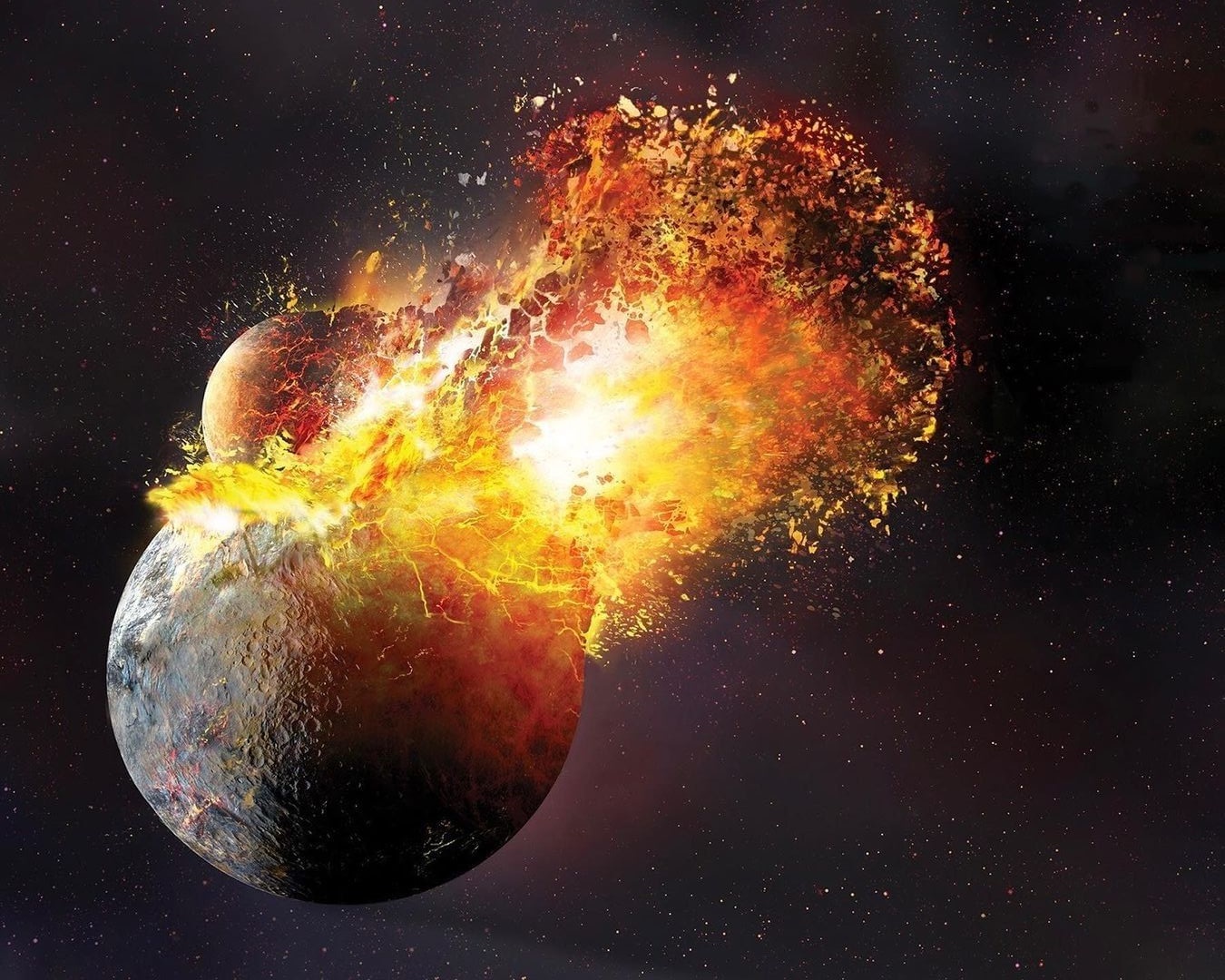
The collision debris material which splashed up off the Earth formed an orbiting debris field of the combined material from the Earth and from Theia, much of which, by the force of gravity, gradually returned to the mostly molten earth, while the remainder coalesced and formed a new planetesimal body which became our Moon. Since both bodies were mostly molten, they both soon regained their round shapes. This remarkable event is now referred to as the Giant Impact Hypothesis, or sometimes the Theia Impact Event, and it has become the generally accepted explanation for how our moon was born.
The giant-impact hypothesis is an astro-geology hypothesis for the formation of the Moon first proposed in 1946 by Canadian geologist Reginald Daly, who at that point in time, had little if any evidence that such an event had actually occurred. The name Theia is derived from the name of Greek goddess Theia who was the putative mother of the moon.
To see a short, two minute video from NASA’s super-computer simulation of this event watch the youtube presentation by NASA at:
The Prequel to This Grand Tale:
O.K.! So much for the drama! How did this fantastic story get cooked up by otherwise boring, levelheaded, “the facts ma’am, just the facts, please.” scientist types?
Prior to the Apollo Moon missions which together returned almost a thousand pounds of moon rocks to the earth to be studied there were four other hypotheses about how the moon might have been formed:
1. The Lunar Capture Theory: This states that the moon was a body which was passing by the Earth and was caught by the Earth’s gravitational attraction.
2. The Terrestrial Split Theory: This was the idea that the Earth split and threw off a fragment which became the Moon. This was first proposed by George Darwin, (son of the famous biologist Charles Darwin) in 1879. In a certain sense it is similar to the Giant Impact Hypothesis without the important impact to explain the earth becoming divided.
3. The Simultaneous Accretion Theory: The hypothesis of accretion suggests that the Earth and the Moon formed together as a double system from the primordial accretion disk of the Solar System.
4. The Terrestrial Nuclear Explosion Theory: A more radical alternative hypothesis, published in 1997 by Russian scientist Vladimir Anisichkin: “The Moon could have formed as a result of explosion of the proto-Earth” proposes that the Moon may have been formed from the nuclear explosion of actinides located on the solid inner core of the Earth.
These four wild ideas clearly illustrate the utter uncertainty of the pre-Apollo mission era of speculation on how the moon might have been created.
Evidence Which Supports the Giant Impact Hypothesis:
The data from the Moon rocks refuted the earlier theories and led to the development of the Giant Impact Hypothesis. That data includes:
The Moon rock’s oxygen isotopic ratios seem to be essentially identical to Earth’s. Oxygen isotopic ratios, which may be measured very precisely, yield a unique and distinct signature for each Solar System body. If Theia had been a separate proto-planet (planetesimal), it probably would have had a different oxygen isotopic signature than proto-Earth, as would the ejected mixed material. Simply the Moon is partial composed of Earth rocks.
Also, the lunar rock’s titanium isotope ratio (50Ti/47Ti) appears so close in its make-up to the Earth’s (within 4 parts per million) that little if any of the colliding body’s mass (Theia’s mass) could have become a part of the Moon.
Apollo samples later revealed that mantle rocks from the Moon and Earth have remarkably similar concentrations of oxygen. And because these lunar and terrestrial rocks are significantly different than meteorites coming from Mars or the asteroid belt, this shows the Moon and Earth’s mantle share a past connection.
Additionally, compared with Earth, lunar rocks were also discovered to be more depleted in so-called volatile elements — those that vaporize easily upon heating — a hint that the Moon was formed at high-temperatures.
In 2023 seismic geophysicists reported that much of the outer mantle of Theia can be found deep within the Earth in the Earth’s deep mantle adjacent to the earth’s core. That large collection of material from Theia is called the large low-shear-velocity provinces (LLSVPs). The existence of these pieces of Theia deep inside the earth is known because of 3-D seismic tomography studies which analyze the propagation of seismic shock waves moving through the deep inner portions of the earth.
It has also been observed that the lunar surface is almost completely covered by impact craters. Clearly some of the Moon’s material is the result of ongoing impacts of many smaller stellar bodies.
The exception to the Moon’s heavily cratered surface is the smoother, areas which have many fewer impact craters which have long been referred to as lunar oceans. These are now thought to be surface feature remnants of the collision surface which was formed as the semi-molten lunar surface rounded up after the giant impact occurred.
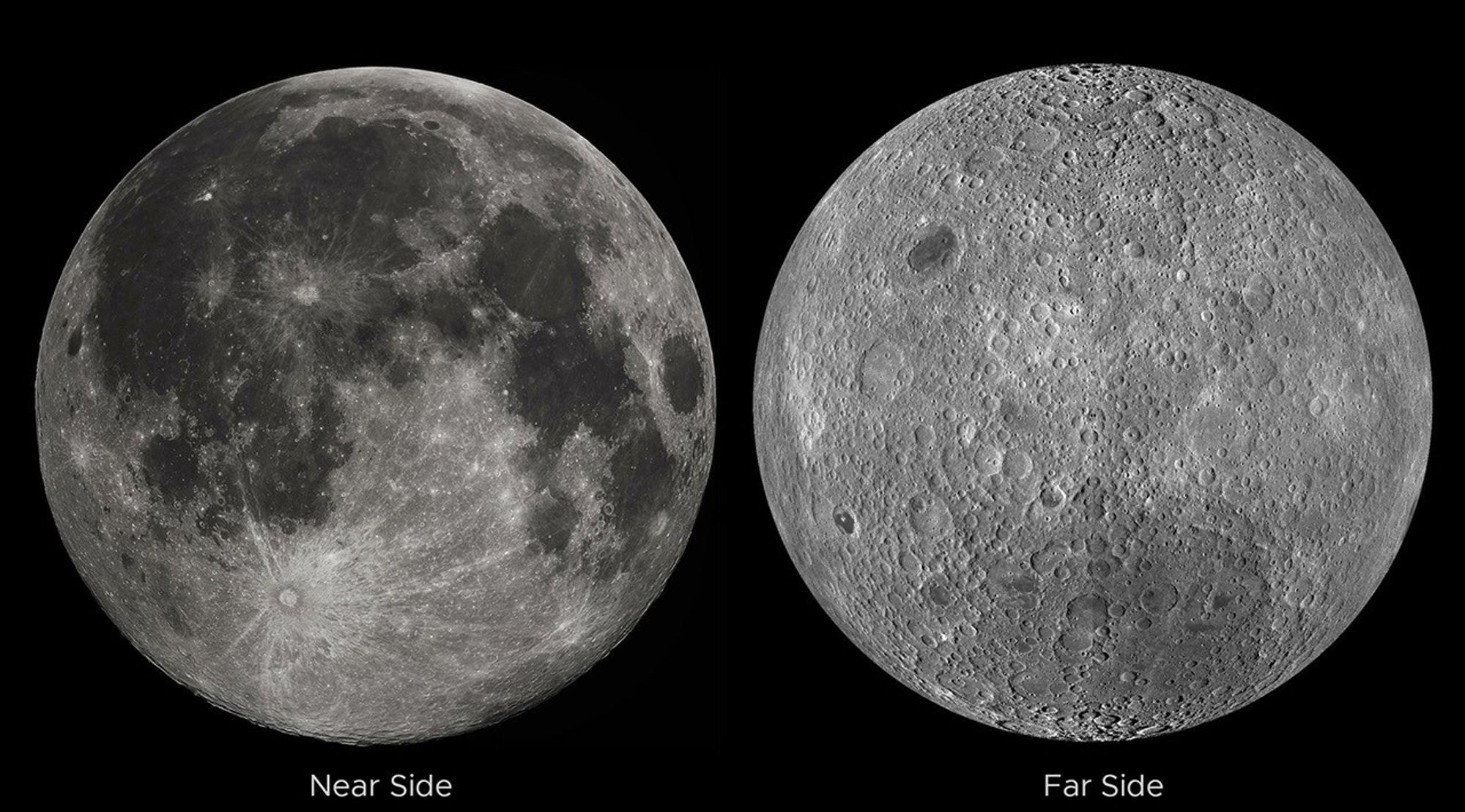
The dark side of the moon (the part of the moon which never faces the earth) clearly has many, many more impact craters on it than the side which always faces the Earth.
Finally the inclination of the Earth’s orbital axis is thought to be evidence which supports the Theia Impact Event story. The rotating proto-planetary disc would have given the Sun its axis of rotation and the Earth’s axis of rotation would most likely have been parallel to the Sun’s. The off-center impact of Theia is thought to explain how the Earth’s rotational axis became inclined away from the Sun’s rotational axis.
Conclusions:
Many once-uncertain aspects of the Giant Impact Hypothesis have been validated. Current planet-formation models predict that large impacts were commonplace in the inner solar system as Earth formed and grew. Thousands of increasingly sophisticated simulations have established that many (if not most) of such giant impacts would produce debris disks or moons. The Moon’s lack of iron (which asteroids and meteors are rich in), is difficult to explain in competing models like that of the gravitational capture of a passing intact lunar-sized planetesimal, which the Giant Impact Hypothesis easily explains. The Moon does not have a significant iron core because the material that coalesced into the Moon came from the outer mantles of the two colliding bodies rather than from their iron-rich cores.
Researchers have proposed many new, creative explanations for how an impact (or impacts) could have produced a Moon so chemically similar to Earth.
Fortunately, the United States’ NASA organization and numerous other countries are planning upcoming robotic and human Moon missions that will provide crucial additional information about the origin of our Moon. For example, new lunar samples may more fully reveal the Moon’s composition at greater depths, or improved measurements of lunar seismic activity and heat flow may better explain the Moon’s internal composition and initial thermal state.
Ultimately, we will continue to pursue the questions about how our Moon came to be, not only so we can understand the history of our own world, but more generally, so we can unravel what our nearest cosmic neighbor can tell us about the formation and evolution of inner planets — both in our solar system and beyond. To quote Buz Lightyear:
“To infinity, and beyond!”