
During the 18th century, the higher efficiency of the nascent factory system made the previously revolutionary cottage industry production system less efficient and therefore newly uncompetitive. As a result the cottage industry system lost its commercial viability and gradually began to fail economically.
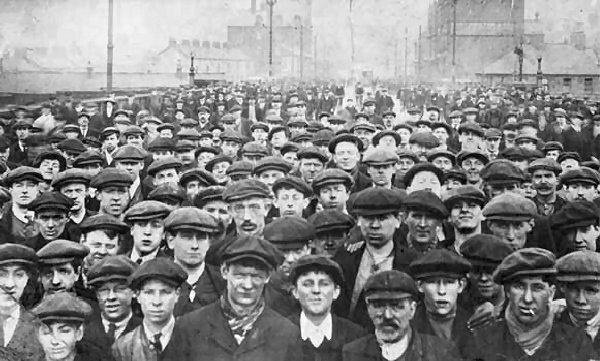
The combination of the decline of cottage industries and the rise of the factory system of manufacturing, swept huge masses of people away from their family farms and villages and into the growing cities to look for employment.
However the “army of the unemployed” factory workers allowed the factory owners and managers to grossly underpay their workers. The poorer, less skilled, elements of England’s middle classes, which had thrived in the cottage industry economy, gradually declined back into their former subsistence existences.
Most of these farm labor workers who moved to the manufacturing cities of England found a Dickensian reality of generally low to medium skilled jobs being offered to an unskilled labor force which was offered low wages in exchange for working long hours in various manufacturing occupations. If the wages offered were too low to allow a married man to support a family and hence those men wouldn’t take the work, then the employers hired adolescent children and destitute single women to do the work. In general the working conditions in these establishments was physically demanding and dangerous. The long hours made an average working day into a somewhat brutal experience.
One influential voice in all this worker turmoil was that of the self-proclaimed labor philosopher Karl Marx and his financial and philosophical supporter, sustainer, and shadow Friedrich Engels (1840s-1870s).
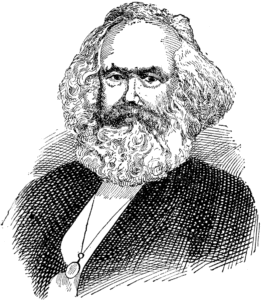
On a pragmatic local level Marx and Engels advised that the exploited laboring class, which he call the proletarian class, should act together in unity to demand that the “greedy bourgeoisie capitalist” class provide laborers with a significantly better wage rate. On a more universal and philosophical level Marx argued that the workers were, the true producers of the goods of society, which from Marx’s perspective was true.
Marx asserted that those exploited workers should and inevitably would rise up and revolt against all of western society and overthrow the capitalist society completely. They could then seize the means of production from the bourgeoisie class for the good of the masses of the working class. The proletarian workers would then operate the factories, and run them for the good of all of society, with all people working as they are able, and receiving equal shares of the benefits of production. The nominal benefits Marx included in his idealistic utopian communist society included:
- Free universal state provided housing for all.
- Free universal state provided healthcare for all.
- Free state provided provisions (food, clothing, energy for heating, etc.) for all.
- Free state provided education and job skills training for all.
To each accord to his needs.
This communist ideal has been roundly attacked by western economic writers and thinkers. In fact Marx’s utopian ideal of a perfect communist society in which everyone gladly shares all equally, is not very different from the voluntary Christian communalism described in the early chapters of Luke’s Acts of the Apostles, or of that which William Bradford describes the initial Pilgrim colonists doing in his venerable On Plymouth Plantation.
However, the important and often overlooked difference between such volitional communalism and Marx’s communism is that Marx’s system is coercive and compulsory.
Marx prophesied that the working class would ultimately reach a point where it had, had all it could stand and that class would revolt against the entire capitalist system which so unjustly enslaved it. Of course, that never happened.
Lenin’s Bolshevik Revolution in the post czarist Russia ruled by the Duma (the nascent Russian parliament) was a revolution of a militant sub-set of Russia’s intelligentia, not its working classes. At the time of Lenin’s revolution, his Bolshevik system of Soviet Communism was forced on the vast people of Russia by a small minority of avid supporters, and it took a decade before most of those people accepted it as the new government structure of Russia.
As a critic of the exploitation of factory workers, Marx was spot on; as social prophet of an angry worker’s revolution Marx was a complete and utter failure.